Central Vietnam · Travel
Thien Mu Pagoda (Thiên Mụ): How to Visit, by Boat or Road
How to visit Thien Mu pagoda in Hue: boat, bike or Grab compared, free entry and hours, what to wear, what to see and a half-day plan, checked November 2026.
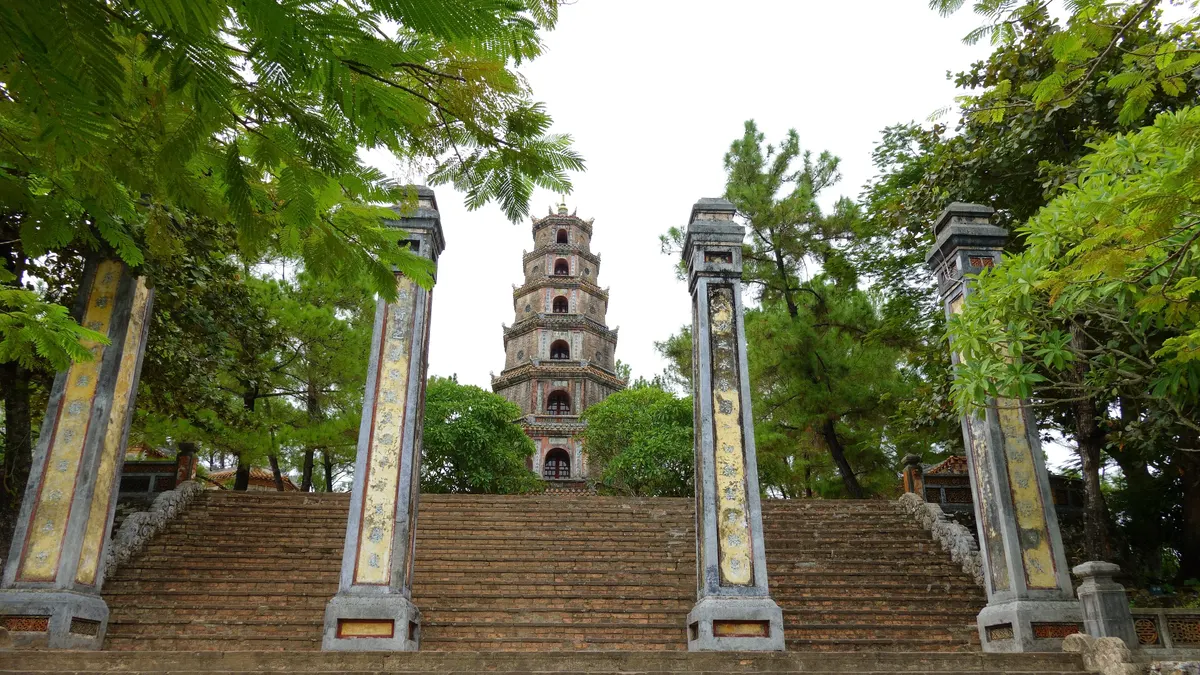
As of November 2026, visiting Thien Mu (Thiên Mụ) pagoda costs nothing: it is a working Buddhist monastery, and Hue’s 2026 heritage tickets, including the 530,000-dong four-site ticket and the 600,000-dong all-sites ticket, cover the Imperial City and royal tombs rather than this pagoda (Bao Quoc te). The real decision is how to get there. A Grab car or taxi is quickest, a bicycle along Kim Long road gives you freedom, and a dragon boat on the Perfume River is the slow, scenic way in. Plan 45–90 minutes at the pagoda itself.
This page covers the visit: transport, hours, etiquette, what to look for and how to fit it into a day. For the city as a whole see our Hue guide; for the boat trip in detail, including the wharf and how to agree a fare, see our Perfume River boat guide. Hue has been a centrally governed city since 1 January 2025.
Thien Mu pagoda at a glance
| What it is | An active Buddhist pagoda founded in 1601, part of the Complex of Hue Monuments system and a special national relic |
| Where | Ha Khe (Hà Khê) hill, north bank of the Perfume River, about 5 km west of central Hue |
| Entry (Nov 2026) | Free; not part of the 2026 Hue monuments tickets |
| Opening hours | No official timetable; guides give about 7:00–17:30 or “all day” |
| Time needed | 45–90 minutes |
| Getting there | Grab or taxi, bicycle or motorbike, dragon boat from Toa Kham wharf (about 30 minutes) |
| Must see | Phuoc Duyen tower (1844), the 1710 bell and 1715 stele (national treasures), the Austin car of Thich Quang Duc, the rear garden |
| Dress | Shoulders and knees covered; shoes off in the halls |
| Best time | Early morning or late afternoon; check flood news in October–December |
Boat, bike or Grab: which way should you go?
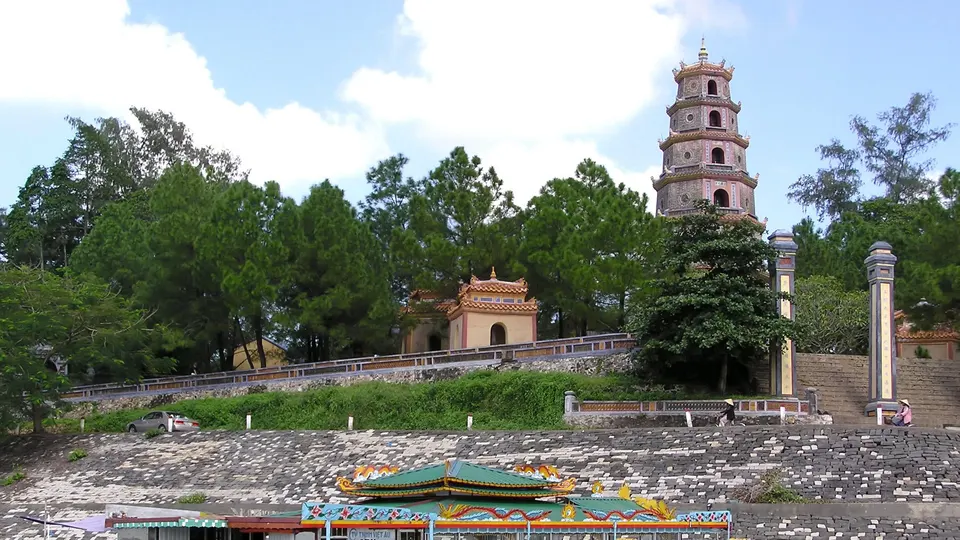
Choose by time and by where you want to arrive. The pagoda has two approaches: a river landing with 24 steps up from the water, and a road gate of four tall pillars right beside the road, from which 15 steps lead up to the tower (Vietnam National Authority of Tourism). Boats bring you to the first, cars and bikes to the second.
| Option | Time from the centre | What it costs | Effort | Best for | Where you arrive |
|---|---|---|---|---|---|
| Grab car or taxi | Short ride of about 5 km | Metered or shown in the app; no official fare | Lowest | Short stays; combining with a tomb or the Citadel | Road gate, 15 steps up |
| Motorbike taxi (Grab bike) or cyclo | Similar to a car; cyclo slower | In the app, or agree before you start | Low | Solo travellers; a slow ride along the river | Road gate |
| Bicycle or rented motorbike | Flat ride along the river and Kim Long road | Rental only | Medium; busy traffic | Independent travellers who want to stop at Kim Long | Road gate |
| Dragon boat from Toa Kham wharf | About 30 minutes each way | Agreed with the boat owner; no official price list | Low, but slow | First-time visitors with two hours, late afternoon | River landing, 24 steps up |
| Boat there, car back | About 30 minutes out, short ride back | Boat plus app fare | Low | Seeing the river without spending two hours on it | River landing |
The decision in one line. With one day in Hue, take a car so Thien Mu fits around the Imperial City. With two days, take the boat one way in the late afternoon and a car back. Boats are covered in our Perfume River boat guide; agree the route, waiting time and price before boarding.
Is Thien Mu pagoda free, and when is it open?
Thien Mu is free. It belongs to the Complex of Hue Monuments system as a special national relic, but it is a living pagoda, and the ticketed sites in Hue’s 2026 fee rules and promotions are the Imperial City, the museum and the tombs. When Hue began giving heritage-train passengers 50% off in November 2026, for example, the five sites listed were the Imperial City, the Royal Antiquities Museum and the tombs of Thieu Tri, Duc Duc and Dong Khanh (VietnamPlus). Thien Mu does not need a ticket, so there is nothing to buy in advance.
Hours are not published officially. A travel guide updated in October 2026 gives roughly 7:00 to 17:30 daily, while another says the pagoda is open all day. Treat daylight as the safe window, and expect different patterns at Tet (the Lunar New Year) and on Buddhist festival days, when local pilgrims fill the courtyard. There is a donation box in the main hall; giving is up to you.
What to see, in the order you meet it
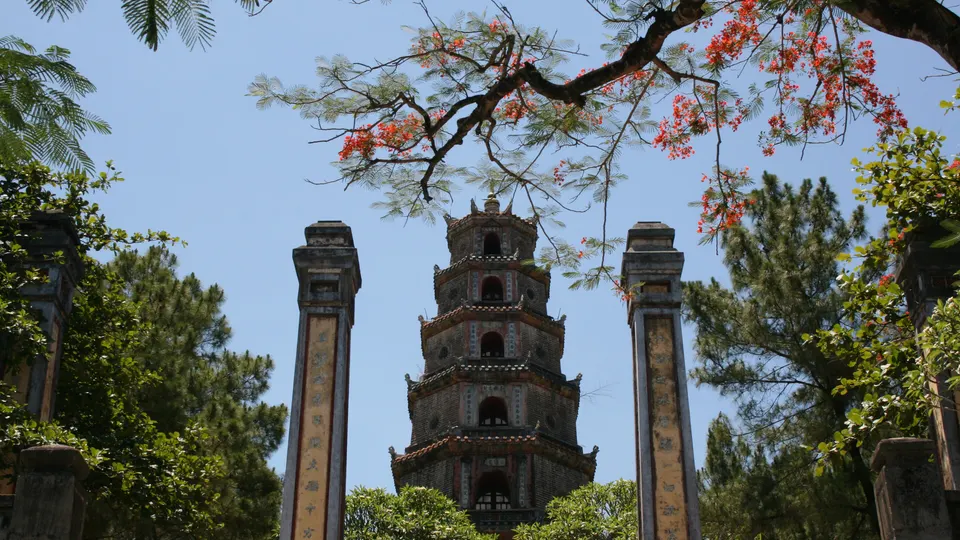
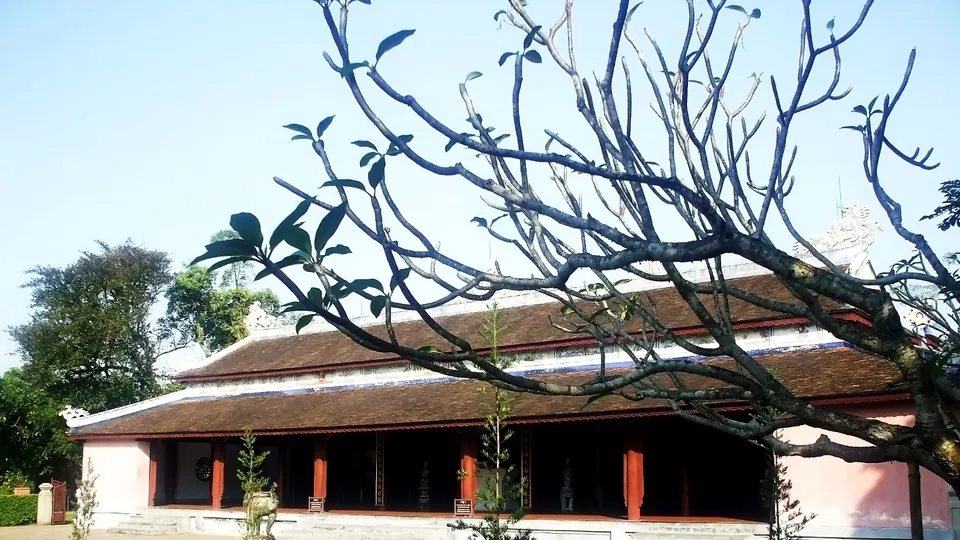
The site is compact and runs uphill from the river. From the road gate or the landing you climb to the octagonal Phuoc Duyen (Phước Duyên) tower, seven storeys and 21 m tall, built in 1844 under Emperor Thieu Tri (Thiệu Trị), Tap chi Cong Thuong reports. Visitors cannot climb it. Between 2003 and 2006 the monuments centre restored 18 structures here for more than 26 billion dong; the tower had been damaged and was leaning about 7 degrees before the work.
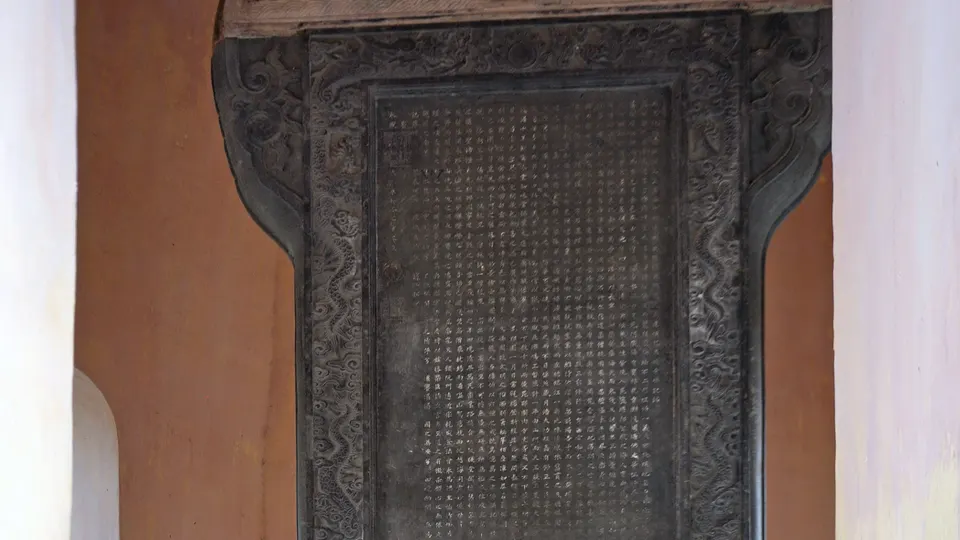
On either side of the tower stand two small pavilions with the pagoda’s two national treasures (VietnamPlus). One holds the bronze bell cast in 1710 for the Nguyen lord Nguyen Phuc Chu (Nguyễn Phúc Chu), about two tonnes, recognised in 2013. The other holds the stone stele of 1715, about 1,250 Chinese characters on a marble turtle, recording his great rebuilding of the pagoda, recognised in 2020. Emperor Thieu Tri’s own stelae and his poem naming Thien Mu among the twenty scenic sights of the capital stand near the gate.
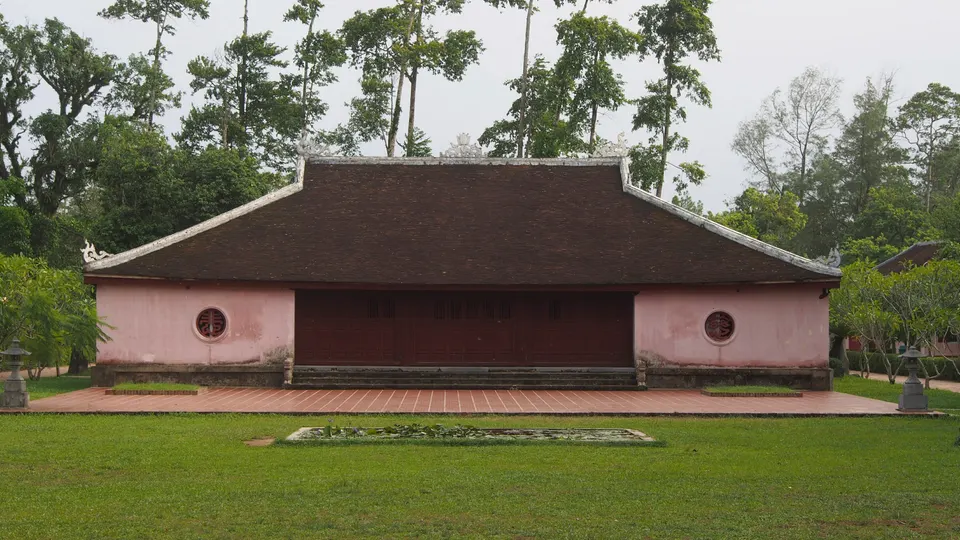
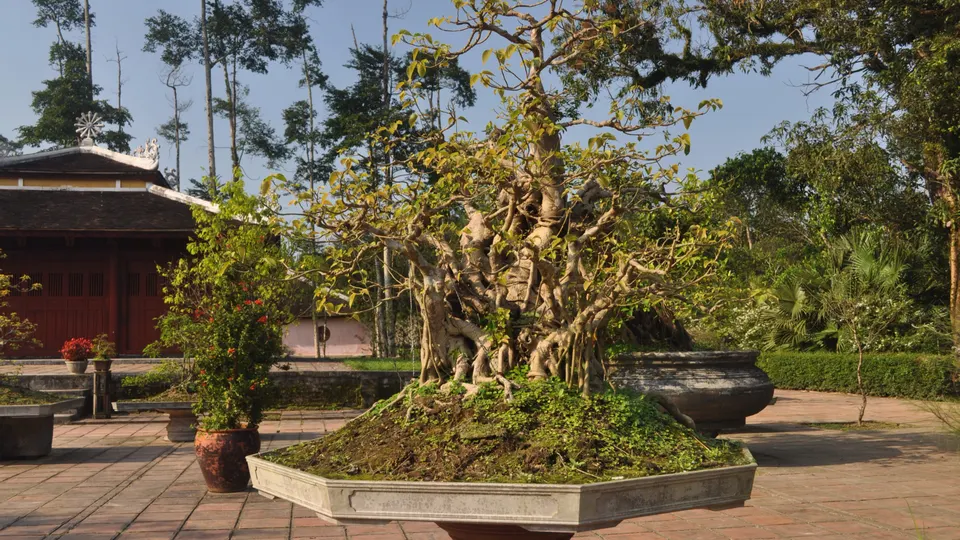
Beyond the inner gate are the halls: the main hall and the halls behind it are used every day by the monks. Behind them a garden of bonsai, pines and stupas runs back towards the hills; the stupa of the late abbot Thich Don Hau (Thích Đôn Hậu) is at the end. Most groups turn back at the main hall, so the garden is the quietest part of the visit.
A note on the name. In 1862 Emperor Tu Duc (Tự Đức) renamed the pagoda Linh Mu, and the old name returned in 1869, so you will still hear both.
The Austin car and 1963
The pagoda keeps a pale blue Austin car linked to the monk Thich Quang Duc (Thích Quảng Đức), who burned himself to death in Saigon in 1963 in protest against the Ngo Dinh Diem government’s treatment of Buddhists (Bao Van hoa). The photograph of that protest became one of the defining images of the period.
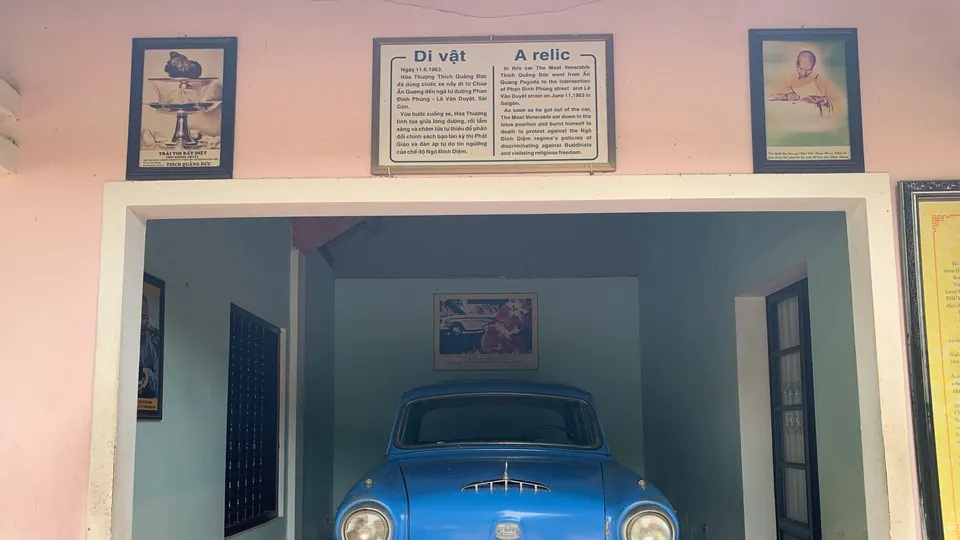
Sources describe the car’s place differently, one in the Huong Nguyen pavilion area, another in a hall to the left of the main sanctuary, so if you do not see it, ask quietly. It sits behind a low fence with a short bilingual panel. This is a place of remembrance for the monks and many Vietnamese visitors: look, read, and keep posing and loud conversation for elsewhere.
What to wear and how to behave
Dress as for any active temple. Guides consistently ask for shoulders and knees covered and shoes off before entering the halls; bring a light shirt or scarf if you are in a vest or shorts, because nothing is lent at the gate. Speak quietly, walk around people who are praying, and do not step on the raised thresholds of the halls.
Photography. Photograph the tower, courtyard and garden freely. Inside the halls take photos quietly and without flash, and put the camera away when a ceremony is under way. Ask before photographing monks, and do not touch or climb on the stelae, the bell or the turtle.
Drones and tripods draw attention at a working monastery; leave them in your bag unless you have permission.
Best time of day, and the flood season
Early morning is calm and cool, before tour groups arrive; late afternoon gives warm light on the tower and fits a sunset boat ride back to the city. Midday in summer is hot on the exposed steps. Weekends and lunar festival days bring local pilgrims, which is lovely to see but busier.
October to December is the flood season in Hue, and it affects the boats and the riverside roads more than the pagoda on its hill. In November 2026 heavy rain closed 67 schools on 10 November, and the Perfume River at the Kim Long gauge, just below the pagoda, peaked at 1.71 m at 4:00 on 11 November, 0.29 m below alert level II (Bao Xay dung). If the river is high, skip the boat and go by car.
Common mistakes and a half-day plan
- Expecting a ticket booth. There is none; the Hue monuments ticket does not include Thien Mu, and you do not need one.
- Arriving in shorts and a vest. Bring a cover-up; nothing is lent at the gate.
- Booking a boat without terms. Agree route, one way or return, waiting time and the price for the boat first.
- Leaving after the tower. The stele, the bell, the car and the garden are the parts most people rush past.
- Taking the river in high water. Check the flood news in October–December.
A half-day plan (afternoon).
- After lunch, take a Grab or taxi to the Thien Mu road gate, or ride a bicycle west along the river and Kim Long road.
- Spend about an hour: tower and steps, the bell and stele pavilions, the main hall (shoes off), the Austin car and the garden at the back.
- Walk down the 24 steps to the river landing for the classic view of the tower from below.
- In the late afternoon either take a dragon boat back to Toa Kham wharf as the light fades, or continue by car to a royal tomb such as Tu Duc; our Hue royal tombs guide explains which tombs suit an afternoon.
- Eat dinner in the centre: our where to eat in Hue guide covers bun bo Hue, small rice cakes and com hen.
With a second day, put the Imperial City in the morning and Thien Mu in the afternoon; our Hue itinerary for 1, 2 or 3 days shows how it fits, and the Central Vietnam hub has the rest of the region.
Frequently asked questions
Is Thien Mu pagoda free to visit?
Yes. Thien Mu is an active pagoda, and travel guides checked in 2026 list entry as free; it is not part of the Hue monuments tickets that cover the Imperial City and tombs. A donation box stands in the main hall.
What time does Thien Mu pagoda open?
There is no official published timetable. Guides give either roughly 7:00 to 17:30 or 'open all day', so plan your visit for daylight hours and expect changes during Tet and Buddhist festivals.
Should I take a boat or a Grab to Thien Mu pagoda?
Take a Grab or taxi if you are short of time or combining Thien Mu with a royal tomb, and a dragon boat from Toa Kham wharf if you want the river view and have about two hours. Many visitors go one way by boat and return by car.
Can you climb the tower at Thien Mu pagoda?
No. Visitors cannot go up the seven-storey Phuoc Duyen tower; you see it from the steps, the courtyard and the river.
Is Thien Mu pagoda worth it with one day in Hue?
Yes, if you keep it to about an hour: pair the Imperial City in the morning with Thien Mu in the late afternoon. Thien Mu is a short stop, not a half-day sight.
Sources and further reading
- Chùa Thiên Mụ – "Đệ nhất cổ tự" đất Cố đô · Vietnam National Authority of Tourism (vietnamtourism.gov.vn), 30 November 2015
- Về cố đô Huế, chiêm ngưỡng 2 Bảo vật Quốc gia ở chùa Thiên Mụ · VietnamPlus (VNA), 5 December 2023
- Phát huy giá trị ngôi quốc tự 420 tuổi · Báo Văn hóa, 13 September 2021
- Chùa Thiên Mụ – Thần Kinh nhị thập cảnh của cố đô Huế · Tạp chí Công Thương, 14 November 2023
- Huế mở rộng đối tượng miễn, giảm phí tham quan di tích lịch sử văn hoá từ năm 2026 · Báo Quốc tế, 28 December 2025
- Huế giảm 50% vé tham quan di tích cho khách đi tàu hỏa di sản · VietnamPlus (VNA), 4 November 2026
- Huế: Mực nước các sông xuống dưới báo động 2, nhiều tuyến đường vẫn còn chia cắt · Báo Xây dựng, 11 November 2026
- Quốc hội thông qua Nghị quyết về việc thành lập thành phố Huế trực thuộc Trung ương · Đại biểu Nhân dân, 30 November 2024
- Thien Mu Pagoda: the complete guide to Hue's riverside landmark · vietnamtourism.com (private travel guide), updated 9 October 2026
- Thien Mu Pagoda Hue: one of the most recognizable landmarks to explore · Vinpearl travel guide
Keep exploring
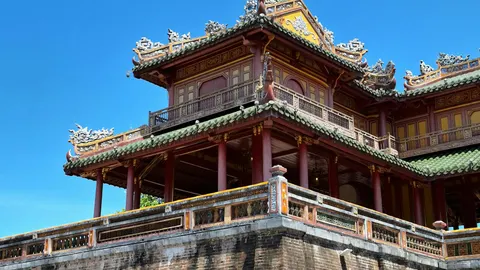 Central Vietnam · Travel Hue (Huế): How Many Days, What to See, 2026 Tickets How many days Hue needs, which Citadel sights and royal tombs to pick, 2026 ticket prices, the flood months to avoid and where to eat in the old royal capital.
 Central Vietnam · Travel Perfume River Boat Trip in Hue: Thien Mu, Tombs, Ca Hue Perfume River boat trips in Hue: Toa Kham wharf, Thien Mu pagoda by dragon boat, Hon Chen and the tombs, ca Hue at night, new electric boats and flood-season advice.
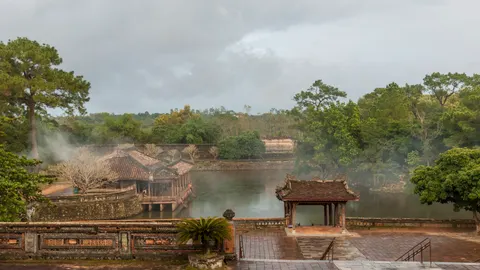 Central Vietnam · Travel Hue (Huế) in 1, 2 or 3 Days: Itineraries and Tickets Hue in 1, 2 or 3 days: what to see in each, the order that works, 2026 ticket prices and combined passes, opening hours, festival seasons and flood months.
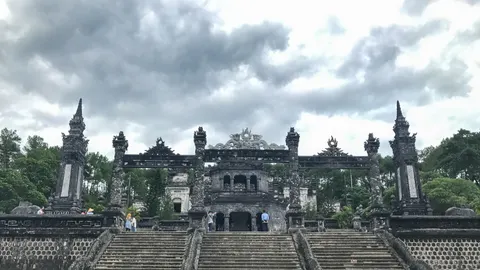 Central Vietnam · Travel Hue Royal Tombs (Lăng tẩm Huế): Which to Visit, Which Ticket Which Hue royal tombs to visit in November 2026: Minh Mang, Tu Duc or Khai Dinh, the right ticket or combo, opening times and half-day routes in the best order.