Central Vietnam · Culture
Hue Court Music (Nhã Nhạc) and Ca Hue: Where to Hear Them
Where to hear Hue court music (nha nhac) and ca Hue: Imperial City venues, Perfume River boats, how the two differ, UNESCO status and how to pick a show.
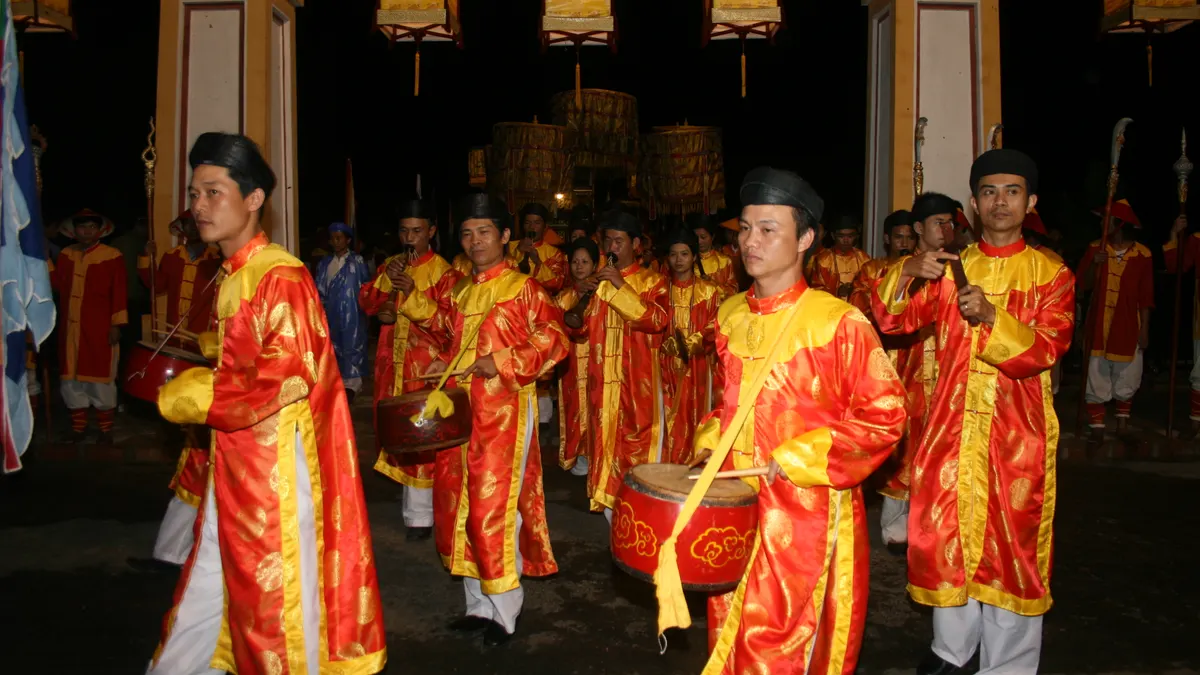
Hue (Huế) court music is heard today in the Imperial City, and ca Hue chamber singing mainly on evening boats on the Perfume River. As of November 2026, the latest published list, given by the Hue Monuments Conservation Centre in March 2025, names four Imperial City sites where artisans regularly play court music for visitors, led by the Duyet Thi Duong royal theatre. We have found no dated 2026 timetable or ticket price for these shows, so check on the day.
Hue, the former imperial capital in Central Vietnam, has two famous kinds of music, and visitors often mix them up. Nha nhac (Nhã nhạc) (nhã nhạc cung đình Huế, “elegant music” of the court) is the ceremonial music of the Vietnamese monarchy, played by large orchestras with singers and dancers. Ca Hue (Ca Huế) (“Hue singing”) is chamber music: a few singers and a handful of string instruments, made for a small room and a few attentive listeners. UNESCO proclaimed nha nhac a Masterpiece of the Oral and Intangible Heritage of Humanity in 2003 and inscribed it on the Representative List in 2008 (UNESCO).
Both survive, but neither lives where it used to. Court music lost its court in 1945; ca Hue moved from private salons onto tourist boats. This guide, part of our Vietnamese culture hub, explains what each is, why they changed, and how to hear them well. Hue itself, a centrally governed city since 1 January 2025 covering the former Thua Thien Hue (Thừa Thiên Huế) province, is covered in our Hue destination guide.
Nha nhac vs ca Hue at a glance
| Nha nhac (court music) | Ca Hue (Hue chamber singing) | |
|---|---|---|
| What it was for | State and religious rituals: coronations, funerals, anniversaries, religious holidays, official receptions | Refined entertainment for the royal family and educated elite, later shared with ordinary Hue people |
| When it took shape | Developed under the Le (Lê) dynasty (1427–1788), codified under the Nguyen (1802–1945); some trace court music back to the Ly (Lý) dynasty | Around the 17th century; at its height from Minh Mang (Minh Mạng) to Tu Duc (1820–1883) |
| Ensemble | Large orchestras with a prominent drum section, percussion, winds, strings, singers and dancers; about 42 kinds of instruments at the Nguyen court | Four or five instruments such as dan nguyet (đàn nguyệt), dan ty ba (đàn tỳ bà), dan nhi (đàn nhị), dan tranh (đàn tranh) and dan tam (a fuller group adds dan bau); 8–10 people in all |
| Repertoire | Two main ensembles, dai nhac (“great music”) and tieu nhac (“small music”), plus court dances | About 60 vocal and instrumental pieces in two modes, the bright dieu Bac (điệu Bắc) and the plaintive dieu (điệu) Nam |
| Traditional setting | Court ceremonies and rites | Small rooms, small audiences, not before crowds or in daylight |
| Recognition | UNESCO: proclaimed 2003, Representative List 2008 | National intangible heritage list, 8 June 2015; UNESCO dossier planned for late 2026–2027 |
| Where you hear it today | Imperial City: Duyet Thi Duong theatre, Ngo Mon (Ngọ Môn), The Mieu (Thế Miếu) and Thai Hoa (Thái Hòa) courtyards; festivals | Evening boats on the Perfume River; free sets in the Imperial City |
What is nha nhac, Hue’s royal court music?
Nha nhac covers the range of music and dance performed at the Vietnamese royal court from the 15th to the mid-20th century. UNESCO dates its development to the Le dynasty and its full institutional form to the Nguyen, whose capital was Hue; a 2003 article in Bao Phap Luat (Báo Pháp Luật) traces Vietnamese court music further back, to the Ly dynasty around 1010. Either way, the Nguyen are the reason it is tied to Hue. It was played at the opening and closing of court ceremonies and was meant to stand for the dynasty’s power and longevity, as well as to honour gods and kings.
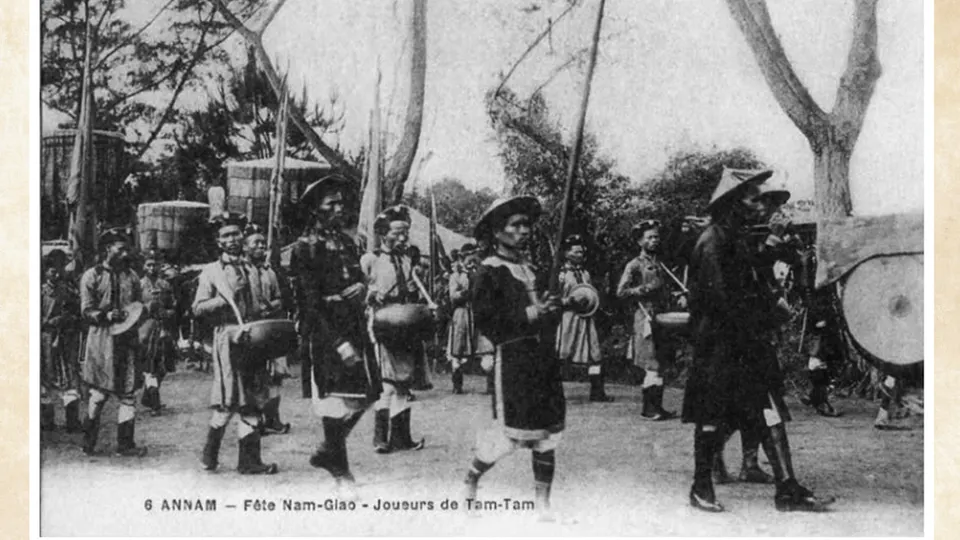
It is music for ritual, not for listening at leisure. A court orchestra had a strong drum and percussion section with wind and string instruments, and performances included singers and dancers in elaborate costume. The Nguyen court used about 42 kinds of instruments, and court records list 126 pieces, according to Bao Phap Luat. Vietnam’s tourism board divides the tradition into three parts: dai nhac, the “great music” of major rites; tieu nhac, the “small music”, much of which survives in folk festivals; and court dances such as the fan dance and the lantern dance (Vietnam Tourism).
That ritual role explains what you see today: a short concert drawn from pieces that once opened and closed ceremonies, not a full rite.
What is ca Hue, and how is it different?
Ca Hue is Hue’s chamber music. It took shape around the 17th century as a refined pastime of the royal family and elite households, reached its height between the reigns of Minh Mang (Minh Mạng) and Tu Duc (1820–1883), and grew out of palace singing in royal palaces and lords’ residences, according to Bao Lam Dong (Bao Lam Dong). From the court it spread to ordinary people and absorbed Hue folk music, which is why sources describe it as a blend of court and folk traditions.
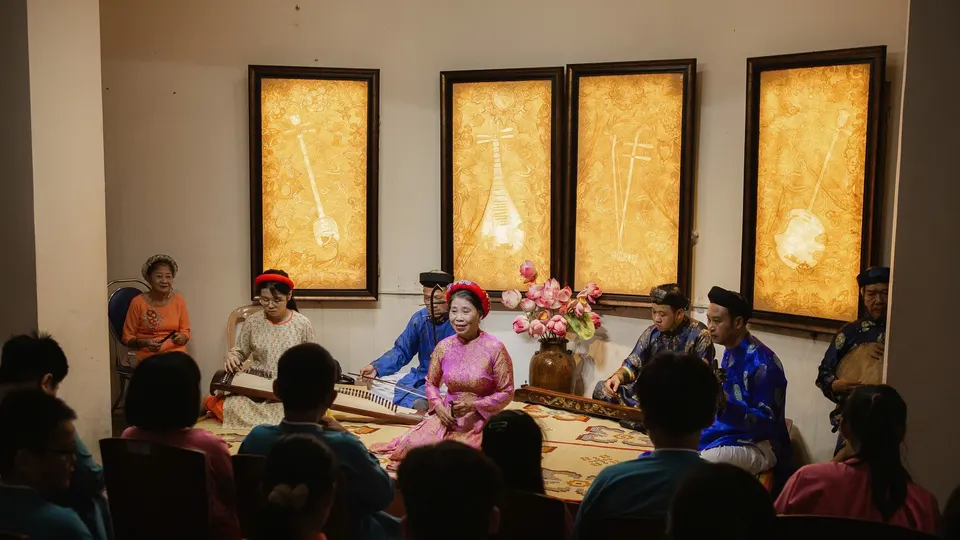
The scale is the difference. A classic ca Hue group has four or five instruments, such as the dan nguyet (moon-shaped lute), dan ty ba (pear-shaped lute), dan nhi (two-string fiddle), dan tranh (zither) and dan tam (three-string lute); a fuller ensemble adds the dan bau, the one-string monochord. Its roughly 60 pieces fall into two modes: dieu Bac, bright and stately, and dieu Nam, sad and yearning, heard in well-known pieces such as Nam ai and Nam binh (Nam bình). Traditionally it was “not performed before crowds or sung under the sun”, Bao Lam Dong notes: it belonged to evenings and small rooms.
It is also tied to how Hue speaks. Dai bieu Nhan dan (Đại biểu Nhân dân), the National Assembly’s newspaper, notes that ca Hue melodies follow the pitch and tonal features of the local dialect, so the singing sounds unmistakably of Hue; our guide to Vietnamese regional accents explains what makes Hue speech distinctive. In short: nha nhac is the voice of the state; ca Hue is the voice of the household and the river.
Why did court music nearly disappear, and how was it revived?
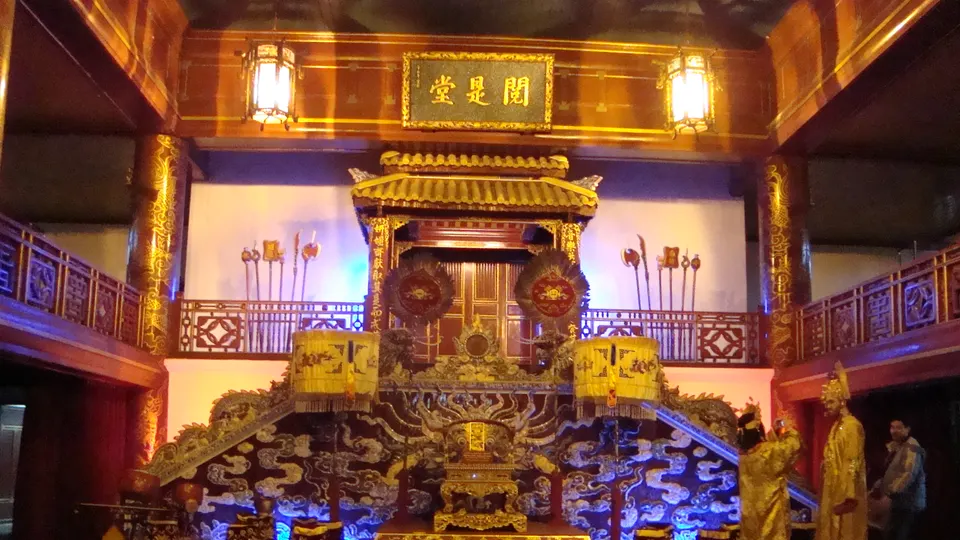
When the monarchy ended in 1945 and decades of war followed, nha nhac lost the rituals it existed for. UNESCO notes that only a few former court musicians kept it alive. Its home stage suffered too. Duyet Thi Duong (Duyệt Thị Đường), the royal theatre inside the Imperial City, was built in the 1820s under Emperor Minh Mang (Bao Phap Luat gives 1826, a 2018 VNA report 1827) for the kings, the royal family, mandarins and foreign guests. In 1962 it was handed to the Hue National Conservatory of Music and heavily altered; restoration began in 1992 and it reopened to visitors on 1 January 2003 (Bao Phap Luat).
UNESCO recognition in 2003 turned rescue into a programme. The Hue Royal Traditional Art Theatre (Nhà hát Nghệ thuật Truyền thống Cung đình Huế) began collecting and restaging lost pieces; by 2012 it had restored about 40 ritual pieces and dances, including Cung Ai, once played only at royal funerals, Vietnam (Việt Nam) News reported. The company has grown from fewer than 30 people to nearly 200, and some artisans come from families linked to court music for four generations, according to the deputy director of the Hue Monuments Conservation Centre, speaking at a 2025 conference. Its director, Pham Thi Bach Hac (Phạm Thị Bạch Hạc), has told VOV that training young performers matters because many older artists have died.
Why do they matter, and what has changed?
For Hue, these two traditions are the sound of its identity as the last royal capital: one recalls the ceremony of the Nguyen state, the other the cultivated private life around it. Nha nhac is also, in UNESCO’s words, the only Vietnamese genre with a nationwide scope and strong links to other East Asian court traditions, and it still inspires contemporary Vietnamese music.
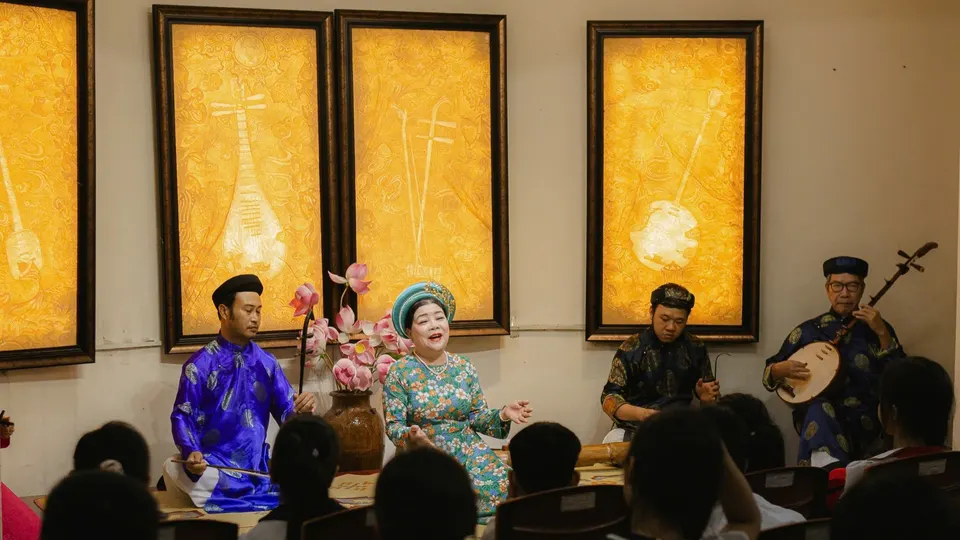
Tradition and today pull in opposite directions for the two. Nha nhac has gone from private court ritual to public performance: you now hear it in short programmes for visitors, at public events such as Tet (Tết) and in reenacted rites such as the Nam Giao sacrifice, which Goldsmiths’ Asian Music Unit recorded in 2014, not at any living court. Ca Hue has gone from a few listeners to many: in July 2024 alone, inspectors counted 1,172 boat performances on the Perfume River with more than 14,400 tourists, Bao Van hoa (Báo Văn hóa) reported. For most visitors, ca Hue now means a boat show.
The next step is a UNESCO bid for ca Hue. Vietnam’s Ministry of Culture put ca Hue on the national intangible heritage list in 2015 (Hue’s ao dai tailoring and wearing tradition followed in 2024), and in October 2026 the city issued a plan to prepare a scientific dossier for UNESCO’s Representative List, (Dai bieu Nhan dan). According to Bao Phap Luat on 22 October 2026, Plan 571/KH-UBND schedules the work from the fourth quarter of 2026 to the end of 2027. Commentators in Bao Phap Luat warn that tourism must not reduce ca Hue to a decorative act, and that inscription “is not the final goal”.
Where can you hear court music and ca Hue in Hue today?
Court music: in the Imperial City. The Hue Monuments Conservation Centre named four sites in 2025 where artisans regularly perform nha nhac for visitors: Duyet Thi Duong, the The Mieu courtyard, the area in front of Ngo Mon gate and the Thai Hoa Palace courtyard (Bao Phap Luat). Duyet Thi Duong also has a small exhibition of costumes and instruments, and its shows combine nha nhac with court dance and court tuong (tuồng) (classical opera). At Tet 2023 the theatre company gave free court-music concerts in the Thai Hoa courtyard after a changing-of-the-guard ceremony at Ngo Mon, the national tourism authority reported; our Tet guide explains the festival itself.
Which option suits you depends on whether you want the ceremonial or the intimate side:
| Option | What you hear | Setting and timing | Best for |
|---|---|---|---|
| Duyet Thi Duong theatre show | Court music with court dance and classical opera | Indoor royal theatre in the Imperial City; check the day’s programme | First-time visitors who want to see the court repertoire from a seat |
| Outdoor court-music sets | Nha nhac played by the royal theatre company | The Mieu courtyard, in front of Ngo Mon, Thai Hoa courtyard (sites named in March 2025); also at Tet | Visitors already touring the citadel by day |
| Ca Hue at Nhat Thanh Lau | Short ca Hue sets, listed as free | Inside the Imperial City; times not published, ask at the gate | A taste of ca Hue without a night out |
| Perfume River boat evening | Ca Hue on a dragon boat (the 2014 rules required a 60-minute programme) | Evenings, from south-bank docks such as Toa Kham | Travellers with one evening who want the classic setting |
| Royal Banquet Night | Staged banquet with performances recreating Nguyen palace banquets | Duyet Thi Duong; 2026 dates were 29 April and 1 May | Groups combining food and spectacle on set dates |

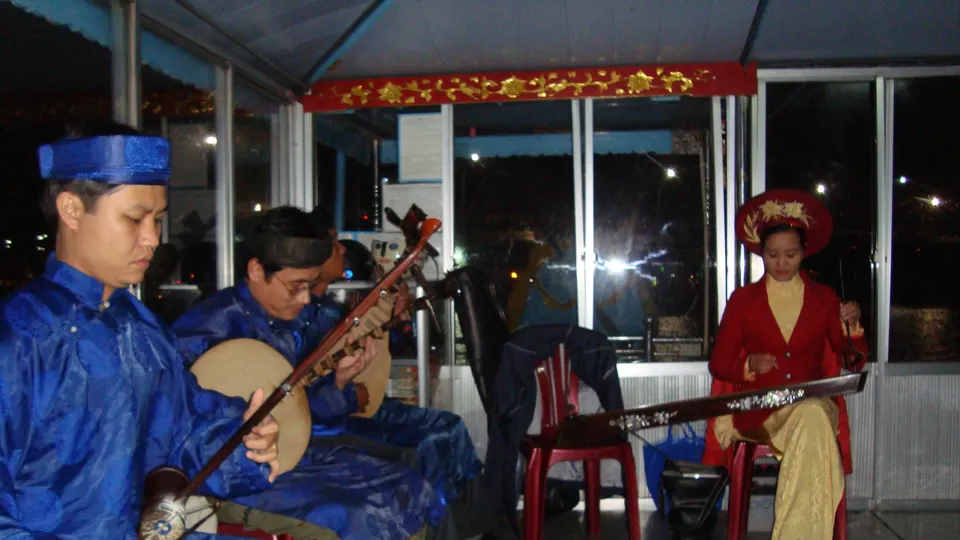
Ca Hue: on the river, and sometimes in the citadel. The classic visitor experience is an evening on a dragon boat on the Perfume River (song Huong (sông Hương)), with boats leaving from docks on the south bank such as Toa Kham (Tòa Khâm). Hue’s city tourism portal also lists free short ca Hue sets at Nhat Thanh Lau (Nhật Thành Lâu) in the Imperial City, organised by the Hue Monuments Conservation Centre. Our Perfume River boat trip guide covers the wharf, the routes and what to agree before you board.
Royal banquet evenings. Duyet Thi Duong also hosts staged royal banquets; in 2026 these included “Royal Banquet Night” evenings on 29 April and 1 May, with performances recreating Nguyen palace banquets, Vietnam News reported. They are modern reconstructions, explained in our guide to Hue royal cuisine.
Programmes, times and prices change from season to season and around the Hue Festival, and we have found no current dated schedule, so check at the Imperial City ticket office or with your hotel before planning around a show.
How do you choose a performance and listen respectfully?
Pick a regulated operator, not a tout. Hue has spent years tidying up the boat trade: in 2014 the rules required at least seven people on a single boat (three musicians and four performers), a full 60-minute programme with proper pieces and instruments, and posted prices, Tuoi Tre (Tuổi Trẻ) reported. A provincial decision of May 2024 added cameras at every performance area, but inspectors still found touts, price-cutting and overloading at the Toa Kham dock, and warned that price wars push down performers’ pay and the quality of the show (Bao Van hoa).
- Book through your hotel or an established operator and confirm the length of the programme and the price before boarding.
- Treat it as a concert. Ca Hue was made for quiet rooms; keep conversation and phone calls for afterwards.
- Ask before close-up photos of individual singers, and avoid flash in the theatre.
- Know what you are hearing. A boat evening is a staged setting for an old art, and a citadel show is a curated selection of court pieces. Both are valuable, but neither is a living court ritual or a private salon.
- Listen for the two modes. Pieces in dieu Nam, such as Nam ai and Nam binh, are meant to sound sad and yearning; dieu Bac pieces sound brighter. Knowing this helps you hear what the singer is doing.
If you have only one evening, a good plan is court music in the Imperial City during the day and ca Hue on the river after dark: together they give you both sides of Hue’s music, the ceremonial and the intimate. For more of the region, see our Central Vietnam guide; to hear how Hue’s chamber music changed after it travelled south, read our guide to don ca tai tu; its northern counterpart is ca tru, the sung poetry of Hanoi.
Frequently asked questions
Is ca Hue the same as Hue royal court music?
No. Nha nhac is the ceremonial music of the Nguyen court, played by large ensembles at state rituals, while ca Hue is chamber singing with a small string ensemble. Ca Hue grew out of entertainment in palaces and noble houses and absorbed Hue folk music, so the two are related but different.
Which venue should I pick to hear nha nhac in Hue?
For a seated show, pick Duyet Thi Duong, the royal theatre in the Imperial City; the Hue Monuments Conservation Centre also named the The Mieu courtyard, the area in front of Ngo Mon gate and the Thai Hoa Palace courtyard as regular court-music sites in March 2025. Schedules change, so check them at the Imperial City ticket office.
Do I need a ticket to hear Hue court music?
Court music for visitors is performed inside Hue's Imperial City, so plan on an Imperial City entry ticket; we have found no dated 2026 price or timetable for the Duyet Thi Duong shows. Hue's city tourism portal lists the short ca Hue sets at Nhat Thanh Lau in the citadel as free.
Are ca Hue boat trips on the Perfume River worth it?
They can be, if you choose with care. Hue regulates the boats: in 2014 the rules required at least seven performers and musicians and a full 60-minute programme, and since 2024 the performance areas are watched by cameras. Book with an established operator rather than a tout at the dock, and expect a staged evening rather than a private salon.
Is nha nhac still played at real ceremonies?
Not at court ones, because the monarchy ended in 1945. UNESCO notes that some forms survive in popular rituals and religious ceremonies, and court music accompanies reenacted rites such as the Nam Giao sacrifice in Hue.
Key sources
- Nhã nhạc, Vietnamese court music · UNESCO Intangible Cultural Heritage
- Khám phá nghệ thuật Nhã nhạc cung đình Huế (Exploring the art of Huế royal court music) · Vietnam Tourism (vietnam.travel)
- Nhã nhạc Cung đình Huế nhìn từ nhà hát Duyệt Thị Đường · Báo Pháp Luật Việt Nam (28 January 2011)
- Đưa dòng nhạc cung đình đến gần du khách · Báo Pháp Luật Việt Nam (8 March 2025)
- Ca Huế – Di sản độc đáo của vùng đất cố đô · Báo Lâm Đồng (14 May 2021)
- Xây dựng hồ sơ Ca Huế trình UNESCO ghi danh · Đại biểu Nhân dân (18 October 2026)
- Duyet Thi Duong Theatre · Vietnam National Authority of Tourism
- Chấn chỉnh hoạt động biểu diễn Ca Huế trên sông Hương · Báo Văn hóa (9 August 2024)
All 19 sources and further reading
- Nhã nhạc cung đình Huế – di sản văn hóa nhân loại · Báo Pháp Luật Việt Nam (8 December 2003)
- Phát huy tinh hoa di sản Ca Huế, mở lối cho công nghiệp văn hóa · Báo Pháp Luật Việt Nam (22 October 2026)
- Listening to Ca Hue in Hue Imperial City · Khám phá Huế (Huế city tourism portal)
- Bringing life to heritage spaces in Hue City · Vietnam National Authority of Tourism (9 February 2023)
- Hue Royal Court Music preserved and promoted · VOV5 (Voice of Vietnam)
- Theatre restores royal court music · Việt Nam News (7 December 2012)
- Huế unveils vibrant summer festival series to draw April holiday crowds · Việt Nam News (1 April 2026)
- Programme to offer visitors new night-time cultural experience in Hue · Báo Bắc Ninh / VNA (28 June 2018)
- Chấn chỉnh hoạt động ca Huế trong dịp Festival Huế · Tuổi Trẻ (5 April 2014)
- Vietnamese Court Music · Asian Music Unit, Goldsmiths, University of London
- Thành phố Huế chính thức trực thuộc Trung ương từ 1/1/2025 · VnEconomy
Keep exploring
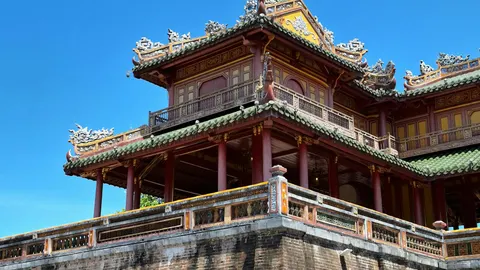 Central Vietnam · Travel Hue (Huế): How Many Days, What to See, 2026 Tickets How many days Hue needs, which Citadel sights and royal tombs to pick, 2026 ticket prices, the flood months to avoid and where to eat in the old royal capital.
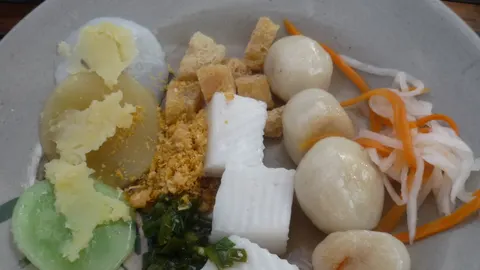 Central Vietnam · Food Hue (Huế) Royal Cuisine: What to Eat and Where to Try It Hue royal cuisine explained: what Nguyen court cooking was, how banh beo, banh nam and banh bot loc differ, and when 2026 palace banquets ran in Hue.
 North · Central · South · Culture Vietnamese Accents Compared: 6 vs 5 Tones, Which to Learn Vietnamese accents compared sound by sound: Hanoi's six tones vs Saigon's five, Hue's local words, the hardest accent, and a table for which accent to learn.