All three regions · Food
Banh Canh (Bánh Canh) by Region: Which Bowl to Order Where
Banh canh by region: which bowl to order where, from Trang Bang pork and Hue's Nam Pho to Saigon crab and coastal fish cake, plus two MICHELIN 2026 shops.
Banh canh (bánh canh) is a Vietnamese soup of thick, chewy rice or tapioca noodles, and each region changes the noodle, the broth and the topping: boiled pork with dew-softened rice paper in Trang Bang, thick shrimpy bowls and snakehead fish around Hue, crab in Saigon and fish cake on the central coast. As of November 2026, two banh canh shops are in the current MICHELIN Guide Vietnam selection, a crab shop in Saigon named a new Bib Gourmand on 4 June 2026 and a snakehead-and-pork shop in Da Nang (VietNamNet). Banh means a flour-based food and canh means soup. This guide sets the main styles side by side, explains why they differ, and tells you which bowl to order where.
Banh canh by region at a glance
| Style | Noodles | Broth | Topping | Where | When |
|---|---|---|---|---|---|
| Trang Bang | Rice flour, pressed into round strands | Pork bone with dried shrimp, carrot, straw mushroom | Boiled pork, trotter | Trang Bang, Tay Ninh; Saigon | Breakfast |
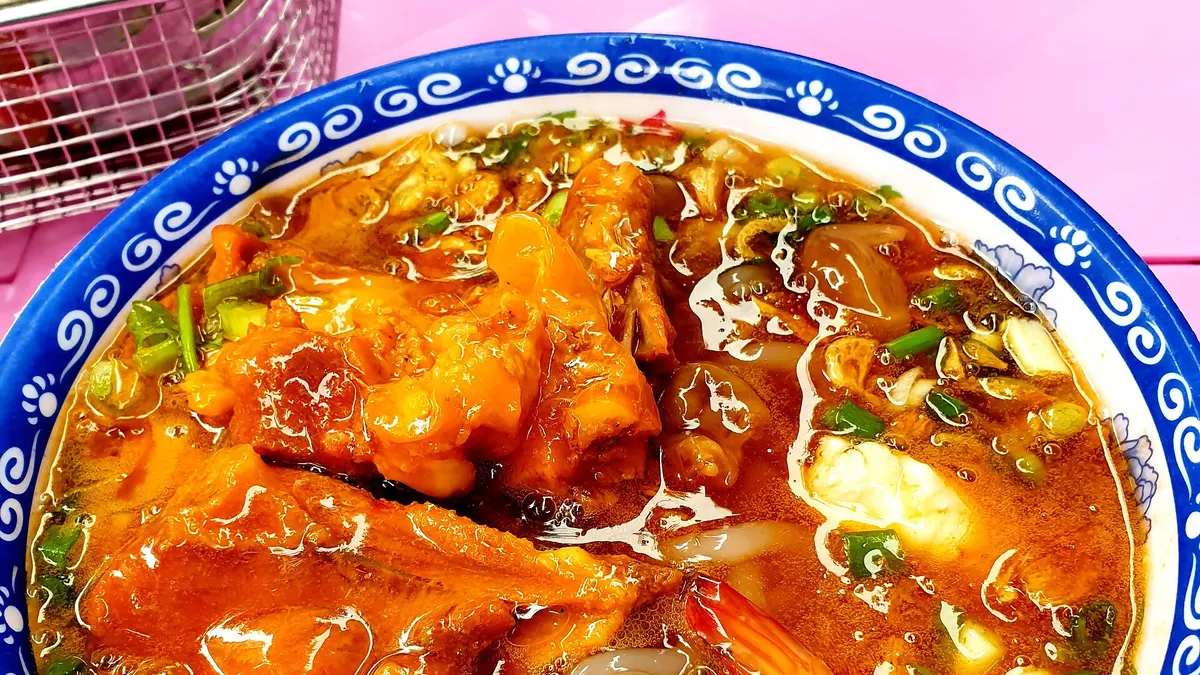
| Nam Pho (Hue) | Rice and tapioca, heavy on tapioca | Thick, orange, with shrimp paste | Shrimp and pork balls, crab | Nam Pho village and Hue | Late afternoon |
| Ca loc (snakehead) | Rice dough rolled and cut, or squeezed | Fish-bone stock | Snakehead fish, small leeks, chilli | Hue, Quang Tri, Quang Binh | Mid-afternoon in Hue; any meal in Quang Tri |
| Cua (crab), Saigon | Thick, round, mostly tapioca | Thick orange crab broth | Crab, fish cake, trotter, egg | Ho Chi Minh City | Varies |
| Cha ca (fish cake) | Rice (Phan Rang, Binh Dinh) or tapioca (Nha Trang) | Fish-bone broth | Fried or steamed fish cake | Nha Trang, Quy Nhon, Phan Rang, Da Nang | Breakfast in Nha Trang |
| Ghe (crab), Vung Tau | Rice or tapioca | Crab-shell stock | Blue swimmer crab | Vung Tau | Varies |
| Bot xat (Mekong) | Rice sheet, hand-sliced | Coconut-milk broth | Duck, shrimp, crab, clams or pork | Mekong Delta | Varies |
What is banh canh, and how is it different from pho or udon?
The noodle is the dish. Banh canh noodles are thick, soft and slippery, made from rice flour, tapioca starch (bot loc) or a mix, and they are formed in very different ways: pressed through a mould, squeezed from a bag into boiling water, or rolled out and cut with a knife. VnExpress’s survey of regional bowls shows each region using its own method, from rice dough dripped into boiling water in Nam Pho to round, mostly tapioca strands in the South (VnExpress).
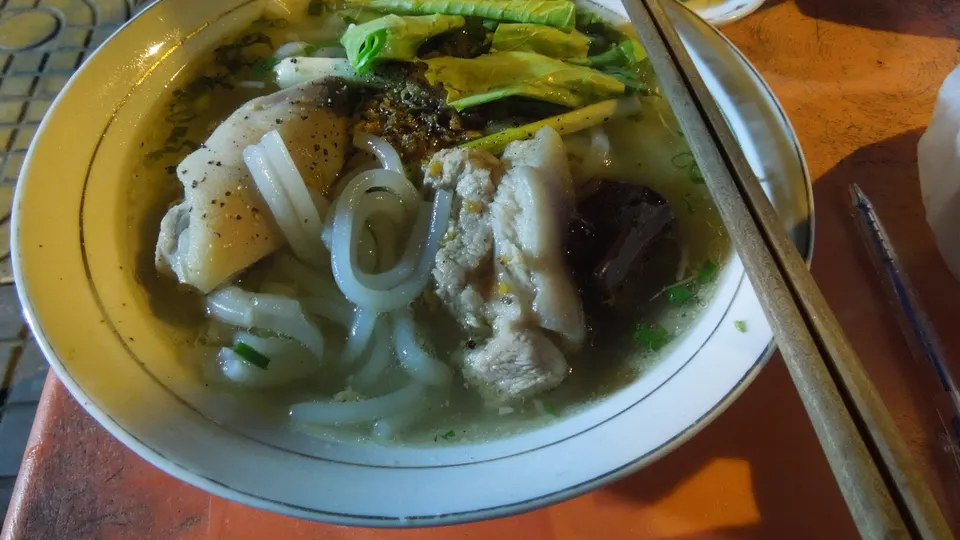
That makes it very unlike pho, whose flat rice noodles sit in a clear, spiced broth, and unlike the springy rice or tapioca noodles of Southern hu tieu. Many visitors compare banh canh to Japanese udon, and the strands do look alike, but udon is a wheat noodle; banh canh is mostly rice and tapioca, although some cooks, for example in Binh Dinh, add wheat flour. Our Vietnamese noodles guide sets it beside pho, bun, hu tieu and mi.
What it means for you. Expect chew rather than bite, and a broth that is often thicker than other Vietnamese noodle soups, especially where tapioca is cooked straight in the pot.
Trang Bang: pork, herbs and dew-softened rice paper
The best-known Southern style comes from Trang Bang (Trảng Bàng), a town on the old road from Saigon to Tay Ninh. Since July 2025 it lies in the enlarged Tay Ninh province, which absorbed Long An under Resolution 202/2025/QH15. Viet Nam News describes the bowl: rice soaked overnight, ground, steamed, kneaded and pressed into long round noodles; a broth of pork bones with carrots, straw mushrooms and dried shrimp; and lean pork and trotters on top, with a plate of more than 20 kinds of fresh greens (Viet Nam News).
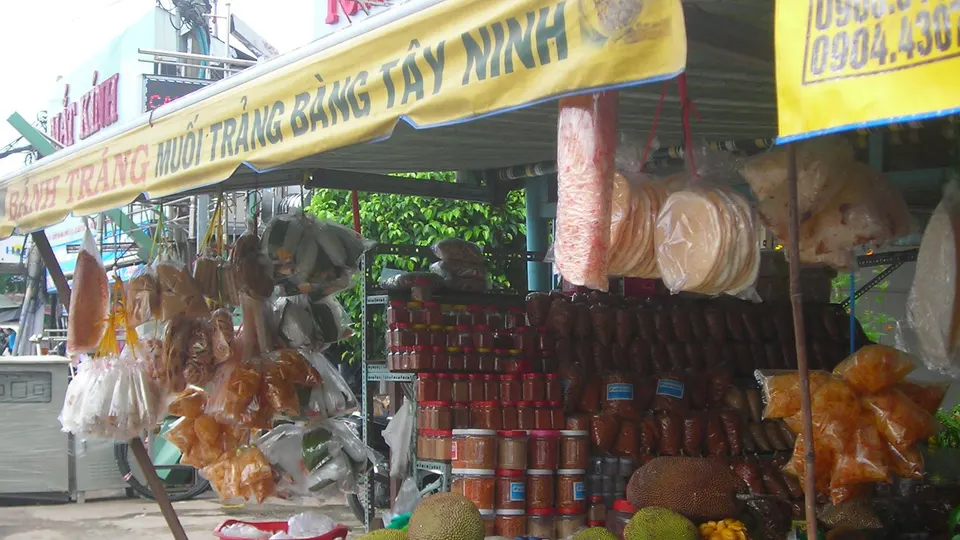
What sets Trang Bang apart is the side plate. The boiled pork is eaten wrapped in banh trang phoi suong, the town’s dew-softened rice paper, with herbs, according to VnExpress. The rice-paper craft itself is national intangible heritage, Bao Van Hoa reports; our guide to banh trang explains how the dew is used. The bowl is now sold across the South, and many shops in Saigon put “Trang Bang” on their sign.
Where it came from. The origin is told as stories, not documented history. One Trang Bang family that once ran a Saigon shop says its grandfather created the dish for French-era convoy drivers who stopped in the town at night (VnExpress, 2012), and Viet Nam News reports a local legend of a nameless woman who gave bowls away and is remembered as the dish’s patron. Treat both as stories. For the town and the Cao Dai Holy See nearby, see our Tay Ninh guide.
Hue and Quang Tri: Nam Pho bowls and snakehead fish
Central Vietnam has two styles that look nothing alike. Banh canh Nam Pho comes from a village about 6 km from Hue, known for its country food (VnExpress, 2023). Saigoneer describes noodles of rice and tapioca “with a heavy lean on the latter”, a thick orange broth flavoured with shrimp paste and coloured by crab or shrimp roe or annatto oil, and shrimp-and-pork balls, eaten, “according to Hue conventions”, in the late afternoon.
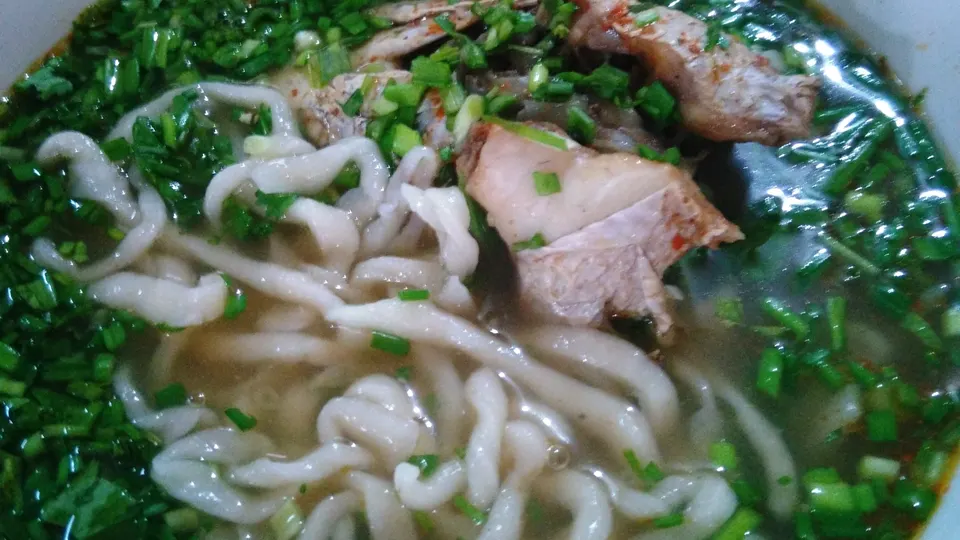
Banh canh ca loc uses snakehead fish, a freshwater fish of the rice fields, cooked in a stock of fish bones and heads, with small leeks (cu nen) and chilli. In Quang Tri it is also called chao bot or chao vat giuong, and the dough is rolled thin with a bamboo tube and cut into strands; people there eat it for breakfast, lunch and dinner (Bao Van Hoa). In Hue, VnExpress describes it as a mid-afternoon snack.
What it means for you. At a Hue stall you may be asked whether you want rice noodles (bot gao) or the tapioca-rice mix (bot loc), Saigoneer notes; rice is firmer, the mix is softer and more slippery. Our map of where to eat in Hue shows where the afternoon snack streets are.
Saigon: banh canh cua, the crab bowl
In Ho Chi Minh City, the crab bowl rules. Banh canh cua has thick, round, mostly tapioca noodles in a thick orange crab broth. The MICHELIN Guide describes the bowl at Banh Canh Cua Ba Ba, a 2026 Bib Gourmand, as crab meat, fish cake and egg strands with fried dough and pork trotter, and a green chilli-lime sauce on the side (MICHELIN Guide). As of November 2026 the listing gives hours of 8am to 8pm, closed on Mondays.
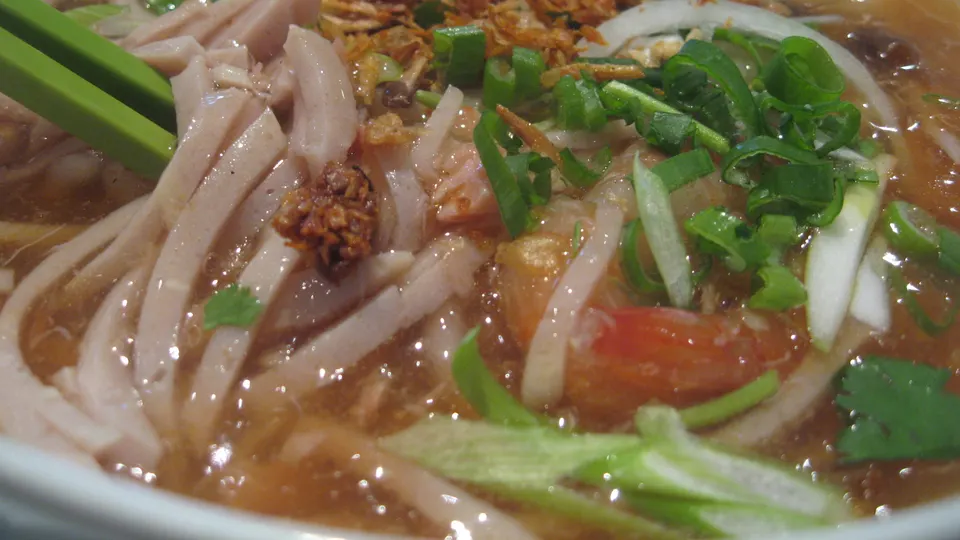
Southern cooks also make a plainer banh canh gio heo, with pork trotters, where the tapioca noodles cook in the broth and thicken it. Shops come and go: a famous Saigon stall on Nguyen Phi Khanh, known for opening for about an hour a day, closed on 30 May 2025 after 50 years, Tuoi Tre News reported, so check any older recommendation before you go.
The coast: fish cake and crab from Quy Nhon to Vung Tau
Along the south-central coast, banh canh comes with cha ca, fish cake, either fried or steamed, in a light fish-bone broth. Tuoi Tre News describes fresh rice-flour noodles and fish-bone broth in Phan Rang, sometimes eaten with a banh mi, and VnExpress traces fish-cake bowls from Binh Dinh to Binh Thuan. In Nha Trang, Vietnam Coracle notes that fish cake is served with rice noodles or chewy tapioca banh canh and is easiest to find at breakfast.
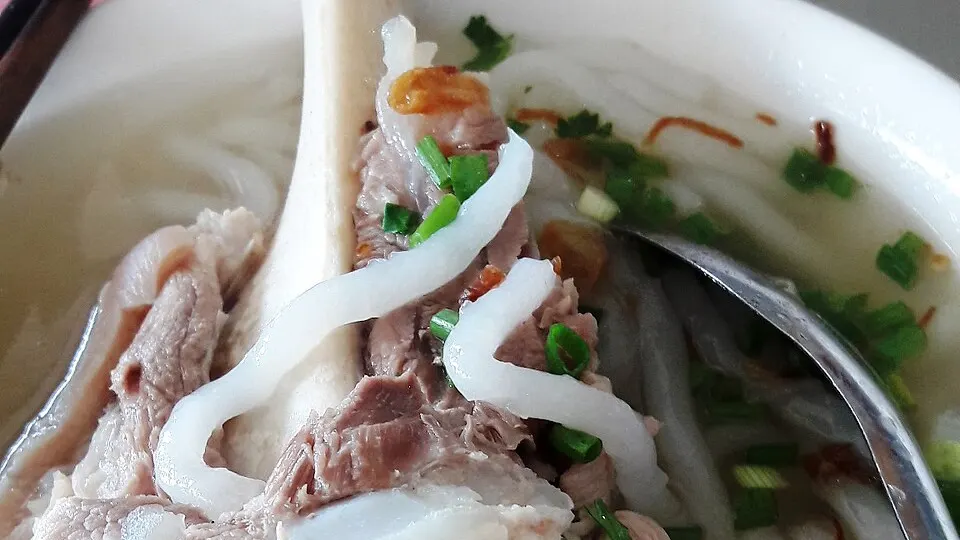
Further south, Vung Tau is known for banh canh ghe, made with blue swimmer crab. The national tourism portal describes thick rice or tapioca noodles in a broth simmered with the crab shells; it also mentions coconut milk, which we could not confirm elsewhere, so ask if you want to avoid it.
Mekong Delta: hand-cut noodles and duck
In the Mekong Delta, banh canh bot xat is closer to home cooking. Saigoneer describes soaked and ground rice pressed into sheets, flattened with a glass bottle and sliced by hand, in a coconut-milk broth often cooked with duck, or with shrimp, crab, clams or pork.
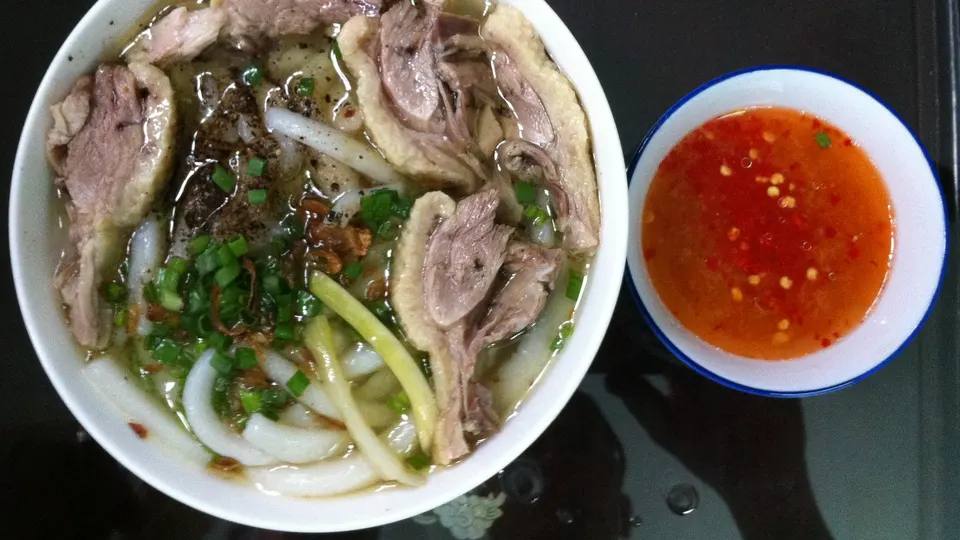
Duck banh canh (banh canh vit) is also sold in Mekong towns as a breakfast or lunch bowl. These versions are less standardised than Trang Bang or crab banh canh, and recipes change from family to family.
How to order and eat banh canh
Say the topping after the name: banh canh cua (crab), banh canh gio heo (pork trotter), banh canh ca loc (snakehead), banh canh cha ca (fish cake), banh canh ghe (blue swimmer crab). In Trang Bang-style shops, the meat may come on a separate plate with rice paper and herbs, to be wrapped and dipped.
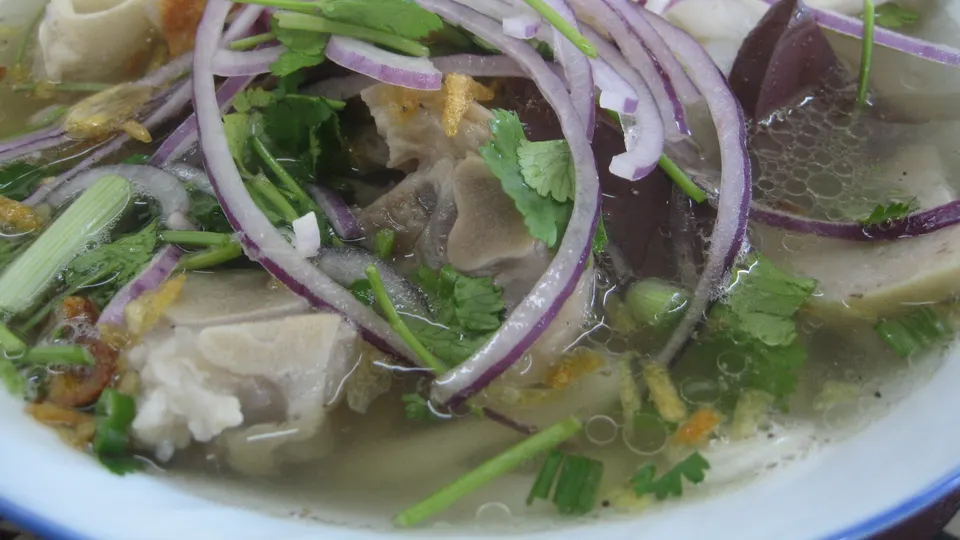
- Season at the table. Add lime, chilli and pepper to taste; crab bowls usually come with a green chilli-lime sauce.
- Eat it hot and fast. Tapioca noodles keep softening and thickening the broth as they sit.
- Match the time of day. Breakfast for Trang Bang and fish cake on the coast, late afternoon for Nam Pho in Hue.
- Choose by taste. For a clean, meaty bowl, Trang Bang; for richness and seafood, crab banh canh; for something light and local, fish cake on the coast; for a thick, shrimpy snack, Nam Pho.
The table below turns that into a choice. Prices are rarely published; the one recent figure is for the Saigon crab shop, where a serving cost 55,000 to 150,000 VND in June 2026 (Znews).
| If you want | Order | Where | When | Verified shop (as of November 2026) |
|---|---|---|---|---|
| A clean, meaty bowl with herbs | Banh canh Trang Bang | Trang Bang, Tay Ninh; many Saigon shops | Breakfast | None carded |
| Rich seafood, very chewy noodles | Banh canh cua | Ho Chi Minh City | Varies | Banh Canh Cua Ba Ba: 8am–8pm, closed Mondays; 55,000–150,000 VND (June 2026) |
| A light, local breakfast | Banh canh cha ca | Nha Trang, Quy Nhon, Phan Rang | Breakfast | None carded |
| A thick, shrimpy snack | Banh canh Nam Pho | Hue | Late afternoon | None carded |
| A fish broth | Banh canh ca loc or a snakehead-and-pork bowl | Hue, Quang Tri; Da Nang | Mid-afternoon in Hue | Banh Canh Yen, Da Nang: 6am–10pm daily |
There is no “original” banh canh to rank above the others. Each is the everyday soup of its own region; browse more of them in our Vietnamese food guides.
Where to try banh canh
MICHELIN Guide (2026 selection) pick
Bánh Canh Cua Bà Ba · Bánh canh cua Bà Ba
Ho Chi Minh City · Chợ Quán ward (former District 5)
84/6 Nguyễn Biểu Street
A crab banh canh shop down an alley that the MICHELIN Guide made a Bib Gourmand in its 2026 Vietnam selection; it serves one dish, by the bowl or in a clay pot for sharing.
Order: Banh canh cua with crab meat, fish cake and pork trotter; add the green chilli-lime sauce.
Many crab banh canh shops use similar names. This card means the one at 84/6 Nguyễn Biểu.
Listed in: MICHELIN Guide (2026 selection) (2026), Znews (2019), VietNamNet · checked November 2026
MICHELIN Guide (2026 selection) pick
Bánh Canh Yến · Bánh canh Yến
Da Nang · Hải Châu ward
253 Nguyễn Hoàng Street
A long-running Da Nang shop in the MICHELIN Guide Vietnam 2026 selection, serving tapioca-and-rice noodles in a snakehead fish and pork broth; Vietnam's national tourism portal says it has operated for more than 30 years.
Order: The mixed bowl with fish cake, quail egg and crab cake, with fried dough on the side.
Listed in: MICHELIN Guide (2026 selection) (2026), Danang Fantasticity (Da Nang tourism portal) (2026), Vietnam National Authority of Tourism (vietnam.travel) · checked November 2026
Addresses and details can change; check before you go. We do not accept payment for listings.
Frequently asked questions
Is banh canh the same as udon?
No. Both are thick and slippery, but udon is a Japanese wheat noodle, while banh canh is a Vietnamese soup whose noodles are usually made from rice flour and tapioca starch.
How is banh canh different from pho?
Pho uses flat rice noodles in a clear, spiced beef or chicken broth. Banh canh uses thick round or cut noodles, often in a thicker broth, with pork, crab, fish or fish cake instead of pho's beef.
How much does banh canh cua cost at Banh Canh Cua Ba Ba in Saigon?
Znews reported in June 2026 that a serving at Banh Canh Cua Ba Ba, 84/6 Nguyen Bieu in Cho Quan ward, costs 55,000 to 150,000 VND. As of November 2026 its MICHELIN listing gives opening hours of 8am to 8pm, closed on Mondays.
What time of day should I eat banh canh?
Trang Bang pork banh canh and the fish cake bowls of Nha Trang and the coast are breakfast food. In Hue, Nam Pho bowls are eaten in the late afternoon and snakehead (ca loc) bowls as a mid-afternoon snack.
Is Banh Canh Yen in Da Nang still in the MICHELIN Guide?
Yes. As of November 2026, Banh Canh Yen at 253 Nguyen Hoang Street in Hai Chau ward is listed in the 2026 MICHELIN Guide Vietnam, with hours of 6am to 10pm daily.
Key sources
- Tứ xứ bánh canh · VnExpress, 6 July 2004
- Rice noodle soup: the most popular dish in Tay Ninh province · Việt Nam News (VNA), 25 August 2026
- Bánh canh Trảng Bàng Ba Xi · VnExpress, 13 January 2012
- 5 món ăn dân dã vùng Nam Phổ · VnExpress, 11 October 2023
- Nhớ món cháo cá 'vạt giường' Quảng Trị · Báo Văn Hóa, 20 January 2021
- 23 quán ăn, nhà hàng mới tại Việt Nam được Michelin vinh danh · VietNamNet, June 2026
- Chàng trai nghỉ làm dược sĩ, kế thừa tiệm bánh canh Michelin của mẹ · Znews, 6 June 2026
- Bánh Canh Cua Bà Ba · MICHELIN Guide Vietnam 2026
All 19 sources and further reading
- These 5 uncommon bánh canh bowls celebrate Vietnam's regional diversity · Saigoneer, 25 May 2025
- Hẻm Gems: Bánh canh Nam Phổ, Huế's hearty, homey afternoon snack · Saigoneer, 18 September 2025
- Bảo tồn, tôn vinh nghề làm bánh tráng phơi sương Trảng Bàng · Báo Văn Hóa, 21 December 2018
- Bánh canh cá lóc, hương vị đất cố đô · VnExpress, 28 September 2011
- Vung Tau crab noodle soup (bánh canh ghẹ) · Vietnam National Authority of Tourism (vietnam.travel)
- Soft and supple banh canh noodle in Vietnam's Phan Rang · Tuổi Trẻ News, 12 June 2021
- Nha Trang food guide · Vietnam Coracle, 9 July 2026
- Ho Chi Minh City's famous '1-hour' banh canh stall closes after 50 years · Tuổi Trẻ News, 31 May 2025
- MICHELIN Guide Vietnam 2026 · MICHELIN Guide, 4 June 2026
- Resolution 202/2025/QH15 on the reorganisation of provincial-level administrative units · LuatVietnam (English)
- Bánh canh · Wikipedia
Keep exploring
 South Vietnam · Food Hu Tieu (Hủ Tiếu): Which Style to Order and Where in Saigon Which hu tieu to order in Saigon: Nam Vang, My Tho or Sa Dec, dry or in broth, how it differs from pho, what a bowl costs in 2026 and where to eat it.
 North · Central · South · Food Hanoi vs Saigon Pho (Phở): Differences and How to Order Hanoi vs Saigon pho: a clear, spare Northern broth or a sweeter Southern bowl with herbs and sauces, plus Central styles, 2026 prices and MICHELIN picks.
 South Vietnam · Travel Tay Ninh (Tây Ninh) Day Trip from Saigon: Holy See, Ba Den Is a Tay Ninh day trip from Saigon worth it? Noon prayer at the Cao Dai Holy See, Ba Den cable car prices for 2026, getting there, a one-day plan, mistakes.
 Central Vietnam · Food Where to Eat in Hue (Huế): Which Dish, Where and When Where to eat in Hue by area and time: bun bo at dawn near Dong Ba, banh khoai on Dinh Tien Hoang, com hen on Con Hen, night stalls and vegetarian picks.