All three regions · Food
Vietnamese Herbs: English Names and How to Eat Each One
Vietnamese herbs by English name: rau ram, perilla, culantro, fish mint and more, with taste, the dishes each suits, regional herb plates and how to wash them.
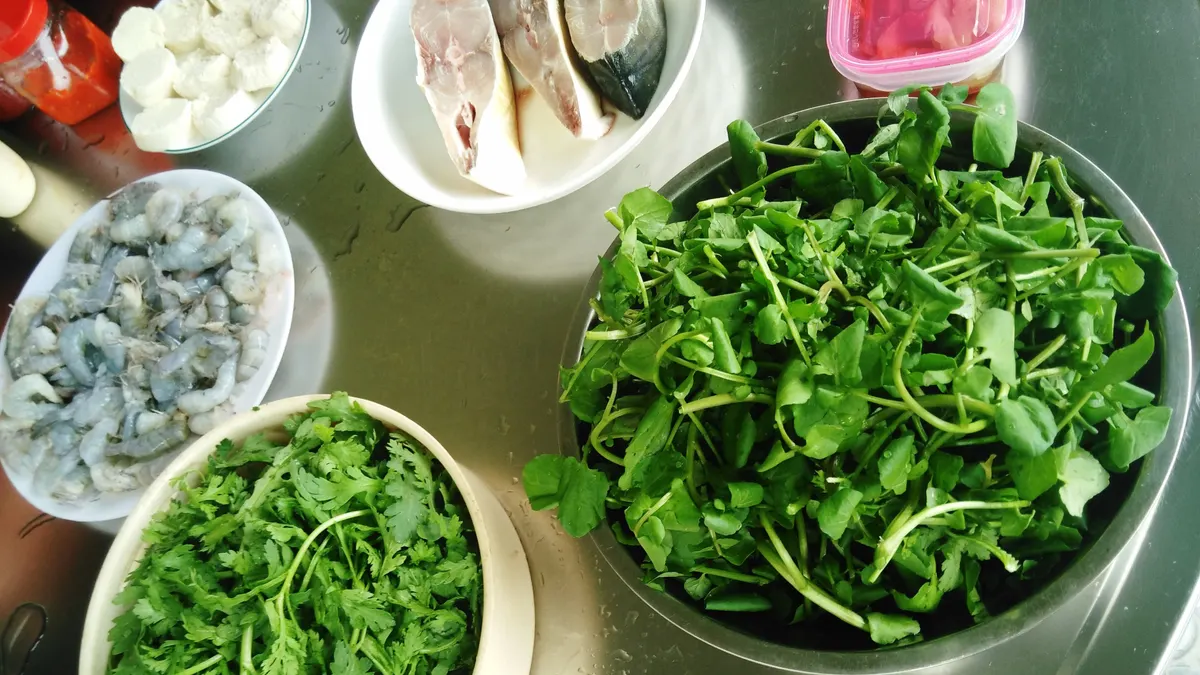
The herbs on a Vietnamese table are, in English, Vietnamese coriander (rau ram), coriander, perilla, Vietnamese balm, Thai basil, several mints, culantro, fish mint, rice paddy herb and dill: you tear them into hot noodle soups or roll them with grilled meat and pancakes, and the dish and the region decide which ones arrive. To see them growing, go to Tra Que, the herb village near Hoi An, which Da Nang’s tourism portal listed in June 2026 as open daily from 8 a.m. to 6 p.m., with entry of about 35,000 dong.
What is the Vietnamese herb plate?
Order noodles, a crisp pancake or grilled pork almost anywhere in Vietnam and something green arrives with it. Vietnamese call the leafy part rau song (sống) (“raw vegetables”: lettuce and other greens) and the herbs rau thom (thơm) (“fragrant greens”). The cookery writer Andrea Nguyen describes the result as the essential salad plate of lettuces and herbs eaten alongside many fried and grilled foods, and a Tuoi Tre (Tuổi Trẻ) News columnist found a basket of greens “de rigeur with most every restaurant meal”.
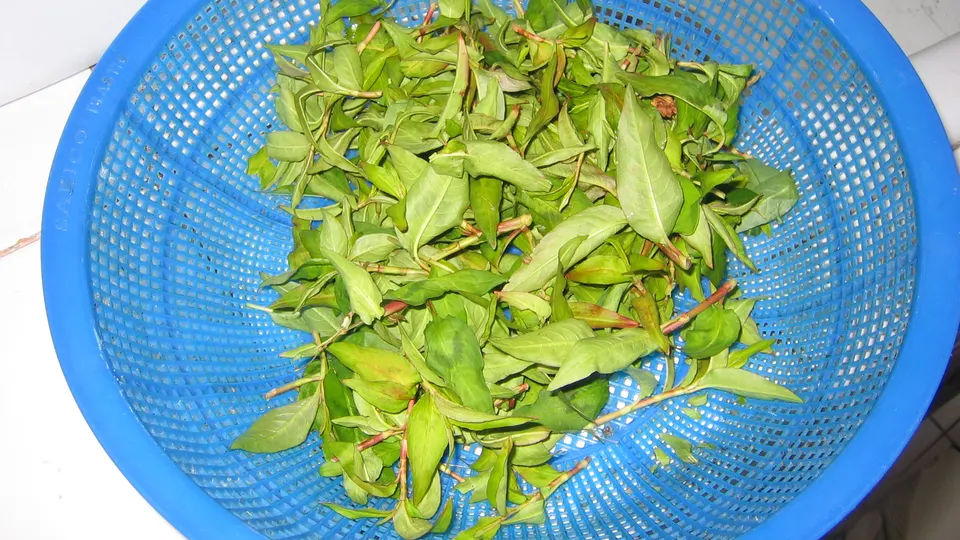
The writer To Hoai (Tô Hoài) put it more simply in 2002: herbs are as necessary to a dish as seasoning. What changes from region to region is which herbs, how many, and what else shares the plate. In short: Hanoi and the North pick a few herbs to suit each dish, Hue (Huế) and the Centre add sour and astringent fruit and banana blossom, and Saigon and the Mekong Delta pile the basket high. This guide covers the herbs one by one, then the regional plates, the reasons behind them and how to eat them. For the wider picture of regional cooking, start with our guide to Vietnamese food by region.
Vietnamese herbs at a glance: English and botanical names, taste, dishes and region
| Vietnamese name (rough sound: Hanoi / Saigon) | English name | Botanical name | Taste | Eaten with | Region that uses it most |
|---|---|---|---|---|---|
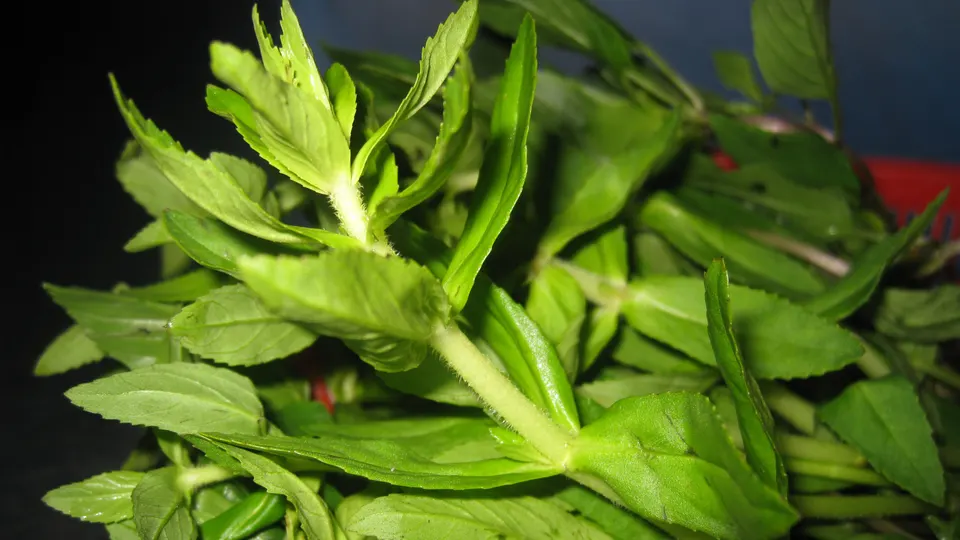
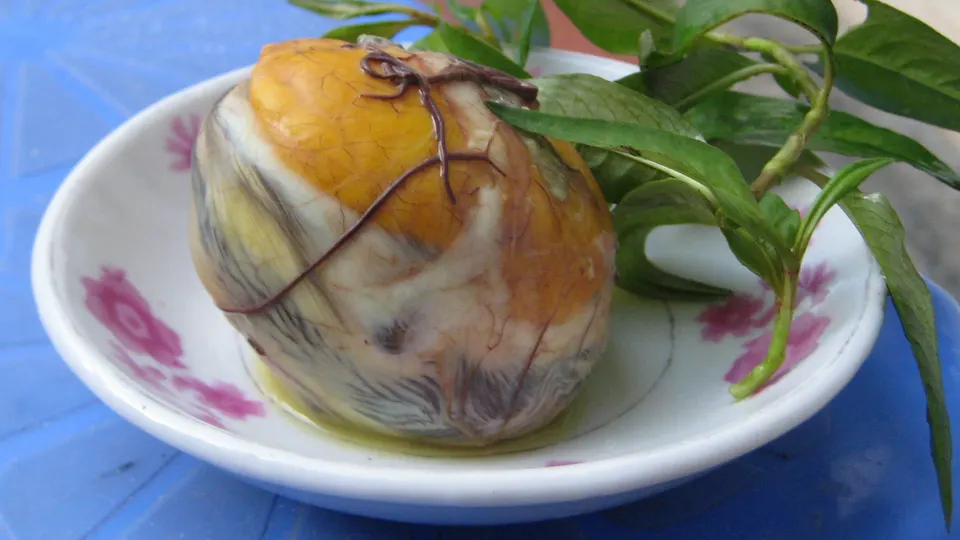
| Rau ram (Rau răm) · “zow zam” / “row ram” | Vietnamese coriander | Persicaria odorata (formerly Polygonum odoratum) | Spicy, with a hint of coriander; counted as “hot” in folk dietetics | Fertilised duck egg (hot vit lon (hột vịt lộn)), chicken salad, goi (gỏi) and nom (nộm) salads, eel glass noodles | Nationwide |
| Rau mui (rau mùi) (South: ngo) · “zow moo-ee” / “ngaw” | Coriander (cilantro) | Coriandrum sativum | Fresh and fragrant; the Northern type is more fragrant, the Southern one has bigger leaves | Chopped into Hanoi pho, soups, porridge, salads; the roots flavour broth | Nationwide |
| Tia to (Tía tô) · “tee-ah toh” | Perilla (shiso) | Perilla frutescens | Slightly minty | Bun cha (Bún chả), shrimp fritters (banh tom (bánh tôm)), fresh spring rolls, porridge | Nationwide |
| Kinh gioi (Kinh giới) · “kin zuh-ee” / “kin yuh-ee” | Vietnamese balm | Elsholtzia ciliata | Lemony, milder than lemon balm | Bun cha, bun dau mam tom (bún đậu mắm tôm), bun rieu cua (bún riêu cua) | Mainly the North |
| Hung que (Húng quế) · “hoong kweh” | Thai basil (purple stems) | Ocimum basilicum (the basil species) | Aromatic, strong | Pho (above all in the South), bun bo Hue (bún bò Huế) | Used most freely in the South |
| Hung Lang (Húng Láng) / hung lui (húng lủi) · “hoong lahng” / “hoong loo-ee” | Vietnamese mints (Lang (Láng) mint; small-leaf mint) | Mentha (mint genus; species not pinned down) | Mild but distinctive mint | Hanoi pho and crab soup (Lang mint); mi Quang (mì Quảng) and pomelo or papaya salads (hung lui) | Lang mint in Hanoi; hung lui in the Centre |
| Hung cay (húng cây) · “hoong kay” | Wild mint, spearmint-like | Mentha (mint genus) | Light, minty, cleansing | Pho, bo kho (beef stew), chicken curry, banh xeo, fresh spring rolls | Mainly the South |
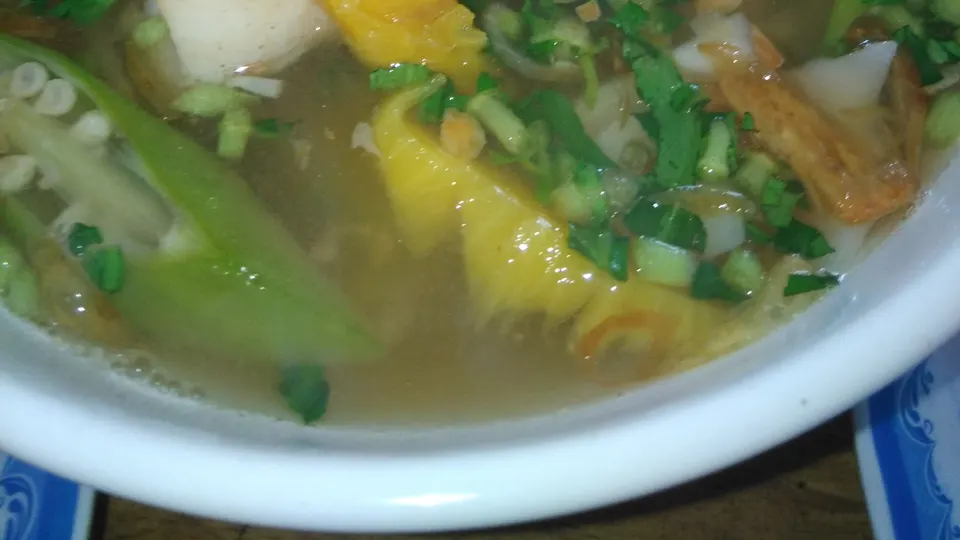
| Ngo (Ngò) gai (North: mui tau (mùi tàu)) · “ngaw guy” | Culantro, sawtooth coriander | Eryngium foetidum | Stronger and earthier than coriander, a little bitter | Beef pho, canh chua (sour soup), bamboo-shoot soup | South for canh chua; North for bamboo-shoot soup |
| Diep ca (Diếp cá) · “zee-ep kah” / “yip kah” | Fish mint | Houttuynia cordata | Sour and pungent; less fishy than the name suggests | Banh xeo (Bánh xèo), grilled meat, fresh rolls | South; many Hanoians avoid it |
| Rau om (North: ngo) · “row om” | Rice paddy herb | Limnophila aromatica | Citrusy with a cumin note, slightly bitter | Canh chua, some pho, sour fish soups | South, often paired with culantro |
| Thi la (Thì là) · “tee lah” | Dill | Anethum graveolens | Fresh; cuts fishiness | Cha ca La Vong (Chả cá Lã Vọng), fish soups, clam soup | Mainly the North |
The botanical names come from PROSEA (Plant Resources of South-East Asia), the regional plant handbook whose species records list the Vietnamese names beside the Latin ones: rau ram, rau mui, tia to, ngo gai and mui tau, diep ca, rau ngo and thi la all appear there, and its basil record gives the Thai name for Thai basil, horapha (PROSEA). Kinh gioi’s name follows a 2022 Hung Vuong University study of the plant. PROSEA records several mints grown in Vietnam, including field mint (Mentha arvensis, Vietnamese bac ha (bạc hà)) and water mint (Mentha aquatica), but does not tie them to market names such as hung Lang or hung lui, so the table gives only the genus. Two PROSEA notes help explain the plate: culantro was introduced to South-East Asia by the Chinese as a substitute for coriander, and fish mint’s crushed leaves have a fish-like smell and are used in salads or as a garnish.
The sounds are rough English approximations without tones, and the regional column shows where a herb is used most, not the only place you will find it. The main split is in the first letter: Hanoi says d, gi and r alike as “z”, while Saigon says d and gi as “y” and keeps r separate, as our guide to Vietnam’s regional accents explains. The same herb can also have two names: coriander is rau mui (mùi) in the North and ngo in the South, culantro is mui tau or ngo gai (ngò gai), and rice paddy herb is ngo or rau om.
Hanoi and the North: a few herbs, matched to each dish
In his essay on herbs, To Hoai describes how Hanoians gave each herb its partners: Lang mint for crab soup and pho, rau ram (răm) for fertilised duck eggs, eel glass noodles and pork sausage, dill for fish soups and braised fish, coriander chopped fine into pho, and perilla with stir-fried water spinach. He also noted that the South praises fish mint while Hanoians shrank from its fishy smell (VnExpress). That logic of matching still shapes the Northern table.
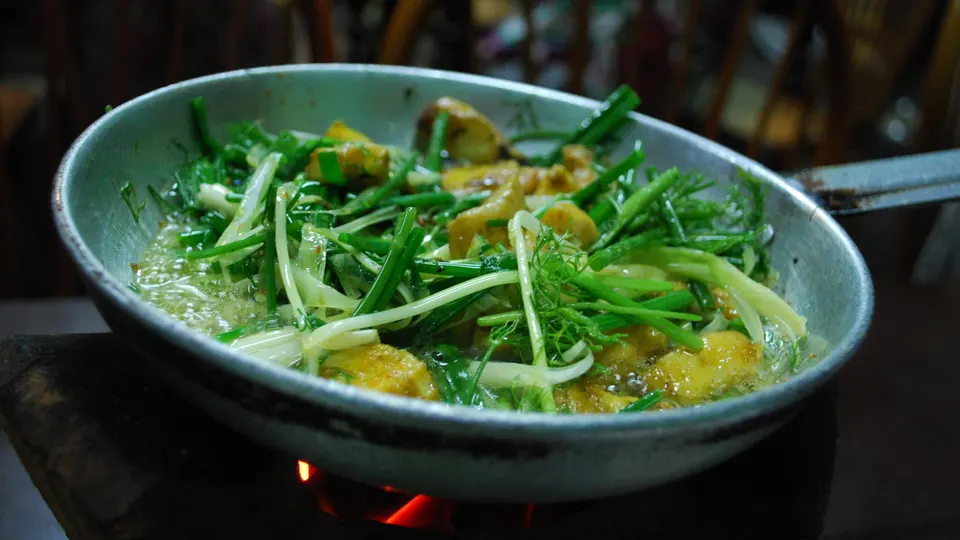
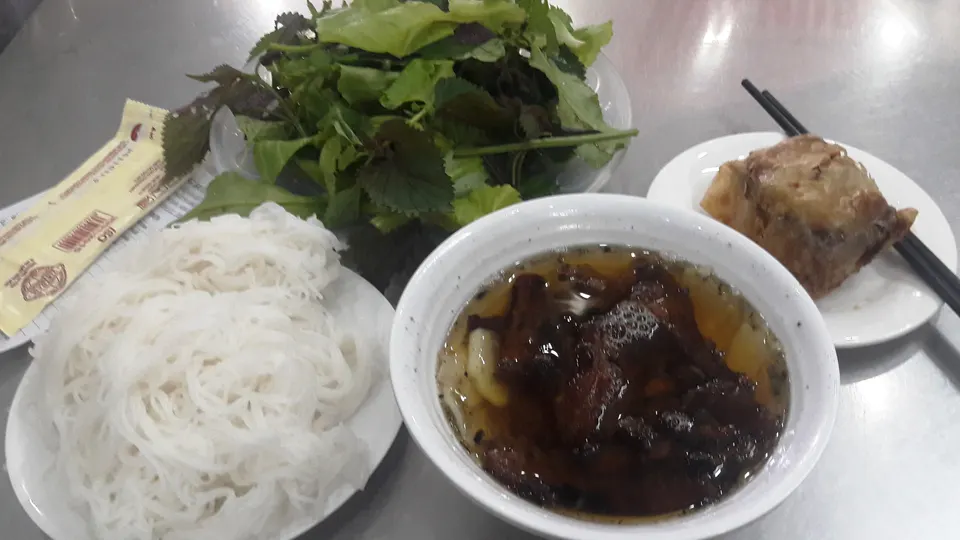
Pho shows it best. MICHELIN quotes a chef who calls the accompaniments of Northern pho “meagre”: Northerners add little to the bowl, and the herbs that matter, such as spring onion and coriander, are already in it rather than on a side plate. Other Hanoi dishes are generous with greens, but with particular ones. Bun cha comes with lettuce and herbs, perilla and Vietnamese balm among them. Vietnam Coracle lists Vietnamese balm as the herb of bun dau mam tom and bun rieu cua too (bún riêu cua too). At cha ca, the turmeric fish fried at the table, dill and spring onion go into the hot pan, and more dill, coriander and Lang mint come on the side, VnExpress writes.
Tradition and practice had already started to part ways by 2002, when To Hoai described the jumbled bundles of mixed herbs sold at markets, a far cry from the one-herb, one-dish pairings he grew up with. Convenience loosens those pairings, and that is worth knowing when a modern shop hands you a mixed plate.
Hue and the Centre: banana blossom, starfruit and green banana
Hue’s plate is about texture and sourness as much as scent. For banh khoai (bánh khoái), Hue’s crisp pancake, the raw plate must hold fig (va (vả)), green banana, starfruit, lettuce, banana blossom and coriander, and without the banana blossom the plate is missing its sweet, astringent bite, according to a VnExpress feature on the city’s food. The same kind of plate goes with bun bo gio heo (bún bò giò heo), fish-cake noodles, com hen (cơm hến) and steamed fish.
Bun bo Hue gets the same treatment: VnExpress lists bun bo gio heo among the dishes served with this raw plate, and Vietnam Coracle adds Thai basil to the herbs that come with it. Further south, in Da Nang (Đà Nẵng) and around Hoi An (both part of Da Nang city since July 2025, when Quang Nam (Quảng Nam) province merged into it), hung lui, the small-leafed mint, belongs with mi Quang. At Da Nang’s banh xeo shops, the herbs come with rice paper for rolling. Vietnam Coracle also places lime basil (e trang (é trắng)) mainly in the Centre and the highlands. A VnExpress overview of the three regional cuisines describes Central food as the boldest of the three, with many spicy and salty dishes, and the cool, crunchy and sour things on a Hue plate sit against that heat.
Saigon and the Mekong Delta: the generous basket
In the South the plate grows. To Hoai noticed that Saigonese tipped whole handfuls of Thai basil into their pho, and MICHELIN lists Thai basil, culantro, spearmint and bean sprouts among the Southern extras. Vietnam Coracle pairs Southern banh xeo with wild mint (hung cay (húng cây)) and fish mint, the herb Hanoians avoided, and canh chua, the sour fish soup, with culantro and rice paddy herb.
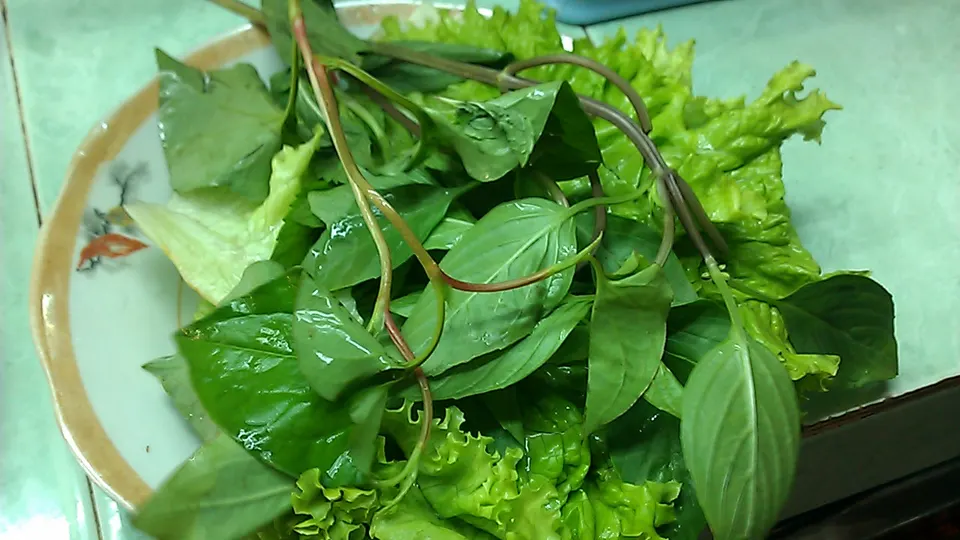
In the Mekong Delta the basket reaches past the garden into the wild. On Cam (Cấm) Mountain in An Giang province, one banh xeo shop serves around 40 kinds of wild leaves free with every order, among them forest perilla, young mango and fig shoots, and other leaves the owner describes as sour, astringent, bitter or medicinal (VietNamNet). VietNamNet also describes delta families eating young cai troi (cải trời) shoots raw with other wild herbs, dipped in braised fish or meat sauce. SGGP noted back in 2010 that such wild greens, once picked by the roadside, had become market specialities, like the dien dien (điên điển) flowers eaten raw with noodles and salted-fish soup.
One small habit shows the regional split. Vietnam Coracle notes that rau ram with a fertilised duck egg is a morning food in the North and more of an evening one in the South.
Why the herb plates differ: climate, migration and taste
The first reason is what grows. MICHELIN’s history of pho puts it plainly: Southerners were more liberal with fresh, uncooked herbs, which grew in abundance on Saigon’s doorstep in the Mekong Delta (MICHELIN Guide). VnExpress’s overview of the three cuisines lists geography, climate, culture and ethnicity together as what shaped each region’s taste: mild and balanced in the North, bold, salty and spicy in the Centre, and sweeter in the South, with Chinese, Khmer and Thai influences.
The second reason is migration. The same MICHELIN article explains that after the country split in 1954, many Northerners moved south and brought pho with them, and found Southern tastes rather different; the Southern bowl that resulted came with herbs and sprouts on the side. Our guide to Hanoi vs Saigon pho tells that story in full.
The third reason is balance. Herbs are not decoration. Vietnam Coracle explains that fertilised duck egg counts as strongly “cold” (yin) in Vietnamese folk dietetics and rau ram as strongly “hot” (yang), so the two are eaten together, and that dill tames the fishy smell of seafood, which is why it goes with fish.
Put side by side, the three regional plates look like this:
| Hanoi and the North | Hue and the Centre | Saigon and the Mekong Delta | |
|---|---|---|---|
| Size of the plate | A few herbs, matched to each dish | Herbs plus sour and astringent fruit and banana blossom | The biggest baskets, often with wild leaves |
| Herbs you will meet | Lang mint, Vietnamese balm, perilla, dill, coriander | Hung lui (with mi Quang), Thai basil (with bun bo Hue), lime basil (Centre and highlands) | Thai basil, culantro, wild mint, fish mint, rice paddy herb |
| Also on the plate | Lettuce with bun cha; spring onion with cha ca | Fig, green banana, starfruit, banana blossom, lettuce | Bean sprouts; wild leaves, dien dien flowers and young cai troi shoots in the Mekong Delta |
| With the noodle soup | Pho: the herbs are in the bowl, few extras on the side | Bun bo Hue: the raw plate, with Thai basil | Pho: Thai basil, culantro, spearmint and bean sprouts on the side |
| Dishes to learn it on | Cha ca, bun cha, eel glass noodles | Banh khoai, bun bo Hue, mi Quang, com hen | Banh xeo, canh chua, pho |
The table sums up the three regional sections above, each drawn from the sources named there; it shows the common pattern, not a rule for every kitchen.
Herb villages: Tra Que in Hoi An and Lang in Hanoi
Tra Que (Trà Quế), about 3 km from Hoi An’s old town, sits between the Co Co (Cổ Cò) River and the Tra Que lagoon. It was formed in the 16th century, and in April 2022 its vegetable-growing craft was recognised as national intangible cultural heritage. In November 2024 UN Tourism named it one of its Best Tourism Villages (Tuoi Tre). VnExpress’s guide to cao lau, Hoi An’s signature noodles, says the dish is not right without Tra Que greens.
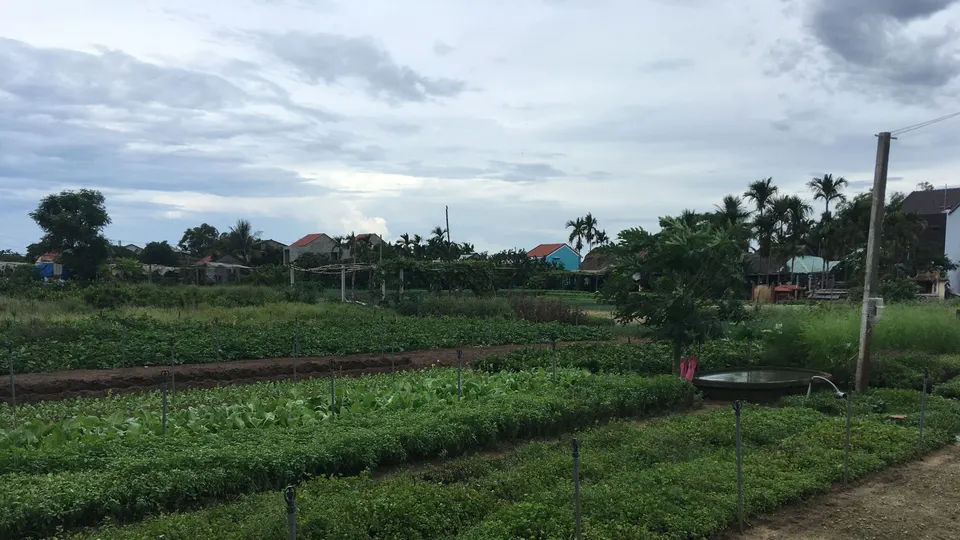
Da Nang’s tourism portal lists Thai basil, perilla, rau ram, spring onion, coriander and fish mint among its crops, and both the portal and Vietnam’s national tourism board describe the village’s signature method: fertilising the beds with weed and algae scooped from the river and lagoon. Each year, usually on the 7th day of the first lunar month, the village holds its Cau Bong (Cầu Bông) festival, honouring Than Nong (Thần Nông), the god of agriculture, followed by the year’s first digging and planting, Tien Phong (Tiền Phong) reports. In 2026 it was held on the morning of 23 February and drew crowds of locals and visitors, with cooking contests, lion and dragon dances, bai choi (a sung folk card game) and vegetable planting. Since the July 2025 reorganisation, Tra Que lies in Hoi An Tay (Hội An Tây) ward of Da Nang city; it was formerly part of Cam Ha (Cẩm Hà) commune in Quang Nam province. Visitors can spend a day as a farmer or take a cooking class built on what they pick.
Lang gave its name to hung Lang, the mint grown in the Lang villages that To Hoai says smells different from look-alike mints. VnExpress’s overview of the three regional cuisines still names Lang mint among Hanoi’s signature flavours, and its cha ca (chả cá) feature lists it on the side plate.
How to use the herb plate: tear, add, wrap
Herbs reach your mouth in one of two ways, and the dish tells you which. In soups, tear the leaves and drop them in: the Tuoi Tre News columnist describes tearing culantro’s long leaves into beef pho (Tuoi Tre News), and Andrea Nguyen also names culantro as the herb favoured for tearing into pho.
- Into the bowl: pho, bun bo Hue, mi Quang, canh chua. Pinch the leaves off the stems, tear them, add a few, taste, then add more. Chefs quoted by the MICHELIN Guide in 2026 give the same advice for pho: taste the broth first, then add herbs gradually.
- Into the wrap: grilled meat, pancakes and fritters. Andrea Nguyen describes grilled foods wrapped in lettuce with herbs: lay the leaf (or rice paper) flat, add herbs and meat, roll it up and dip it. The Tuoi Tre News columnist singles out perilla as a wrap for shrimp fritters and bun cha, and at Da Nang’s banh xeo shops you roll your own rice paper parcels.
- Into the pan: dill is the exception. At cha ca it goes into the sizzling pan with the fish and spring onion before you eat it.
- With the egg: with a fertilised duck egg, take a few leaves of rau ram with each spoonful.
Are raw herbs safe to eat? Washing and food safety
Herbs on a Vietnamese plate are eaten raw, so how they are washed matters. A food-safety explainer in Tuoi Tre in August 2025, drawing on Vietnam’s Food Safety Authority (Cuc An toan thuc pham (Cục An toàn thực phẩm), part of the Ministry of Health), sets out the routine: rinse off soil and dust in clean water, soak the greens for 5 to 10 minutes in clean water or a weak salt solution (0.9%), then rinse several times under running water. Leafy greens are best washed leaf by leaf, greens eaten raw deserve extra care, and soaking much longer is not better: the paper warns it can wash out nutrients.
The US Centers for Disease Control and Prevention is more cautious with visitors. Its travel advice is to avoid raw foods and fresh salads, which “may be contaminated with human or animal waste that even clean water can’t wash off”, and to eat fruit or vegetables only if you can peel them yourself or wash them in bottled or disinfected water (CDC).
What that means in practice:
- Cooking at home or in a class: follow the Tuoi Tre routine, and use bottled or disinfected water, as the CDC suggests, if you are unsure of the tap.
- At a street stall or restaurant: you cannot see how the plate was washed. If you have a sensitive stomach or a short trip with no room for illness, the CDC’s line is to skip the raw plate and eat the cooked dish on its own.
- Herbs torn into hot soup count as raw herbs: neither source makes an exception for them.
Where to buy or see Vietnamese herbs: markets and Tra Que
The easiest place to learn the herbs by sight is a morning market, where they are sold by the bundle. Da Nang’s tourism portal describes Hoi An’s central market, on Tran Phu (Trần Phú) Street by the river, as open from around 5 a.m. to 6 p.m., with bundles of green vegetables and fresh herbs brought in from the surrounding countryside for dishes such as cao lau and mi Quang; it recommends going early for the liveliest atmosphere. A Tuoi Tre News columnist noted back in 2012 that street markets sell small bushels of these greens cheaply.
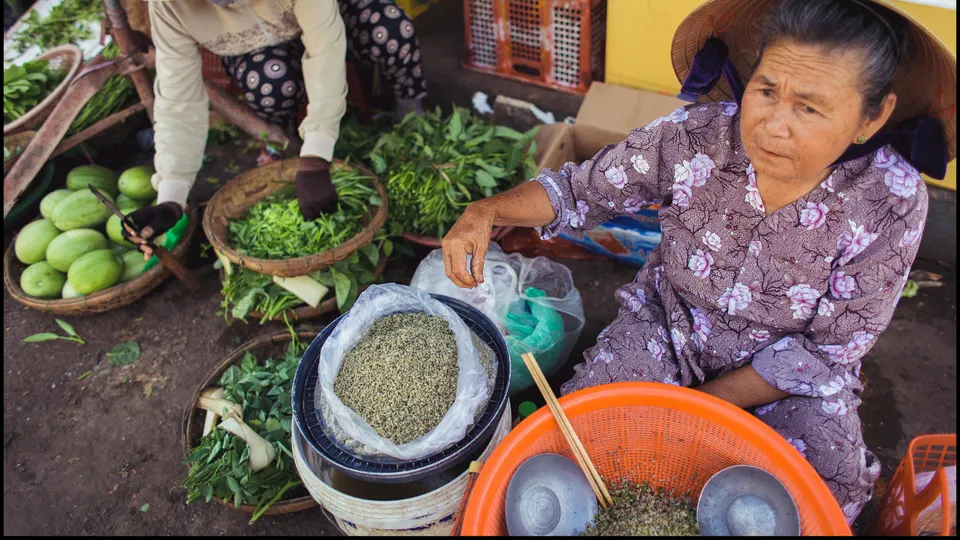
Tra Que’s herbs travel further than Hoi An. At Ba Hoa market in Saigon, a neighbourhood market where, in Tuoi Tre News’ words, Quang Nam lives on, the paper found bundles of herbs on sale at dawn in February 2026, and many sellers insisted they came from Tra Que.
To see the herbs in the ground, visit Tra Que itself. Da Nang’s tourism portal gives these practical details (June 2026) (Da Nang Fantasticity):
- Opening hours and ticket: 8 a.m. to 6 p.m. daily; entry about 35,000 dong per person.
- Getting there: about 3 km from the old town, so by bicycle, motorbike or taxi; the portal suggests cycling.
- When to go: early morning or late afternoon, when it is cooler and farmers are at work in the beds. Vietnam’s national tourism board suggests February to April and September to December as the best months.
- What to do: a farmer-for-a-day session (tilling, sowing, watering with the traditional shoulder baskets) or a cooking class built on what you pick, such as banh xeo, fresh rolls and mi Quang; the portal gives about 200,000 to 500,000 dong for a farming tour and 300,000 to 400,000 dong for a cooking class, and the national tourism board also mentions herbal foot baths.
- What grows there: more than 50 kinds of vegetables and herbs, including mint, lime basil, young mustard greens and garlic chives, on more than 18 hectares worked by 202 households, Tien Phong reported in September 2026 (crop list: Tien Phong, 2024; Vietnam News, 2024).
Our Hoi An food guide lists where to eat cao lau and banh xeo with those herbs after a morning in the fields.
Common mistakes with Vietnamese herbs
Most herb mistakes are small. They come from treating the plate as a garnish, or from assuming the same herbs mean the same thing everywhere. Vietnam Coracle’s guide covers most of the confusions, and these are the ones visitors meet most often.
- Tipping the whole plate in at once. Herbs are there to adjust the bowl to your taste, so add them gradually.
- Mixing up coriander and culantro. Ngo gai (culantro) has long, saw-edged leaves and a stronger, earthier taste than coriander. They are not interchangeable.
- Swapping coriander for rau ram. Andrea Nguyen insists coriander cannot replace it. The peppery bite is the point with duck eggs and chicken salad.
- Expecting a Saigon herb plate in Hanoi. A sparse Hanoi pho is not a stingy one. The Northern style puts the broth first.
- Judging fish mint by its name. Vietnam Coracle says it is nowhere near as fishy as most people expect, although it divides opinion and many Hanoians have long avoided it.
- Assuming the herbs abroad are the same. Andrea Nguyen notes that the mints sold outside Vietnam differ from those in Vietnam, and that sorrel on the herb plate is a Vietnamese-American practice.
Where to taste the regional herb plates
The quickest way to learn the herbs is to eat one signature dish in each region and pay attention to the plate. In Hanoi, order bun cha, eel glass noodles or cha ca and look for perilla, Vietnamese balm, dill and Lang mint. In Hue, order banh khoai or bun bo Hue and look for banana blossom and starfruit.
In Da Nang, roll your own banh xeo in rice paper. Our banh xeo guide compares the Central and Southern versions. Near Hoi An, visit Tra Que to see the herbs in the ground. In Saigon and the Mekong Delta, try canh chua with culantro and rice paddy herb, or a Southern banh xeo with a full basket. The places below are a good start. When in doubt, watch the next table and copy what goes into the bowl and what goes into the wrap.
Where to taste the herb plate
Local favourite
Trà Quế vegetable village · Làng rau Trà Quế
Hội An (Đà Nẵng city) · Hội An Tây ward (former Cẩm Hà commune), about 3 km from the old town
Trà Quế village, Hội An Tây ward, Đà Nẵng
The herb village that supplies Hội An's tables: basil, perilla, Vietnamese coriander, coriander and fish mint are grown here in beds fertilised with river weed. The growing craft is national intangible heritage (2022), and UN Tourism named Trà Quế a Best Tourism Village in 2024.
Order: A farming day or a cooking class where you pick herbs for bánh xèo, fresh rolls or mì Quảng.
Recommended by: Đà Nẵng Fantasticity (Đà Nẵng Department of Tourism) (2026), Tuổi Trẻ (2024), Tiền Phong (2026) · checked November 2026
MICHELIN Guide pick
Bún Chả Hương Liên · Bún chả Hương Liên
Hanoi · Hai Bà Trưng ward
24 Lê Văn Hưu Street
Listed in the MICHELIN Guide Vietnam 2026, whose inspectors single out the 'fragrant herbs and fresh salad leaves' served with the smoky grilled pork: a good place to meet the Northern bún chả basket.
Order: Bún chả with its herbs and salad leaves; most guests order the 'Obama combo' with a fried seafood roll.
Famous for its 'Obama combo' and photos of celebrity guests, so expect crowds.
Listed in: MICHELIN Guide Vietnam 2026 · checked November 2026
MICHELIN Guide pick
Miến Lươn Đông Thịnh · Miến lươn Đông Thịnh
Hanoi · Old Quarter, Hoàn Kiếm ward
87 Hàng Điếu Street
A Bib Gourmand eel shop whose dry noodles are tossed with crisp eel, herbs, peanuts and shallots. MICHELIN's inspectors name perilla and mint among the herbs: the Northern habit of a few herbs matched to one dish.
Order: Miến trộn (dry glass noodles with crispy eel).
Listed in: MICHELIN Guide Vietnam 2026, MICHELIN Guide (2024) · checked November 2026
MICHELIN Guide pick
Bánh Xèo Bà Dưỡng · Bánh xèo Bà Dưỡng
Đà Nẵng · Hòa Cường ward
280/23 Hoàng Diệu Street, at the end of an alley
Listed in the MICHELIN Guide Vietnam 2026. Everything comes with fresh herbs, pickled papaya, cucumber and strips of eggplant, and you roll your own rice paper wraps at the table: the Central Vietnamese way of eating herbs.
Order: Bánh xèo and grilled pork skewers, rolled in rice paper with herbs and dipped in the minced-pork and peanut sauce.
Listed in: MICHELIN Guide Vietnam 2026 · checked November 2026
Addresses and details can change; check before you go. We do not accept payment for listings.
Frequently asked questions
What herbs come with pho?
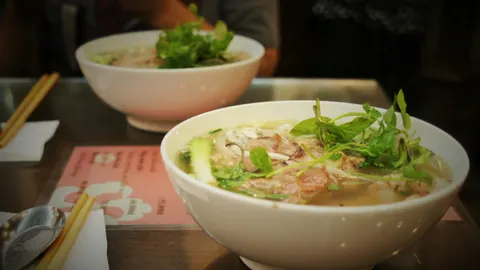
In Saigon and much of the South, pho usually comes with Thai basil (hung que), culantro (ngo gai), mint and bean sprouts on the side. In Hanoi the extras are sparse: the herbs that matter, such as spring onion and coriander, are already in the bowl.
Can I use ordinary coriander instead of rau ram?
Not really: cookery writer Andrea Nguyen insists coriander cannot replace rau ram (Vietnamese coriander). Rau ram is spicier and more peppery, and that bite is the point with fertilised duck egg (hot vit lon) and chicken salad.
How much does it cost to visit Tra Que herb village?
Da Nang's tourism portal (June 2026) lists entry to Tra Que village near Hoi An at about 35,000 dong per person, open 8 a.m. to 6 p.m. daily. A farming tour costs about 200,000 to 500,000 dong and a cooking class about 300,000 to 400,000 dong, depending on the programme.
Is fish mint really fishy?
Fish mint (diep ca) is sour and pungent, and Vietnam Coracle says it is nowhere near as fishy as most people expect. It divides opinion: it is a standard herb with banh xeo in the South, while many Hanoians have long avoided it.
When is the best time to visit Tra Que village?
Go early in the morning or late in the afternoon, when it is cooler and farmers are working the beds, as Da Nang's tourism portal suggests; Vietnam's national tourism board names February to April and September to December as the best months. Tra Que's Cau Bong festival falls on the 7th day of the first lunar month and was held on 23 February in 2026.
Key sources
- Rau thơm · VnExpress (Tô Hoài), 21 March 2002
- Trà Quế Hội An nhận giải Làng du lịch tốt nhất năm 2024 · Tuổi Trẻ, 15 November 2024
- Làng rau Trà Quế · Đà Nẵng Fantasticity (Đà Nẵng Department of Tourism), 16 June 2026
- Who invented Vietnamese pho? · MICHELIN Guide
- Herbal enhancement · Tuổi Trẻ News (John Russack), 6 June 2012
- Savor crispy bánh xèo with wild greens atop Cấm mountain · VietNamNet, 19 March 2025
- Persicaria odorata (rau răm), PROSEA Handbook 13: Spices · PROSEA – Plant Resources of South-East Asia
- Food and Drink Considerations When Traveling · US Centers for Disease Control and Prevention (CDC)
All 38 sources and further reading
- Hơn 400 năm người Trà Quế giữ đất lành trồng rau sạch · Tiền Phong, 27 September 2026
- Bắp chuối làm ngon tiệc Huế · VnExpress, 21 May 2003
- Thơm mãi vị chả cá Lã Vọng · VnExpress, 5 September 2013
- Đặc sản cao lầu Hội An · VnExpress, 3 March 2012
- Nét đặc sắc trong ẩm thực ba miền · VnExpress, 31 August 2016
- Lễ hội ở làng rau trăm tuổi của Hội An · Tiền Phong, 23 February 2026
- Độc đáo lễ hội cúng thần rau ở Hội An · Tiền Phong, 11 February 2024
- Tra Que Vegetable Village, Hoi An: the ultimate green trip · Vietnam National Authority of Tourism (vietnam.travel)
- Trà Quế village wins as one of the Best Tourism Villages 2024 · Việt Nam News, 15 November 2024
- Inspectors' favourite Bib Gourmand dishes in Vietnam 2024 · MICHELIN Guide, 20 June 2024
- Learning Vietnamese: the alphabet and phonetics · Tuổi Trẻ News, 30 December 2011
- Herbs & spices in Vietnamese food: a guide · Vietnam Coracle (Thảo Phan), August 2022
- Mega Vietnamese herb primer · Viet World Kitchen (Andrea Nguyen)
- Mekong Delta locals turn wild vegetable into delicious summer dishes · VietNamNet, 15 May 2026
- 'Wild' vegetables turn gourmet specials · Sài Gòn Giải Phóng (SGGP), 17 February 2010
- Hội An Market · Đà Nẵng Fantasticity (Đà Nẵng Department of Tourism), 13 July 2026
- Nghề trồng rau Trà Quế Hội An · Đà Nẵng Fantasticity (Đà Nẵng Department of Tourism), 11 August 2025
- Ba Hoa Market: Where Quang Nam lives on in HCMC · Tuổi Trẻ News / The Saigon Times, 16 February 2026
- How to Eat Pho Like a Local, According to Vietnamese Chefs · MICHELIN Guide, 30 April 2026
- Coriandrum sativum (rau mùi), PROSEA Handbook 13: Spices · PROSEA – Plant Resources of South-East Asia
- Perilla frutescens (tía tô), PROSEA Handbook 13: Spices · PROSEA – Plant Resources of South-East Asia
- Ocimum basilicum (sweet basil), PROSEA Handbook 13: Spices · PROSEA – Plant Resources of South-East Asia
- Eryngium foetidum (ngò gai, mùi tàu), PROSEA Handbook 13: Spices · PROSEA – Plant Resources of South-East Asia
- Houttuynia cordata (diếp cá), PROSEA Handbook 8: Vegetables · PROSEA – Plant Resources of South-East Asia
- Limnophila aromatica (rau ngổ), PROSEA Handbook 12(2): Medicinal and poisonous plants · PROSEA – Plant Resources of South-East Asia
- Anethum graveolens (thì là), PROSEA Handbook 13: Spices · PROSEA – Plant Resources of South-East Asia
- Mentha arvensis (bạc hà), PROSEA Handbook 12(1): Medicinal and poisonous plants · PROSEA – Plant Resources of South-East Asia
- Thành phần hóa học của tinh dầu cây Kinh giới (Elsholtzia ciliata (Thunb.) Hyl.) trồng tại tỉnh Phú Thọ · Tạp chí Khoa học và Công nghệ, Trường Đại học Hùng Vương, 2022
- Có phải ngâm rau càng lâu, rau càng sạch? · Tuổi Trẻ, 28 August 2025
- Láng · Wikipedia (background)
Keep exploring
 North · Central · South · Food Hanoi vs Saigon Pho (Phở): Differences and How to Order Hanoi vs Saigon pho: a clear, spare Northern broth or a sweeter Southern bowl with herbs and sauces, plus Central styles, 2026 prices and MICHELIN picks.
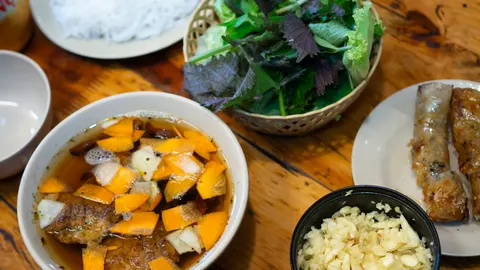 North Vietnam · Food Bun Cha (Bún Chả) in Hanoi: How to Eat It, What It Costs What bun cha is, why Hanoi eats it at lunch over charcoal smoke, how to eat it the local way, and how it differs from southern bun thit nuong.
 Central Vietnam · Travel Hoi An (Hội An): How Many Days, What to See, When to Go How many days Hoi An needs, what the 80,000 or 120,000 dong ticket covers, lantern nights, where to eat, beaches, flood months and getting there from Da Nang.
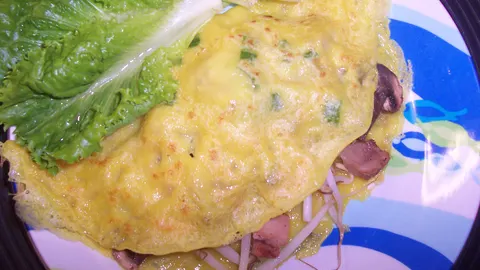 North · Central · South · Food Banh Xeo (Bánh Xèo): South vs Central and What to Order Banh xeo South vs Central: a big folded Saigon pancake or small crisp seafood ones, plus Hue's banh khoai, 2026 prices, what to order and MICHELIN picks.