North Vietnam · Travel
Ban Gioc Waterfall, Cao Bang (Cao Bằng): How to Visit
Ban Gioc Waterfall in Cao Bang: getting there from Hanoi, 2026 tickets, best months for water, border rules, Nguom Ngao cave, Pac Bo and Cao Bang vs Ha Giang.
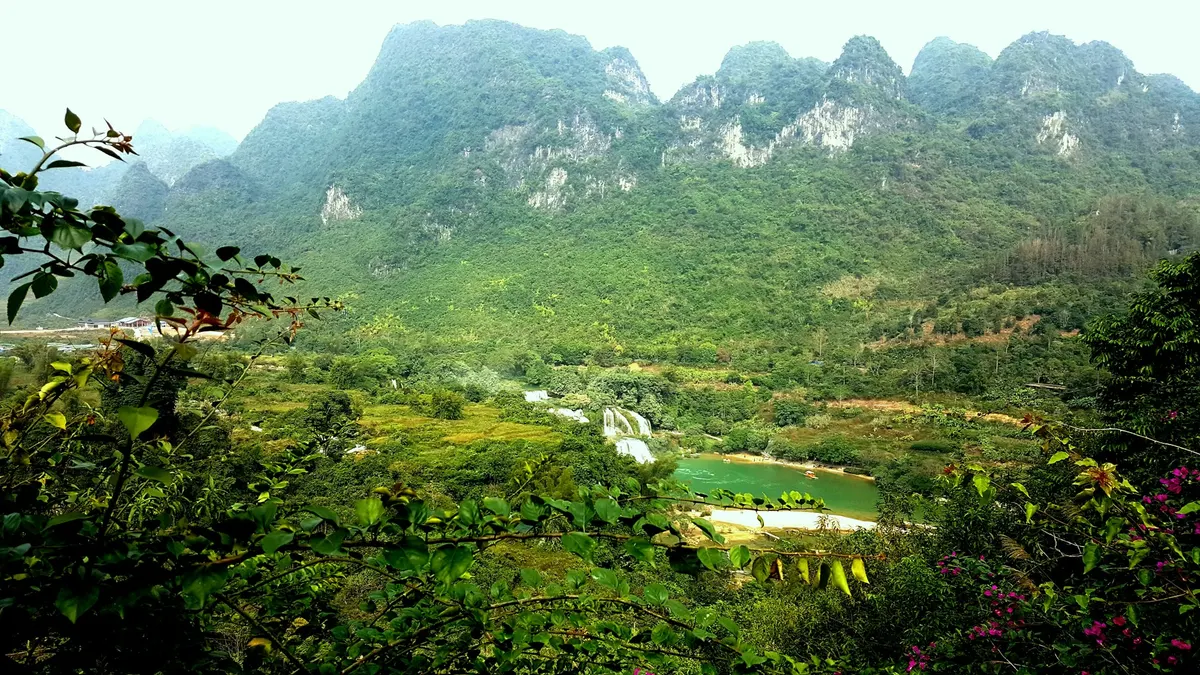
To visit Ban Gioc (Bản Giốc) Waterfall, travel about 280 km from Hanoi to Cao Bang (Cao Bằng) city, 6–8 hours by bus, then a further 80–90 km by road to the falls on the Chinese border, and plan at least one night in the province. As of November 2026, the latest published entry fee is 45,000 dong per person (VnExpress’s Cao Bang guide, updated January 2026), with bamboo rafts paid separately, and you should carry your passport because the falls lie in a border area. Go between June and September for the most water, or from October for calmer, clearer pools.
Cao Bang is a mountain province in Vietnam’s far northeast, on the border with China’s Guangxi region, and most people go there for one sight: Ban Gioc Waterfall (thac Ban Gioc (thác Bản Giốc)). The falls are worth the long road, but the province around them is the better reason to stay: green limestone valleys where Tay (Tày) and Nung (Nùng) families farm, caves and lakes inside a UNESCO Global Geopark, and Pac Bo (Pác Bó), the cave where Ho Chi Minh (Hồ Chí Minh) lived after returning to Vietnam in 1941.
Cao Bang is also one of the few names the 2025 reorganisation left alone. When Vietnam cut its provinces from 63 to 34 on 1 July 2025, Cao Bang was one of 11 provinces that were not merged (LuatVietnam), unlike its neighbours Ha Giang (now part of Tuyen Quang) and Bac Kan (now part of Thai Nguyen). Its communes did change, and that matters when you read a map: see the note on names below.
Cao Bang at a glance
| Where | Far northeast Vietnam, on the border with Guangxi, China; province unchanged in the July 2025 merger |
| Main sight | Ban Gioc Waterfall on the Quay Son (Quây Sơn) river, in Dam Thuy (Đàm Thủy) commune (former Trung Khanh (Trùng Khánh) district) |
| Status | Non Nuoc Cao Bang (Non Nước Cao Bằng) UNESCO Global Geopark, recognised in April 2018 and revalidated since |
| Also see | Nguom Ngao (Ngườm Ngao) cave, Thang Hen lakes, Pac Bo relic site, Khuoi Ky (Khuổi Ky) stone-house village |
| People | Tay and Nung are the best-known groups; also Mong (Mông), Dao, Lo Lo (Lô Lô) and San Chi (Sán Chỉ) |
| Waterfall seasons | Fullest about June–September; calmer and clearer about October–May; flow also depends on upstream dams |
| Getting there | About 280 km from Hanoi to Cao Bang city (6–8 hours by bus, depending on the source), then 80–90 km to the falls |
| Tickets | Ban Gioc 45,000 dong and Nguom Ngao 45,000 dong per person (VnExpress, January 2026); rafts extra; Pac Bo free since 4 July 2026 |
Is Cao Bang worth the trip?
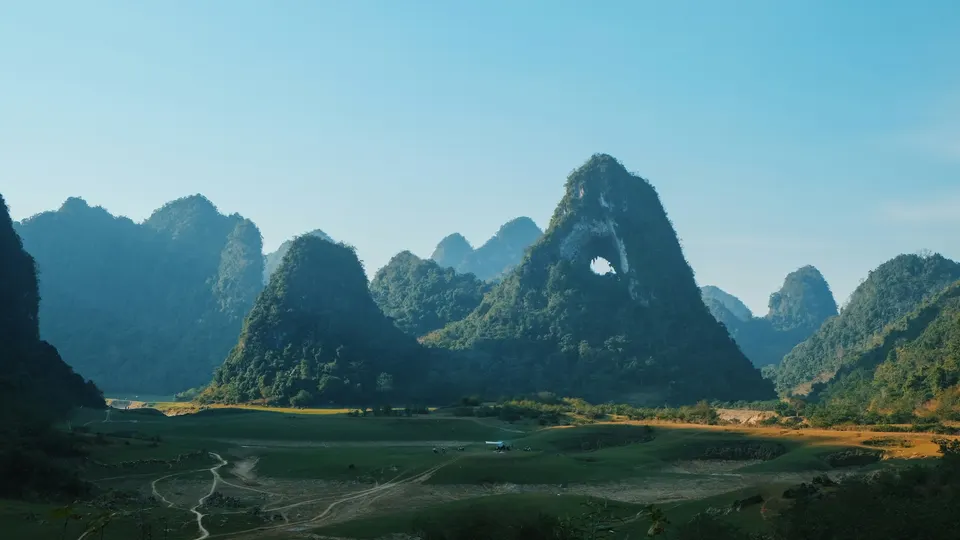
Yes, if you have time and want the northern mountains without the crowds of Sa Pa or the riding culture of the Ha Giang Loop. Cao Bang is a slower trip. The landscapes are karst, as in Ha Giang, but lower and wetter: rice valleys between limestone towers, rivers, waterfalls and caves rather than bare stone plateau and high passes.
It is less suited to a short trip: the falls are about 340 km from Hanoi, so treat the journey as a day in itself (see how to visit, below). A two-day dash to see one waterfall can disappoint, especially if the water is low; a few days that also take in the caves, lakes and villages rarely do.
Ban Gioc Waterfall: how to visit
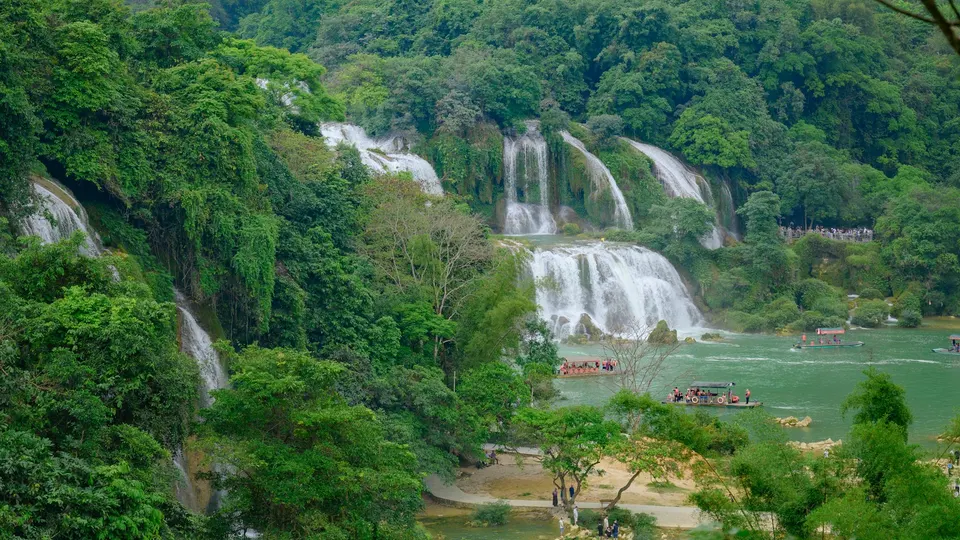
Ban Gioc is not one curtain of water but a series of falls spread across hundreds of metres of limestone. The main fall drops in three tiers, more than 30 m on its longest step, and the whole system is described by Vietnamese press as over 60 m high in total. A large wooded islet splits the main stream, and the Quay Son river feeds it all. Vietnamese and international sources often call it the largest natural waterfall in Southeast Asia and the fourth-largest waterfall on a national border; these are descriptions rather than official rankings, but they give a sense of its breadth.
Most visitors see it in two ways. Bamboo rafts run by local operators take you across the pool to the foot of the falls, and the national tourism site recommends midday, when sun through the spray can make rainbows. For the view from above, walk up to Phat Tich Truc Lam Ban Gioc (Phật Tích Trúc Lâm Bản Giốc) pagoda, about 500 m from the falls. Come early in the day if you can; VnExpress notes that mornings are quieter.
A visit, step by step
- Get to Cao Bang city. It is about 280 km from Hanoi; buses leave from My Dinh station, and VnExpress estimates six to seven hours while the national tourism site says around eight. The falls are a further 80 km or so, according to VnExpress, or 89 km by the national tourism authority’s count, which puts Ban Gioc about 340 km from Hanoi in all. A night in Cao Bang city or near the falls turns the visit from a rush into a day. For buses and road travel in general, see our guide to getting around Vietnam.
- Buy tickets at the site. Entry to the falls is 45,000 dong per person, and so is entry to Nguom Ngao cave, according to VnExpress’s Cao Bang guide as updated in January 2026 (VnExpress). Bamboo rafts to the foot of the falls are paid separately; we found no dated official price for them, so ask at the jetty.
- Time your visit. Come early, and avoid public holidays if you can: over the 2026 holiday from 25 April to 1 May the falls drew more than 26,000 visitors, with crowds building from early morning (Dai bieu Nhan dan). In the dry season, the water is often fuller around the middle of the day (see the next section).
- See it from below and above. Take a raft across the pool, then climb to the pagoda for the view over the whole system. Allow time for Nguom Ngao cave and the stone village of Khuoi Ky nearby (both described below).
- Respect the border. Carry your passport. Vietnam’s land border regulation (Decree 34/2014) requires everyone in a border area to carry the required papers, and foreigners who stay overnight there to register with the commune police, so check that your accommodation has registered your stay. The province’s management rules for the Ban Gioc tourist area, issued on 26 February 2025, forbid using a visit to cross the border illegally, require cross-border visitors to stay in designated places, and allow boats to moor only at designated landings.
Which plan suits you?
| Plan | Time needed | What it involves | Who it suits |
|---|---|---|---|
| Ban Gioc only | Two days from Hanoi, with a night in the province | Bus to Cao Bang city (6–8 hours), 80–90 km by road to the falls; entry 45,000 dong (VnExpress, January 2026) plus a raft | Travellers short on time who accept that the water may be low |
| Ban Gioc, Nguom Ngao and Khuoi Ky | A full day in the falls area | A second 45,000 dong ticket for the cave; Khuoi Ky stone village about 3 km from the falls | Most first-time visitors |
| Add the Chinese bank (Detian) | Same-day return | Pre-booked group visit through a licensed operator; one ticket covers both banks on the Chinese side (China Daily, October 2026) | Travellers who can arrange papers in advance and confirm their nationality is accepted |
| Add Pac Bo and Thang Hen | One or two more days | Pac Bo is 50–55 km north of Cao Bang city and free to enter since 4 July 2026 (VOV) | Travellers interested in history, lakes and karst |
| Combine with Ha Giang | A week or more | Two border geoparks on one trip | Slow travellers and riders |
Common pattern, real exception. Most days the falls are open as normal, but high water can stop visits. In late June 2024, after a week of heavy rain on the Chinese side, the Quay Son flooded the area below the falls and boat trips and sightseeing were halted for several days (SGGP). In the rainy season, check the forecast and keep a spare day.
Names on maps and tickets after July 2025
Older guidebooks place Ban Gioc in “Đàm Thủy commune, Trùng Khánh district”. Under the 2025 commune reorganisation, Dam Thuy was merged with Chi Vien (Chí Viễn) and Phong Chau (Phong Châu) into a larger Dam Thuy commune, and the old Trung Khanh township became Trung Khanh commune. Pac Bo’s commune, Truong Ha (Trường Hà), absorbed the former Xuan Hoa (Xuân Hòa) township and the communes of Quy Quan (Quý Quân) and Soc Ha (Sóc Hà) and kept the name Truong Ha. Thang Hen’s former Quoc Toan (Quốc Toản) commune is now part of Tra Linh (Trà Lĩnh) commune. Cao Bang city itself is now divided into the wards of Thuc Phan (Thục Phán), Nung Tri Cao (Nùng Trí Cao) and Tan Giang (Tân Giang). The new units began work on 1 July 2025, but old district names still appear on signs, tickets and maps.
When does Ban Gioc have the most water?
The short answer is the rainy season. From about June to September the Quay Son swells and the separate falls merge into one wide white wall of water; from October to May the flow calms and the water turns clear turquoise (Vietnam National Authority of Tourism).
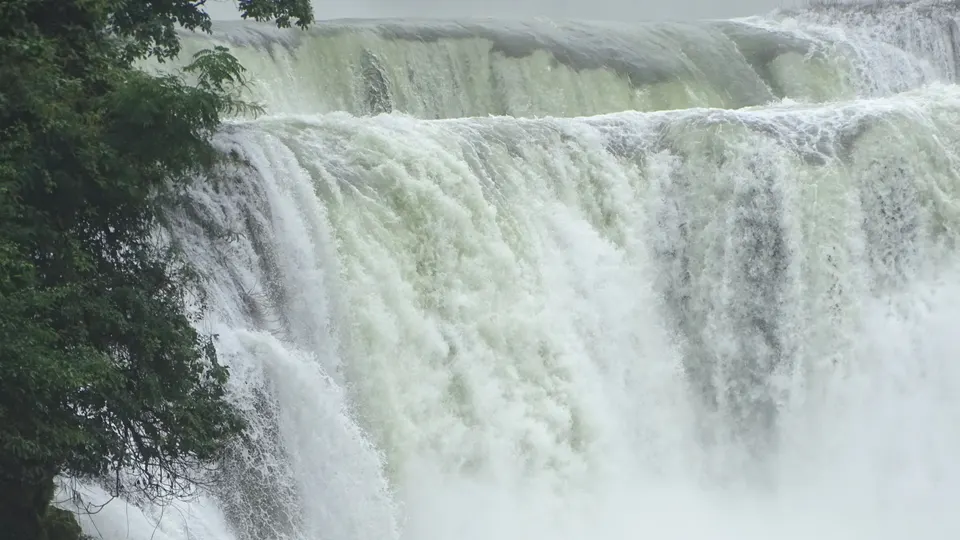
Which of those is “best” depends on what you want, and sources disagree. VnExpress calls August and September the beautiful season for heavy, clear water and ripe rice on some terraces, and suggests October for the falls with golden fields. The national tourism authority’s Cao Bang guide recommends the dry season, October to April, for travel in general, with cold winters from November to February. Summer means the most water but also heat, humidity and wet mountain roads.
Common pattern, real exception. Rain sets the seasons, but people also control the river. Hydropower plants upstream on the Quay Son release water through their gates, and in dry spells the falls can shrink sharply. In spring 2023, after a dry period, the provincial industry department ordered three plants to keep their gates open for longer over a public holiday so that the falls would look full for visitors, according to a VnExpress report. In practice this means two things: low water in the dry season is normal, and the flow can differ from one day, or even one hour, to the next. If the waterfall is the whole point of your trip, go between June and October and keep a spare day.
| Months | What the water does | Good for | Watch out for |
|---|---|---|---|
| June–September | Fullest: the separate falls merge into one wide wall (VNAT); VnExpress singles out August–September | The most water | Heat, humidity and wet roads; floods can halt rafts, as in June 2024 |
| October | Still strong, with the rice harvest around the falls (VnExpress, VNAT) | Water plus golden fields; Trung Khanh chestnuts | Busier weekends |
| November–February | Calmer, clear turquoise pools (VNAT) | Dry travel | Cold nights; lower water on some days |
| March–May | Lowest before the rains; dams release water around the middle of the day (10:30–13:00 by VNAT’s account, 9:30–14:30 in a 2023 report) | Quiet visits | Arrive late morning; holidays are crowded |
For the wider weather picture across the country, see Vietnam weather by month.
A waterfall on the border: Ban Gioc and Detian
The falls lie on the border between Vietnam and China. The Chinese side, in Daxin county of Guangxi, calls them Detian (in Vietnamese Duc Thien (Đức Thiên)), and you will see the combined name Ban Gioc–Detian in official use. Until recently, visitors from each country saw the falls only from their own bank.
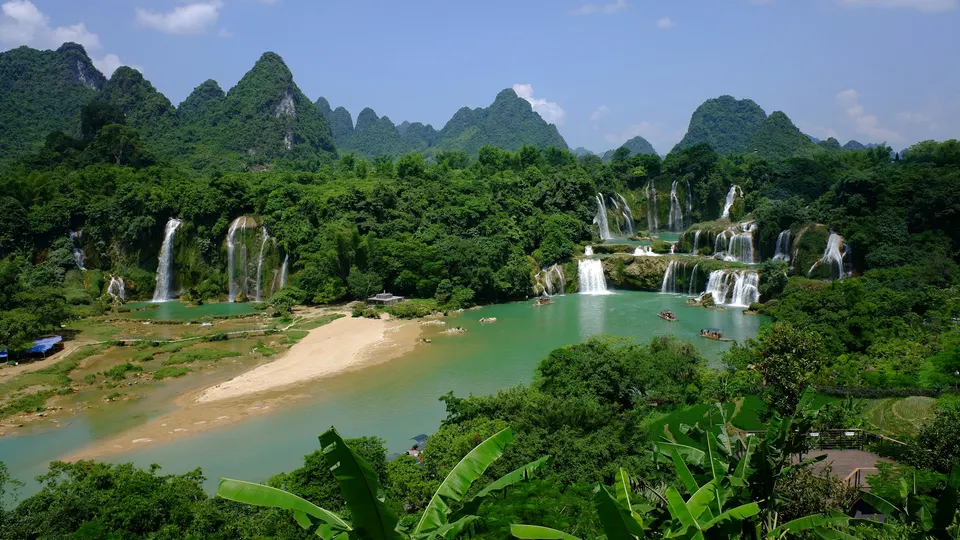
That has changed. In November 2015 the two governments signed an agreement on jointly protecting and using the area’s tourism resources, which took effect in 2016. A shared scenic area opened on a trial basis on 15 September 2023 and officially on 15 October 2024 (Tuoi Tre). It covers 400 hectares, half on each side. At launch, visits were limited to 1,000 people a day in groups of up to 20, combining Ban Gioc and the pagoda on the Vietnamese side with Detian’s viewpoints and a shopping street on the Chinese side. Vietnam (Việt Nam) News, citing the state news agency, describes joint tours with simplified immigration procedures. In December 2025 the two sides agreed to build a border landmark square inside the area, planned for completion in 2026; in late October 2026 China Daily reported the square around the old No. 53 boundary marker still under construction.
How it works now: Nhan Dan reported in August 2025 that visitors cross on a passport, without a visa, or on a border pass, and return the same day; its examples were Vietnamese and Chinese tourists. On the Chinese side, China Daily reported in October 2026 that trips are booked in advance through a platform linked to the immigration service, that one ticket covers sights on both banks, and that the zone had handled nearly 160,000 crossings since the 2023 trial, with a one-day record of 1,272 visitors. None of the reports we found says whether travellers of other nationalities can join.
What this means for you. You can still see Ban Gioc fully from the Vietnamese side without crossing anything. If you want to visit the Chinese bank, book the joint-area tour through a licensed operator in advance and ask whether your nationality is accepted and what documents you need, because procedures are set by both countries and may change. Do not wander towards border markers on your own.
Tradition vs today. Until recently the falls were a frontier that people looked across. Today the same river is a shared tourism project, promoted by both governments as a symbol of cooperation, and the new facilities are part of that story.
Nguom Ngao cave and the Thang Hen lakes
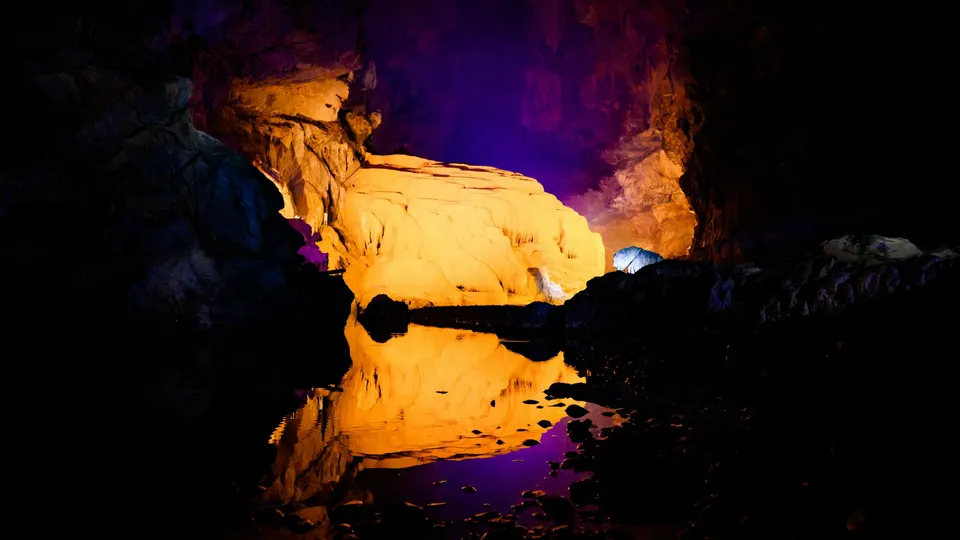
Two other sights explain what the geopark is about. Nguom Ngao near Ban Gioc means “tiger cave” in the Tay language. It is a limestone system of more than 2 km, of which a little under 1 km is lit and open to visitors; you go in at one mouth, Nguom Lom (Ngườm Lồm), and come out at another (Vietnam National Authority of Tourism). Bring water: the walk through can take an hour.
Thang Hen (ho (hồ) Thang Hen), at about 1,000 m in the former Tra Linh district, is a chain of 36 small lakes linked by caves and underground channels. In the rainy season the water rises and the lakes join up between the karst peaks; in the dry season they separate again. It is the clearest example on the trip of how water moves through limestone: much of it underground, out of sight. Nearby, a karst peak with a cave running right through it is known as the Mountain’s Eye (Mat Than Nui (Mắt Thần Núi)); the national tourism site recommends a local guide to reach it.
Near Ban Gioc you can also visit Khuoi Ky, a small Tay village of stone stilt houses about 3 km from the falls, a reminder that the people here have long built with the rock around them.
Non Nuoc Cao Bang: why it is a UNESCO Global Geopark
Most of what you visit lies inside the Non Nuoc Cao Bang UNESCO Global Geopark, recognised in April 2018 as Vietnam’s second, after the Dong Van (Đồng Văn) Karst Plateau in Ha Giang. It covers more than 3,600 km² across dozens of communes and records over 500 million years of the Earth’s history in more than 130 geological heritage sites: karst towers, caves, valleys, rivers and lakes (Vietnam News). UNESCO reviewed it in 2022 and again in 2025, and it kept the title: the renewed certificate was presented in Paris in April 2026.
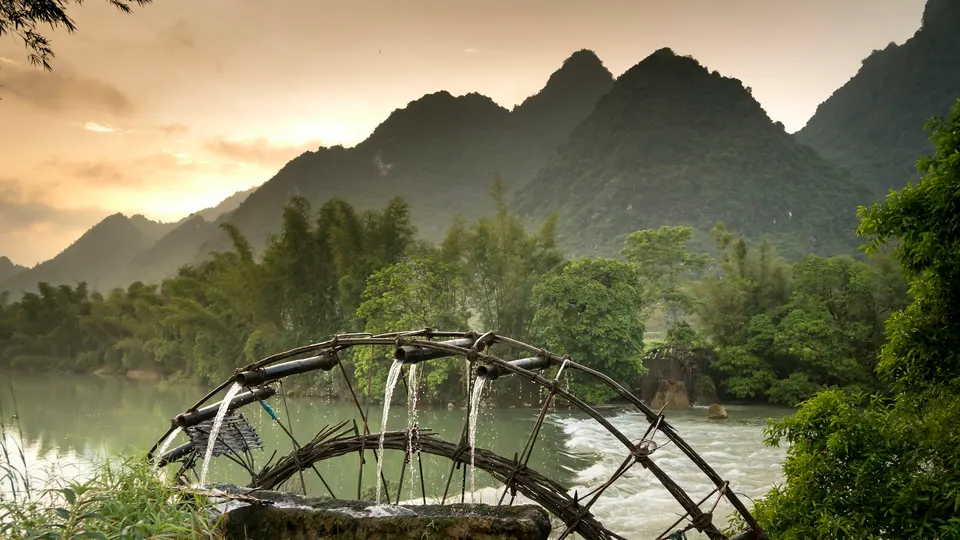
As in Ha Giang, a geopark is not a fenced reserve. It is a lived-in, farmed landscape where geology, history and culture are protected together. More than 95% of the people living in Cao Bang’s geopark belong to ethnic minority groups, and the area also includes over 200 ranked historical relics. A route linking it with the Dong Van geopark is being developed.
Pac Bo: where Ho Chi Minh came home
Pac Bo, in Truong Ha commune about 50–55 km north of Cao Bang city, is the province’s most important site for Vietnamese visitors. Ho Chi Minh crossed back into Vietnam here in 1941, after about thirty years abroad, and lived in Coc Bo (Cốc Bó) cave on what is now called Karl Marx mountain. The stream below, whose Tay name meant “heaven spring”, he renamed Lenin stream (VOV5). About a kilometre from the cave he presided over a conference of the Indochinese Communist Party in May 1941, whose decisions fed into the August Revolution of 1945. Pac Bo was declared a special national relic site in 2012, and since 4 July 2026 entry has been free for all Vietnamese and international visitors (VOV).
What this means for you. For many Vietnamese families and school groups this is a pilgrimage, not a sightseeing stop. Dress modestly, keep your voice down at the cave and the temple, and allow several hours: VnExpress suggests about four to see the site properly.
Tay, Nung and Then: the culture of the valleys
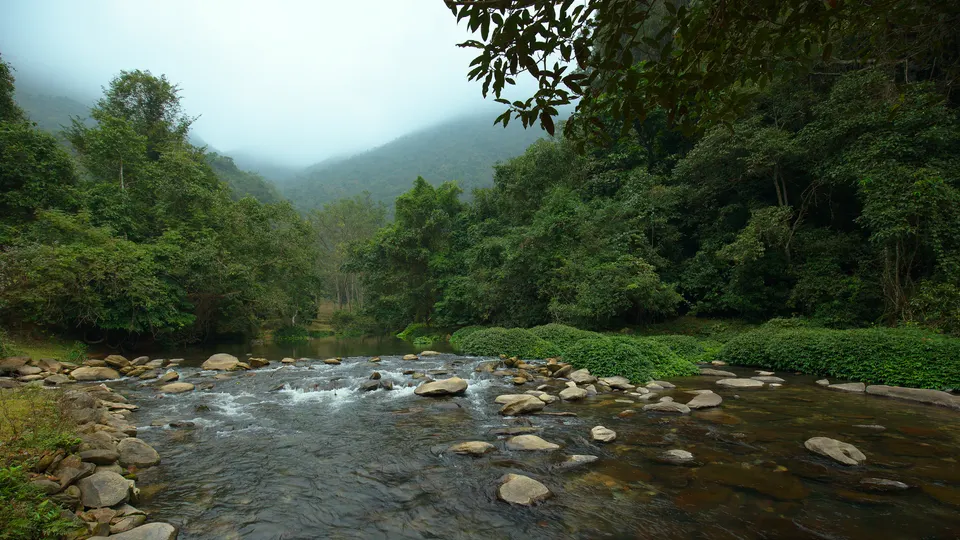
The Tay and Nung are Cao Bang’s best-known peoples, alongside Mong, Dao, Lo Lo, San Chi and others; the province counts more than nine groups. Festivals include the Tay Long Tong (Lồng Tồng), the Mong Gau Tao (Gầu Tào) and the Dao cap sac (cấp sắc) initiation ceremony.
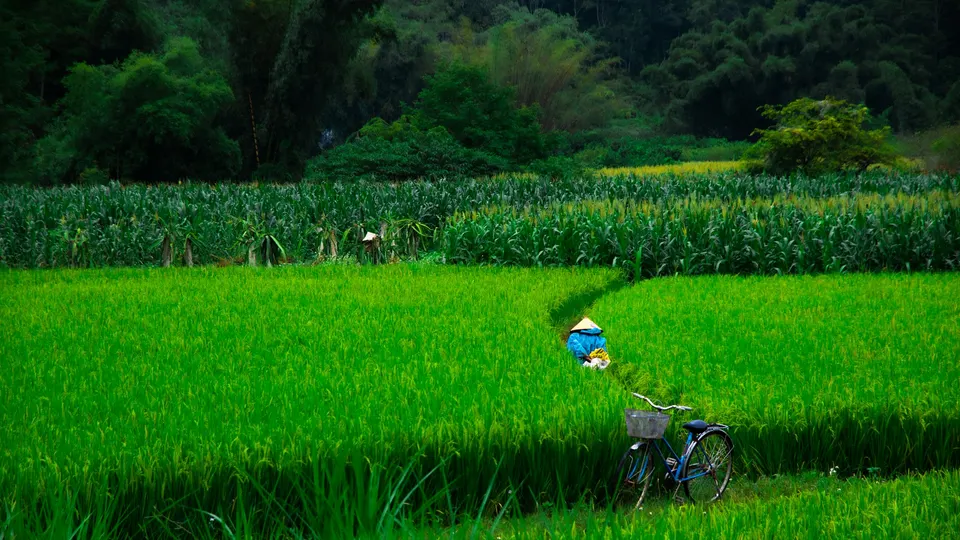
The tradition to recognise is Then, a ritual practice of the Tay, Nung and Thai (Thái). In a Then ceremony a master, who may be a man or a woman, sings and plucks the dan tinh (đàn tính), a gourd lute, with rattle-bells and other ritual objects, and the songs describe a journey to the heavens to carry offerings and prayers for peace, healing, good harvests or a happy new year. UNESCO added the practice to its Representative List of intangible heritage in 2019 (UNESCO).
Tradition vs today. Then was traditionally a ritual held in homes and at a master’s altar, not a performance. Rituals still take place where Tay, Nung and Thai people live, but Then singing is now also taught in community classes, and some masters teach it online to learners far from the mountains. A song performed for guests is not the same thing as a ritual held for a family: if you are invited to a ceremony, treat it as a religious occasion and ask before filming. The Thai share of the tradition is the one you meet in Mai Chau, so the same lute links valleys hundreds of kilometres apart.
What to eat in Cao Bang
Cao Bang’s food is hearty mountain cooking with a strong Tay and Nung accent. Look for:
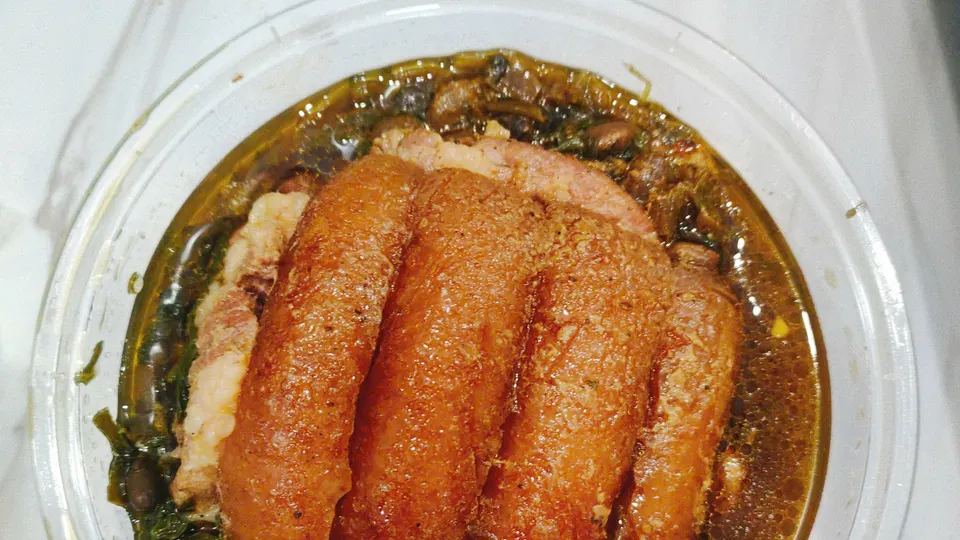
- Pho (Phở) chua (sour pho): rice noodles topped with fried pork belly, roast duck and fried sweet potato, a long way from the pho of Hanoi and the South.
- Banh cuon (Bánh cuốn): steamed rice rolls, found all over Cao Bang city.
- Roast duck and khau nhuc (khâu nhục): Cao Bang roast duck, and khau nhuc, steamed pork belly.
- Trung Khanh chestnuts (hạt dẻ Trùng Khánh): from the district around Ban Gioc, in season around October–November, according to VnExpress.
From about November to February, also look for banh ap chao (bánh áp chao), a winter snack.
Cao Bang or Ha Giang, and how to fit it in
The two border provinces are often compared because they share a lot: limestone geoparks, the Chinese border, and Tay, Nung and other groups. The difference is in the experience. Ha Giang (since July 2025 part of Tuyen Quang province) is high, bare and dramatic, built around a riding loop and Hmong plateau villages. Cao Bang is lower and greener, built around water, caves and valley farming. If you have a week or more, the two can be combined (October, when VnExpress suggests seeing the falls with golden fields, is also one of the best months for the Ha Giang Loop), and the planned geopark route between them may make that easier.
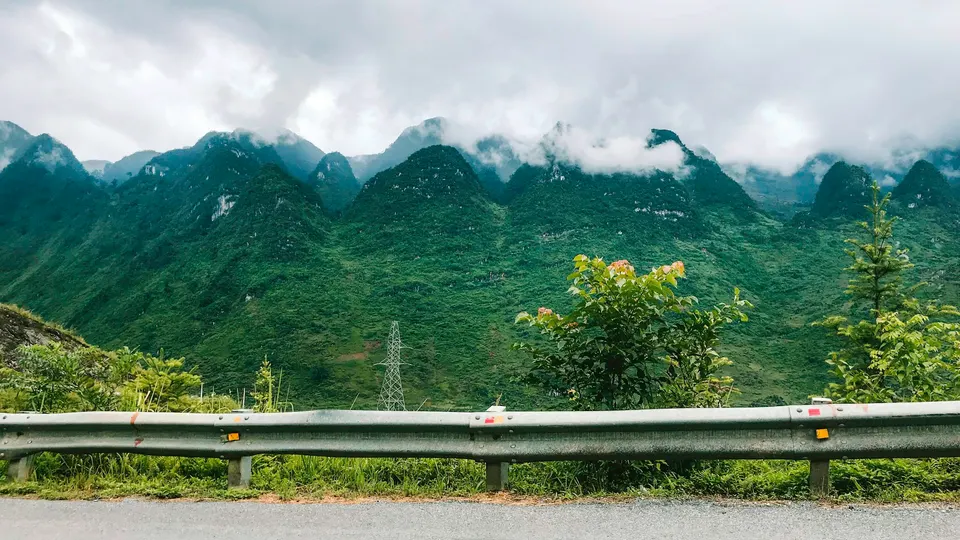
Most travellers reach Cao Bang by bus or car from Hanoi, and buses leave from Hanoi’s My Dinh (Mỹ Đình) station. For the wider picture of the region’s seasons, food and the post-2025 map, start at our North Vietnam hub, and see our Vietnam travel section for planning across the regions.
Frequently asked questions
Do I need my passport to visit Ban Gioc Waterfall?
Yes. Ban Gioc Waterfall is in a land border area, where Vietnam's Decree 34/2014 requires visitors to carry their papers and foreigners staying overnight to be registered with the commune police, so carry your passport and check that your hotel or homestay has registered you.
Can foreigners cross into China at Ban Gioc Waterfall?
Not on their own. The joint Ban Gioc–Detian scenic area runs pre-booked group visits; Nhan Dan (August 2025) describes Vietnamese and Chinese visitors crossing on a passport without a visa and returning the same day, and China Daily (October 2026) reports advance booking linked to the Chinese immigration service, but none of these reports says whether other nationalities can join, so ask a licensed operator before you plan on it.
Is Pac Bo free to visit?
Yes. According to VOV, Cao Bang province stopped charging entry at the Pac Bo special national relic site, and at the Tran Hung Dao Forest relic site, for all Vietnamese and international visitors from 4 July 2026.
Which month should I visit Ban Gioc Waterfall?
Go between June and September for the most water, when the separate falls merge into one wide wall, or in October for strong water with the rice harvest around the falls. From November to May the pools are calmer and clearer, but upstream hydropower dams set the flow, so low water is common in the dry season.
Should I go to Cao Bang or Ha Giang?
Choose Ha Giang for high passes, a riding loop and Hmong plateau villages; choose Cao Bang for a lower, greener trip built around Ban Gioc Waterfall, Nguom Ngao cave, the Thang Hen lakes and Tay–Nung valleys. Both are UNESCO Global Geoparks on the Chinese border, and with a week or more you can combine them.
Key sources
- Resolution 202/2025/QH15 on the reorganization of provincial-level administrative divisions · LuatVietnam (text of the National Assembly resolution)
- Ban Gioc Waterfall: Majestic beauty on the Northern border · Vietnam National Authority of Tourism (vietnam.travel)
- Discovering Cao Bang: 7 must-do experiences · Vietnam National Authority of Tourism (vietnam.travel)
- Vietnam, China officially open Ban Gioc - Detian Waterfalls · Tuổi Trẻ News, 15 October 2024
- Cẩm nang du lịch Cao Bằng (Cao Bằng travel handbook) · VnExpress, 2022, updated January 2026
- Efforts made to preserve, promote values of Non Nước Cao Bằng Global Geopark · Việt Nam News, 5 June 2026
- Pac Bo – a special national relic site in Cao Bang · VOV5 (Voice of Vietnam)
- Practices of Then by Tày, Nùng and Thái ethnic groups in Viet Nam · UNESCO Intangible Cultural Heritage
All 27 sources and further reading
- Cao Bằng hợp tác du lịch xuyên biên giới (Cao Bằng's cross-border tourism cooperation) · Nhân Dân, 1 August 2025
- China-Vietnam Detian-Ban Gioc Waterfall cross-border tourism cooperation zone · China Daily Hong Kong (Ren Qi), 29 October 2026
- Nghị định 34/2014/NĐ-CP về Quy chế khu vực biên giới đất liền (Decree on the land border area regulation) · Thư Viện Pháp Luật (text of the Government decree, 29 April 2014)
- Quyết định 248/QĐ-UBND năm 2025 về Quy chế quản lý Khu du lịch thác Bản Giốc (management rules for the Bản Giốc tourist area) · Hệ thống Pháp luật (text of the Cao Bằng People's Committee decision, 26 February 2025)
- Heavy rains, flooding temporarily close Ban Gioc Waterfall to tourists · Sài Gòn Giải Phóng (English), 27 June 2024
- Cao Bằng: Lượng khách du lịch tăng cao trong dịp nghỉ lễ 30/4 và 1/5/2026 · Đại biểu Nhân dân, 3 May 2026
- Cao Bằng miễn phí tham quan các khu di tích quốc gia đặc biệt từ ngày 4/7 · VOV, 3 July 2026
- Ban Gioc Waterfall · Vietnam National Authority of Tourism (vietnamtourism.vn)
- Nghị quyết 1657/NQ-UBTVQH15 về việc sắp xếp các đơn vị hành chính cấp xã của tỉnh Cao Bằng năm 2025 (Resolution on Cao Bằng's commune-level units) · LuatVietnam (text of the National Assembly Standing Committee resolution), 16 June 2025
- Bản Giốc–Detian Waterfalls site: a symbol of Việt Nam – China friendship · Việt Nam News (VNA), 8 September 2025
- Pilot opening of Ban Gioc-Detian waterfalls site slated for October · Vietnam News Agency, 19 April 2023
- Ban Gioc-Detian Waterfalls border landmark square to take shape in 2026 · VOV, 12 December 2025
- Sắp có quảng trường mốc giới thác Bản Giốc (Border landmark square planned at Bản Giốc) · Báo Lào Cai, 12 December 2025
- Water returns to Ban Gioc Waterfall in time for holiday · Bắc Ninh Newspaper (from VnExpress), 2 May 2023
- Non Nước Cao Bằng UNESCO Global Geopark prepares for re-evaluation · Việt Nam News, 2 June 2025
- Vietnamese park recognized as UNESCO Global Geopark · Tuổi Trẻ News, 5 May 2018
- Cao Bang UNESCO Global Geopark · Nature and Biodiversity Conservation Agency (Ministry of Agriculture and Environment)
- Pac Bo becomes national special relic site · Tuổi Trẻ News, 9 October 2012
- Preserving UNESCO-recognised Then singing in Vietnam · VOV, 25 September 2022
Keep exploring
 North Vietnam · Travel Ha Giang (Hà Giang) Loop: What to See and How to Ride Safely What to see on the Ha Giang Loop, from Ma Pi Leng and Lung Cu to Dong Van's old quarter, and how to ride it safely under the 2026 tour and licence rules.
 North Vietnam · Travel Hanoi: How Many Days, What to See and When to Go Hanoi travel guide for 2026: how many days and where to stay, Noi Bai airport, walking-street hours, the new low-emission zone, Train Street and where to eat.
 North Vietnam · Travel Mai Chau (Mai Châu) from Hanoi: Bus, Homestay, 2-Day Plan Mai Chau from Hanoi: getting there by bus, car or motorbike, what a Ban Lac stilt-house homestay costs, a one- or two-day plan and when the rice turns gold.