North Vietnam · Travel
Ninh Binh (Ninh Bình): How Many Days, Boats and Tickets
Ninh Binh: how many days you need, Trang An or Tam Coc boats, 2026 ticket prices, when the rice turns gold, the Hoa Lu capital, what to eat and a 2-day plan.

For most travellers one night in Ninh Binh is the sweet spot: a day trip from Hanoi covers one boat trip and the Hoa Lu temples, while a night in Tam Coc village adds Bich Dong, Bai Dinh and the Mua Cave climb. Budget about 300,000 dong for an adult on the Trang An boats, the price the site’s management board set in July 2026 according to CafeF, against 250,000 dong for Tam Coc on the province’s latest official list from March 2025. Expect company: the provincial statistics office counted nearly 20 million visitor arrivals in the first eight months of 2026, VOV reported in August 2026.
Ninh Binh (Ninh Bình), at the southern edge of the Red River Delta in North Vietnam, is where the flat rice plain suddenly breaks into hundreds of steep limestone towers, with rivers running between them and straight through them in caves. Most visitors come for a rowing-boat trip through that scenery. The more interesting reason to come is that this is where the Vietnamese state first had a capital of its own. In the 10th century the kings of Dai Co Viet (Đại Cồ Việt) ruled from Hoa Lu (Hoa Lư), a citadel tucked among these towers, before the court left for the open plain at Thang Long (Thăng Long), today’s Hanoi.
Read the landscape and the history together and Ninh Binh makes sense: a maze of rock and water that was perfect for defence and poor for running a country. This guide explains that story, helps you choose honestly between Trang An (Tràng An) and Tam Coc (Tam Cốc), and separates the old sacred sites from the new mega-pagoda that now draws the biggest crowds.
Ninh Binh at a glance
| Region | North Vietnam, southern edge of the Red River Delta; Ninh Binh province, which since 1 July 2025 also includes the former Ha Nam (Hà Nam) and Nam Dinh (Nam Định) provinces |
| Known for | Tower-karst scenery, rowing-boat trips at Trang An and Tam Coc, the ancient capital Hoa Lu, Bai Dinh (Bái Đính) pagoda |
| UNESCO | Trang An Landscape Complex, inscribed 2014; Vietnam’s first mixed natural and cultural World Heritage site; 6,226 ha plus a 6,026 ha buffer zone |
| History | Hoa Lu, capital of Dai Co Viet 968–1009 under the Dinh (Đinh) and early Le (Lê) dynasties |
| How long | A day trip is possible; one or two nights for Trang An, Tam Coc, Hoa Lu and Bai Dinh |
| Where to stay | Tam Coc village for most first-timers; near Trang An and Hoa Lu for an early boat; Ninh Binh city only for a late train |
| Boat tickets | Tam Coc 250,000 dong (2025 list); Trang An 300,000 dong adult (reported July 2026) |
| Best time | Late May–early June for golden rice at Tam Coc; January–March for spring festivals; avoid Tet (Tết) crowds |
| Getting there | About 90–100 km from Hanoi; roughly 1.5–2 hours by road |
| Eat | Mountain goat (de nui), crispy rice crust (com chay) |
A landscape that was once a sea
The heart of the province is the Trang An Landscape Complex (Quần thể danh thắng Tràng An). UNESCO describes it as a humid tropical tower-karst landscape “in the final stages” of its geological evolution: towers, cones and enclosed hollows linked by underground waterways, some of them navigable by small boats (UNESCO). After the last ice age the sea repeatedly flooded the area; erosion notches in the cliffs, wave-cut platforms and layers of marine shells record it, and at times the massif was an archipelago. It is now entirely on land.
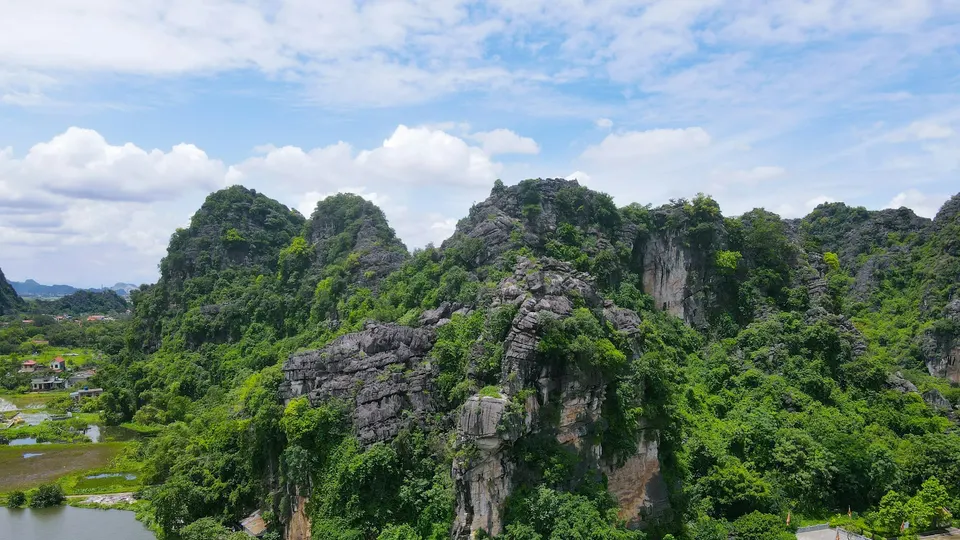
That is the honest answer to the nickname. Vietnamese media call Tam Coc “Ha Long (Hạ Long) Bay on land”, and the comparison is more than a figure of speech: these towers are a drowned karst like Ha Long Bay, only here the sea has retreated and rice paddies have taken its place.
People have lived in the caves for a very long time. UNESCO cites cave deposits showing a continuous sequence of human occupation over more than 30,000 years, as hunter-gatherers adapted to dramatic changes in climate and sea level. The property also contains temples, pagodas, rice fields and small villages, and it lies largely within three protected areas: the Hoa Lu Ancient Capital, the Trang An–Tam Coc–Bich Dong (Bích Động) scenic landscape and the Hoa Lu special-use forest.
The World Heritage Committee inscribed it in June 2014 at its session in Doha, as Vietnam’s first site recognised for both natural and cultural value. UNESCO lists it under three criteria, one cultural (v, for the record of human adaptation) and two natural (vii for beauty, viii for geology), and gives the property as 6,226 hectares inside the Trang An massif, ringed by a 6,026-hectare buffer zone. In April 2026 the government approved a conservation plan for the 9,663-hectare Trang An–Tam Coc–Bich Dong scenic area that promises strict control of visitor numbers and construction and keeps villages from urban expansion, Viet Nam News reported. Vietnamese heritage bodies describe the complex as taking in the Trang An ecotourism area, Tam Coc–Bich Dong, the ancient capital of Hoa Lu and Bai Dinh Pagoda.
Hoa Lu: why the first capital was here, and why the court left
In the 10th century Dinh Bo Linh (Đinh Bộ Lĩnh) reunified the country, took the title King Dinh Tien Hoang (King Đinh Tiên Hoàng) and named it Dai Co Viet. Hoa Lu was its capital for only 41 years, from 968 to 1009: twelve years under the Dinh dynasty, then 29 under the early (or “former”) Le dynasty founded by Le Hoan (Lê Hoàn), King Le Dai Hanh (Vietnam National Authority of Tourism).
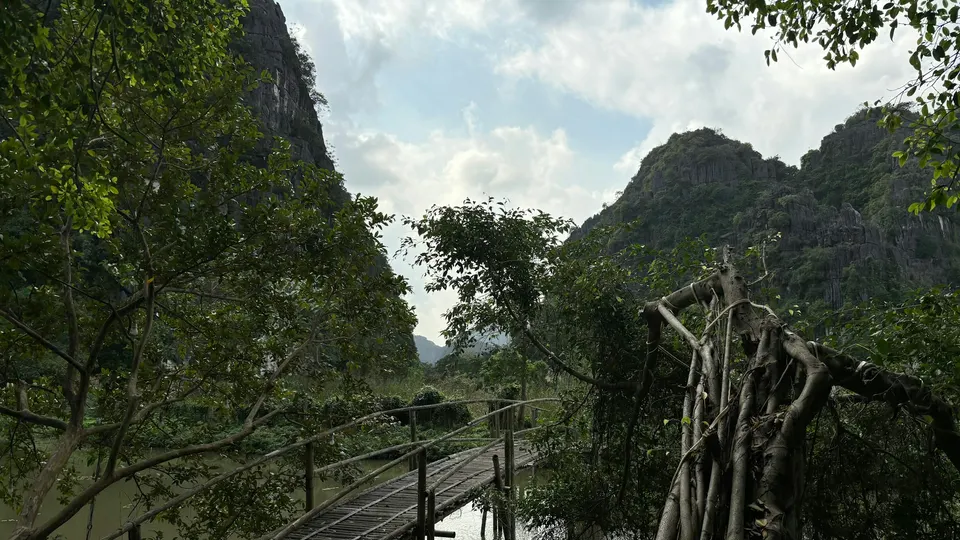
Why here? The national tourism authority describes the Trang An limestone mountains as forming “a natural wall” around the old citadel, with the Hoang Long (Hoàng Long) River and its tributaries supplying waterways. For a young kingdom in a violent century, and facing a Song Chinese invasion in Le Hoan’s time, a capital that enemies could only reach through narrow valleys and rivers made strategic sense. UNESCO puts it simply: Hoa Lu was “strategically established” in this landscape.
Why leave? In 1010 King Ly Thai To (King Lý Thái Tổ), whose dynasty had itself emerged at Hoa Lu, moved the capital to Dai La (Đại La) and renamed it Thang Long. His edict on the move is blunt about the old site: the Dinh and Le had “obstinately” stayed there, their dynasties were “short lived” and the people suffered. Dai La, by contrast, lay in the heartland, at an equal distance from the four directions, protected from floods and “sufficiently vast and level”. Read against Ninh Binh’s towers, the contrast is clear. What made Hoa Lu a good fortress, cramped valleys walled by rock, made it a poor seat for a state that needed space, roads and rice land. The edict is also a political document justifying a new dynasty, so treat its verdict on its predecessors with that in mind.
What survives today are two temples, about 500 metres apart in Truong Yen (Trường Yên): one to King Dinh Tien Hoang and one to the early Le kings, standing on the foundations of the old palaces. The national tourism authority says they were first built in the 11th century after the court left and reconstructed in 1696, so the wooden halls you see are mostly 17th-century and later, not 10th-century. Sources differ on whether the Le temple’s main figure is Le Dai Hanh (Lê Đại Hành) or his son Le Ngoa Trieu (Lê Ngọa Triều). The Hoa Lu festival (also called the Truong Yen festival), honouring the Dinh and Le kings, falls on the 9th to 11th days of the third lunar month: 25–27 April in 2026, according to Bao Van Hoa.
Trang An or Tam Coc: which boat trip?
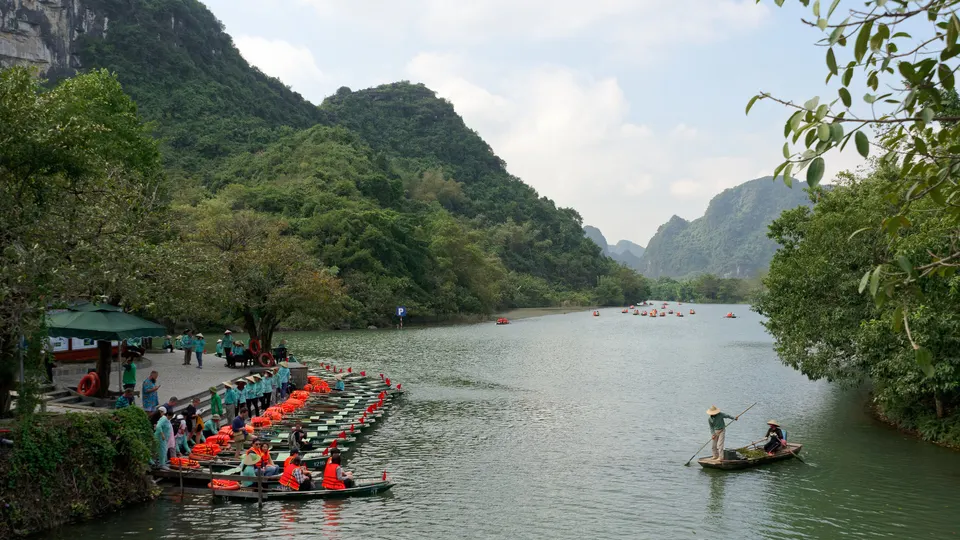
Both are trips in small flat-bottomed boats rowed by local people, and both pass through caves under the karst. The short answer: choose Trang An if you have most of a day and want caves, riverside temples and the protected landscape at the heart of the UNESCO site; choose Tam Coc if you are short on time, visiting in the harvest weeks, or want to stay in the village and combine the boat with cycling, Bich Dong and the climb to the Hang Mua (Múa) viewpoint.

Trang An suits travellers with half a day or more: a choice of set routes of roughly 1.5 to 4 hours past long water caves and riverside temples. Tam Coc is the shorter trip, about two hours on the Ngo Dong (Ngô Đồng) river through rice fields and three caves, at its best in the golden-rice weeks. Our Tam Coc vs Trang An guide compares the routes, seasons, closures and quieter alternatives such as Van Long (Vân Long) in detail.
When is the best time to visit Ninh Binh, and when is the rice gold?
The fields along the Ngo Dong River are what make Tam Coc, and they change through the year. The golden moment is short: VnExpress reported in early June 2023 that the main crop at Tam Coc was “ripe and golden” and that the province’s golden-season tourism week ran until 4 June, “when the rice season ends”. In 2026 the provincial tourism week opened on 23 May, timed, in the words of the province’s deputy chairman, for “the most beautiful time of the year, when the Tam Coc rice fields turn bright gold” (Bao Van Hoa).

The gold is only one of the reasons to pick your month. The national tourism authority describes four distinct seasons, with hot, humid summers and cool, drizzly winters, and recommends April to June, with autumn also cool and clear. Festivals, holiday closures and summer floods matter just as much:
| When | In the fields and the weather | Festivals and crowds | Watch out |
|---|---|---|---|
| December–February | Cool and drizzly; flooded paddies and young rice by February (photo above) | Tet: on 16–17 February 2026 Trang An and Van Long closed and Tam Coc closed for set hours, while Bai Dinh, Hoa Lu and Mua Cave stayed open (VnEconomy) | Check Tet opening days for your year |
| January–April (lunar months 1–3) | Mild; rice growing | Bai Dinh festival opens on the 6th day of the first lunar month (22 February in 2026) and runs to the end of the third (Nhan Dan); Hoa Lu festival on the 9th–11th days of the third month; Trang An festival in the middle of the third month (opened 3 May in 2026) | Big pilgrim crowds at Bai Dinh in the festival weeks |
| Late May–early June | Golden rice at Tam Coc; exact dates shift with each crop | Provincial tourism week (opened 23 May in 2026); harvest weekends are the busiest | Book a bed early; go on a weekday |
| June–August | Hot and humid; Vietnam Airlines’ guide suggests avoiding the heat | Vietnamese summer holidays | Storms and floods: Trang An suspended route 3 from 31 July 2026 when cave water rose (CafeF) and stopped all boats from 23 August 2026 for storm No. 4 (VOV) |
| September–November | Cool and clear; Vietnam Airlines’ guide recommends it for clear air | Outside the festival season and the harvest peak | Storms can still close boat routes; check the day before |
In short: come in late May or early June for the gold, in autumn for clear air, in the first three lunar months for the festivals, and check closures around Tet and in storm season. If you dislike crowds, the national tourism authority also advises avoiding peak holidays such as Tet.
Old sanctuaries and a new mega-pagoda
Ninh Binh shows the gap between tradition and today more sharply than almost anywhere in the North.
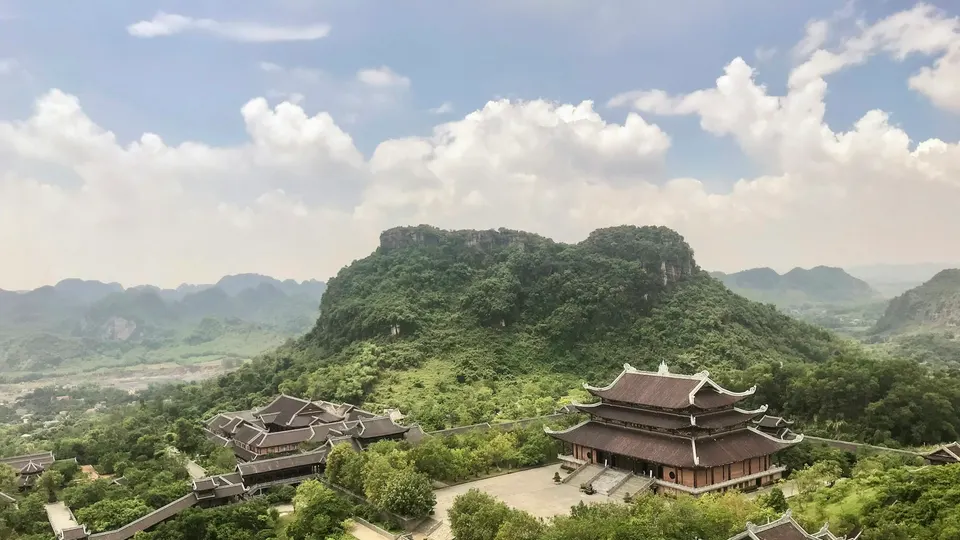
Bich Dong pagoda, near Tam Coc, is the old kind of sacred site: a small complex built into a cliff on three levels, the lower, middle and upper pagodas (chùa Hạ, chùa Trung, chùa Thượng). The national tourism authority says the site was chosen in 1428 by two monks drawn by the view of river and mountains, and that the scholar Nguyen Nghiem (Nguyễn Nghiễm) named the grotto Bich Dong in 1773, which it translates as “Green Pearl Grotto” (Vietnam National Authority of Tourism).
Bai Dinh is the new kind. Next to a much older pagoda set in small mountainside caves, a new complex was built from 2003 to mark Thang Long’s thousandth anniversary in 2010. The tourism authority calls it the largest pagoda complex in Vietnam and lists its records: a 36-tonne bronze bell, about 500 stone arhat statues along a corridor of roughly a kilometre, and a 100-tonne bronze Shakyamuni Buddha. Figures for the total area differ between sources, so treat any single number with caution. UNESCO notes that the “recently reconstructed” Bai Dinh complex sits in the buffer zone of the World Heritage property rather than within it.
A third kind stands in Kim Son in the south of the province: Phat Diem (Phát Diệm) Cathedral, a Catholic complex of stone and lim hardwood built between 1875 and 1899 that gives a Gothic church the roofs of a Vietnamese temple, according to Vietnam Airlines’ travel guide. It is busiest at Christmas, when our Christmas and New Year in Vietnam guide suggests it as a day out.
Neither kind is more “authentic” than the other. Bai Dinh is a working Buddhist site, busiest in the festive weeks around Tet like most of Ninh Binh, and it says a lot about how faith, tourism and national pride mix in Vietnam today. But if you want to understand why Ninh Binh mattered for a thousand years, the Hoa Lu temples, Bich Dong and the old cave pagoda above Bai Dinh tell that story better than the new halls.
What to eat in Ninh Binh: mountain goat and crispy rice
Two dishes come up in almost every Vietnamese account of Ninh Binh food: de nui, mountain goat, and com chay, crispy rice crust. Both are tied to the landscape you came to see.
De nui (mountain goat). Goats range over the limestone hills, and Vietnamese writers credit that for meat that is firm and low in fat. The classic preparation is de tai chanh (dê tái chanh): VnExpress describes the meat steamed with lemongrass until just pink, sliced thin and tossed with lime juice, lime leaves, ginger, chilli and toasted sesame, often wrapped in sung (fig) leaves and eaten with green banana, star fruit and herbs. Vietnam Airlines’ guide also lists it grilled and as a hotpot. Goat restaurants cluster in the Hoa Lu area around Trang An and Truong Yen; VnExpress counted more than a hundred in the old Hoa Lu district alone back in 2012.
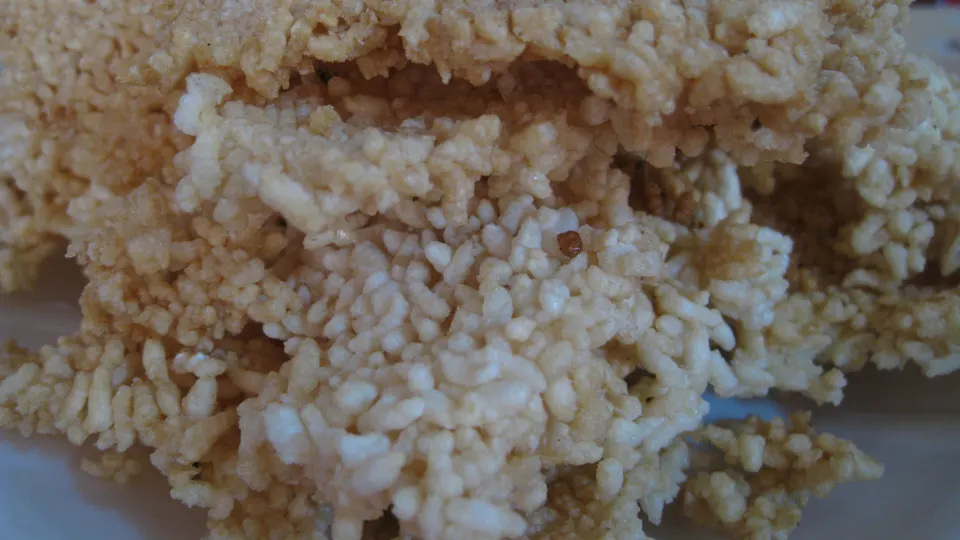
Com chay (crispy rice). This is the crust that forms at the bottom of the rice pot, dried and then deep-fried to order so it arrives hot and crunchy, with a hot sauce poured over or served alongside. VnExpress described the older version, sold to travellers passing through Ninh Binh town, with a sauce of pork heart, liver and kidney thickened with arrowroot starch. Today it is usually paired with goat: a Vietnam (Việt Nam) News review described scorched rice made from Kim Son (Kim Sơn) sticky rice and broken rice, sun-dried for two days before frying, served with a sauce of goat bone broth and goat meat (Vietnam News).
Other local specialities named in Vietnam Airlines’ guide include fish braised in a clay pot with gao (gáo) fruit (ca kho gao) and, in spring, sticky rice with weaver-ant eggs (xoi trung kien). We have not listed individual restaurants: the press coverage we could verify is either old or lacks exact addresses, so it does not meet our standard for a recommendation.
A province redrawn in 2025
Vietnam’s National Assembly cut the country’s provinces from 63 to 34 with Resolution 202/2025/QH15, adopted on 12 June 2025; the new local governments started work on 1 July 2025. Ninh Binh was one of the winners: Ha Nam, Nam Dinh and Ninh Binh were merged into a new province that kept the Ninh Binh name, with a natural area of 3,942.62 km² and a population of 4,412,264 (Resolution 202/2025/QH15).

Bao Dai bieu Nhan dan (Báo Đại biểu Nhân dân), the National Assembly’s newspaper, reported in September 2025 that Hoa Lu has been designated the political and administrative centre of the enlarged province. For travellers the change mostly shows on maps and addresses: Trang An, Tam Coc and Hoa Lu are where they always were, but “Ninh Binh province” now also covers the Nam Dinh area, whose own style of pho (phở) is now part of the province’s food story.
The enlarged province is also drawing more visitors than ever. Ninh Binh welcomed nearly 20 million visitor arrivals in the first eight months of 2026, up 24.13% on a year earlier, including more than 2.2 million international visitors, and earned over 20,611 billion dong from tourism, according to provincial statistics office figures (with August estimated) reported by VOV on 22 August 2026. Most of those visitors head for the same boats and temples, so weekdays and early starts matter more each year.
Where should you stay: Tam Coc, Trang An or Ninh Binh city?
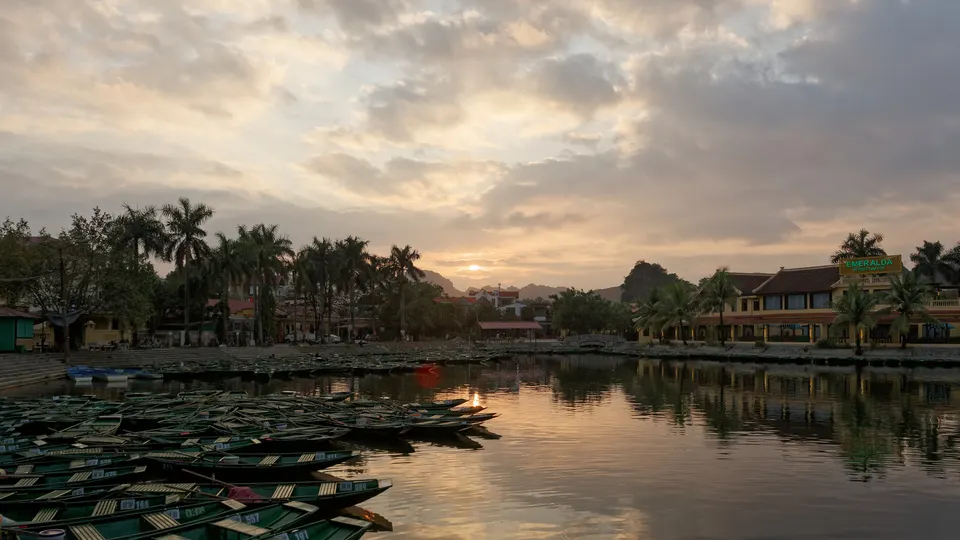
For most first-time visitors the answer is Tam Coc: the Tam Coc boats and Bich Dong are on the doorstep, Trang An is about 20 minutes away by road, and the two-day plan in Vietnam Airlines’ Vietnamese-language guide puts its night in a Tam Coc homestay. Stay near Trang An and Hoa Lu if you want to be on the Trang An boats early, and in Ninh Binh city only if you arrive late by train or bus. Our full guide to where to stay in Ninh Binh compares four bases, including the quiet edges near Hang Mua and Van Long, with getting around from each, how many nights to book and a 2026 festival and harvest calendar.
| Base | Where it is | Best for | Trade-offs |
|---|---|---|---|
| Tam Coc village (Ninh Hai) | About 7 km from Ninh Binh city, at the Tam Coc boat wharf (provincial tourism centre) | First visit; cycling; the Tam Coc boat, Bich Dong and the Mua Cave climb without a car | The busiest area in the harvest weeks; you still need a ride to Trang An, Hoa Lu and Bai Dinh |
| Around Trang An and Hoa Lu | Close to the Trang An wharf and the Hoa Lu temples, about 13 km from the city | An early Trang An boat; Hoa Lu on the same morning; goat restaurants, which cluster in this area | Inside or near the heritage core zone, where the province said in October 2026 that about 128 lodgings did not meet business conditions; book a registered place |
| Ninh Binh city | Train station and coach stops in the centre | Late arrivals; early trains on; a night between transfers | 7–13 km from the main sights; taxi, Grab or a hired motorbike every day |
About that core-zone warning. In a directive of 29 October 2026 the provincial government told the police to review accommodation businesses in the Trang An area, after finding about 128 establishments in the core zone that did not meet the conditions to operate, 93 of them opened after 2016, and promised action on land and building violations, Bao Van Hoa reported on 6 November 2026. That does not mean you cannot stay near Trang An, but it is a good reason to book a place with a business name and a clear address and to keep the confirmation.
How many days? A realistic 1-day and 2-day plan
Ninh Binh works as a day trip from Hanoi, but one night makes it far better, and on a longer trip such as our two-week Vietnam itinerary you can head south by rail from here instead of returning to Hanoi. The national tourism authority calls it “perfect for a weekend stopover”, says Tam Coc’s shorter routes suit travellers with less time, and suggests Trang An if you have more than one day (vietnam.travel).

| Morning | Midday | Afternoon | Evening | |
|---|---|---|---|---|
| 1 day (from Hanoi) | Arrive and go straight to one boat trip: Trang An (the short route takes 1.5–2 hours) or Tam Coc (about 2 hours) | Goat and com chay near Trang An or Truong Yen | Hoa Lu temples, close to the Trang An wharf | Back to Hanoi by van or car |
| 2 days, day 1 | Hoa Lu temples | Lunch in the Hoa Lu area | Tam Coc boat, then Bich Dong, about 2 km away | Night in Tam Coc |
| 2 days, day 2 | Trang An boat (about 3 hours on routes 1–3) or Bai Dinh | Lunch | Bai Dinh or the Hang Mua climb | Train or van onward |
- One day: pick one boat trip, not two. The provincial tourism centre listed four Trang An routes in March 2025, three of about three hours and a short route 4 of 1.5 to 2 hours; Tam Coc’s round trip is about two hours.
- Two days, one night: Vietnam Airlines’ plan is Hoa Lu, the Tam Coc boat and Bich Dong, a night in a Tam Coc homestay, then Bai Dinh and the Mua Cave viewpoint on day two. The table above adds Trang An as the alternative for day two if you prefer caves to the pagoda.
- Three days, two nights: the same guide adds Trang An on the first day and a boat trip on the Van Long wetland on the third; our Van Long guide explains whether it is worth it and how to look for its langurs. The national tourism authority notes Van Long is on the IUCN Green List and quieter than Tam Coc and Trang An.
Getting there from Hanoi. Ninh Binh is about 90–100 km from Hanoi (sources differ: Vietnam Airlines gives about 90 km, the national tourism authority about 100 km). By car or motorbike Vietnam Airlines gives about 1.5–2 hours on National Road 1A or the Hanoi–Ninh Binh expressway, and warns of dense morning fog; buses take about two hours to Ninh Binh city. Our guide to getting from Hanoi to Ninh Binh compares the train, vans, buses and tours with current times, coach stations and the transfer from the station. Ninh Binh also lies on the North–South railway; our guide to getting around Vietnam by train, bus and plane explains when the night train beats a flight for the onward trip south.
What do tickets cost, and what should you check before you go?
Ticket prices are set by the sites and the province and change, so treat these as dated guides. The latest official list we could find is the province’s 2025 list (Ninh Binh Tourism); since then, Trang An’s management board has announced a higher adult price, reported by CafeF on 31 July 2026.
| Site | Adult ticket | Source and date |
|---|---|---|
| Trang An boat | 300,000 dong (children 1–1.3 m: 150,000) | Trang An management board, reported by CafeF, 31 July 2026; 250,000 on the 2025 list |
| Tam Coc–Bich Dong boat | 250,000 dong; 350,000 including the electric car | Provincial list, March 2025 |
| Hoa Lu ancient capital | 20,000 dong | Provincial list, March 2025 |
| Bai Dinh pagoda | 60,000 dong (stupa); 100,000 return electric car; 150,000 combined | Provincial list, March 2025 |
| Mua Cave viewpoint | 100,000 dong | Provincial list, March 2025 |
| Thung Nham bird park | 150,000 dong, boats included | Provincial list, March 2025 |
| Van Long wetland | 100,000 dong | Provincial list, March 2025 |
Before you go
- Check the routes that day: after heavy rain Trang An closes routes or the whole site (31 July and 23 August 2026), and around Tet some sites close for a day or two.
- Time the season: late May to early June for gold at Tam Coc; avoid Tet, harvest weekends and other peak holidays if you dislike crowds.
- Buy at the official ticket desk and check the price there; the figures above are dated and may have changed.
- Dress for temples: shoulders and knees covered at Bai Dinh, Bich Dong and the Dinh and Le temples.
- Read the landscape with the history: see the Hoa Lu temples on the same day as a boat trip, and the reason the kings chose, then left, this place becomes obvious.
Ninh Binh fits naturally into a wider northern trip: start at our North Vietnam hub, compare it with the sea karst of Ha Long Bay or the cave country of Phong Nha in Central Vietnam, or continue into the hills at Mai Chau.
Frequently asked questions
Is it safe to book a homestay inside the Trang An heritage area?
Book with care: in a directive of 29 October 2026 the Ninh Binh provincial government told the police to review lodgings in the Trang An core zone, where about 128 establishments did not meet business conditions, Bao Van Hoa reported on 6 November 2026. Choose a registered hotel or homestay with a business name and full address, or stay in Tam Coc village or Ninh Binh city.
Are the Trang An boats running in the rainy season?
Usually, but not always. Trang An suspended boat route 3 from 31 July 2026 until the water in its caves fell to a safe level, and Ninh Binh stopped all Trang An boats on 23 August 2026 for storm No. 4, so check the routes the day before in June to September.
How busy is Ninh Binh in 2026?
Very busy: Ninh Binh province counted nearly 20 million visitor arrivals in the first eight months of 2026, up about 24% on 2025, VOV reported. Go on a weekday, take an early Trang An or Tam Coc boat, and avoid Tet and the late May to early June harvest weekends if you dislike crowds.
Do I need to cover up to visit Bai Dinh and the Hoa Lu temples?
Yes. Bai Dinh pagoda, Bich Dong pagoda and the Dinh and Le temples at Hoa Lu are working sacred sites, so wear clothes that cover your shoulders and knees.
Was Kong: Skull Island filmed in Ninh Binh?
Yes. Vietnam's national tourism authority says two of the Trang An boat routes pass locations where scenes from Kong: Skull Island were filmed.
Key sources
- Trang An Landscape Complex · UNESCO World Heritage Centre
- Ancient capital offers colourful history lessons of two dynasties · Vietnam National Authority of Tourism
- A guide to the boat tours of Ninh Binh · Vietnam National Authority of Tourism (vietnam.travel)
- Bich Dong Pagoda · Vietnam National Authority of Tourism
- Resolution 202/2025/QH15 on the reorganization of provincial-level administrative divisions · LuatVietnam (text of the National Assembly resolution)
- Khai mạc Tuần Du lịch Ninh Bình 2026 · Báo Văn Hóa, 23 May 2026
- Taste buds tickled by mountain goat · Việt Nam News, 7 June 2020
- Ticket price list for tourist destinations in Ninh Binh 2025 · Ninh Binh Tourism Promotion Information Center, updated 4 March 2025
All 35 sources and further reading
- Marvel at Phat Diem Cathedral – A 130-Year-Old Religious Wonder · Vietnam Airlines travel guide
- Ninh Bình đón gần 20 triệu lượt khách, thu hơn 20.600 tỷ đồng 8 tháng · VOV, 22 August 2026
- Trang An named Vietnam's first UNESCO-recognized mixed heritage · Tuổi Trẻ News, 24 June 2014
- Trang An Landscape Complex – A Dual Heritage of Nature and History in Vietnam · Thăng Long - Hà Nội Heritage Conservation Centre
- Hoa Lu Ancient Capital · Vietnam National Authority of Tourism
- The royal edict on the transfer of the capital of Thăng Long in the year 1010 · Government of Viet Nam (Thăng Long - Hà Nội portal)
- Tam Coc shimmers in silver and gold · VnExpress International
- Tam Coc – Ha Long Bay on land · VOV5 (Voice of Vietnam)
- Bai Dinh Pagoda · Vietnam National Authority of Tourism
- Bái Đính Temple · Wikipedia (see its cited sources)
- Ninh Bình vững bước trong kỷ nguyên mới · Báo Đại biểu Nhân dân, 4 September 2025
- Mùa vàng ở Tam Cốc · VnExpress, 2 June 2023
- Du lịch Ninh Bình (travel guide) · Vietnam Airlines
- Ninh Binh specialties (travel guide) · Vietnam Airlines
- Đặc sản dê tái chanh Ninh Bình · VnExpress, 6 January 2012
- Cơm cháy Ninh Bình · VnExpress, 25 October 2003
- Trang An boat routes · Ninh Binh Tourism Promotion Information Center, updated 28 March 2025
- Tam Coc – Bich Dong · Ninh Binh Tourism Promotion Information Center, updated 8 August 2024
- Ninh Binh (destination page: best time, climate) · Vietnam National Authority of Tourism (vietnam.travel)
- Từ hôm nay, Tràng An tạm dừng tuyến tham quan này: Du khách chú ý · CafeF, 31 July 2026
- Ninh Bình tạm dừng hoạt động loạt điểm du lịch tránh bão số 4 · VOV, 23 August 2026
- Lịch hoạt động các điểm tham quan Ninh Bình trong dịp Tết Nguyên đán 2026 · VnEconomy, 13 February 2026
- Những lễ hội truyền thống đầu năm 2026 ở Ninh Bình · Báo Văn Hóa, 2026
- Khai hội chùa Bái Đính năm 2026: Lan tỏa giá trị “Linh thiêng miền đất cổ” · Nhân Dân, 22 February 2026
- Trang An Festival 2026 opens in Ninh Binh · Quân đội Nhân dân (People's Army Newspaper), May 2026
- Master plan to elevate Trang An–Tam Coc–Bich Dong as a global tourism hub · Việt Nam News, 22 April 2026
- Ninh Bình giao Công an tỉnh rà soát, xử lý vi phạm trong kinh doanh lưu trú tại Di sản Tràng An · Báo Văn Hóa, 6 November 2026
Keep exploring
 North Vietnam · Travel Tam Coc vs Trang An (Tràng An): Which Ninh Binh Boat Trip? Tam Coc or Trang An? Compare Ninh Binh's boat trips by route, caves, crowds, season and time, plus Thung Nham, Van Long and half-day or full-day plans.
 North Vietnam · Travel Hang Mua (Hang Múa): Worth the Climb? Ticket and Best Time Is Hang Mua worth the climb? As of November 2026: about 500 steps, 45 to 60 minutes up, a 150,000 dong ticket since April and the best time of day to go.
 North Vietnam · Travel Hanoi to Ninh Binh (Ninh Bình): Train, Bus or Tour? Hanoi to Ninh Binh in 2026: train, limousine van, bus, Grab or day tour compared, with dated times and fares, the station transfer and a day-trip plan.
 North Vietnam · Travel Hanoi: How Many Days, What to See and When to Go Hanoi travel guide for 2026: how many days and where to stay, Noi Bai airport, walking-street hours, the new low-emission zone, Train Street and where to eat.
 North Vietnam · Travel Ha Long Bay (Hạ Long) or Lan Ha Bay: Which to Choose How Ha Long Bay and Lan Ha Bay differ: what the drowned limestone karst is, UNESCO status since 1994 and 2023, floating villages then and now, and when to go.
 North Vietnam · Travel Mai Chau (Mai Châu) from Hanoi: Bus, Homestay, 2-Day Plan Mai Chau from Hanoi: getting there by bus, car or motorbike, what a Ban Lac stilt-house homestay costs, a one- or two-day plan and when the rice turns gold.