North Vietnam · Travel
Which Day Trip from Hanoi? Ninh Binh vs Ha Long vs Bat Trang
Which day trip from Hanoi? Ninh Binh, Ha Long Bay, Bat Trang, Duong Lam and the Perfume Pagoda compared by road time, effort and season, as of November 2026.

For one day out of Hanoi, pick Ninh Binh: it is about 90–100 km away, roughly 1.5–2 hours by road, and one boat trip plus the old capital at Hoa Lu fits comfortably. Ha Long Bay is better with a night, because the road alone can take 2.5–3.5 hours each way; Bat Trang suits a half day and Duong Lam a slow one. As of November 2026 the Perfume Pagoda is out of festival season (the 2026 festival ran from 18 February to 11 May), so it is quiet until the next spring pilgrimage.
Hanoi sits in the middle of the Red River Delta, and within two or three hours of the Old Quarter you can be rowed through limestone caves, shape a bowl in a pottery village, walk lanes of thousand-year-old house walls or join a spring pilgrimage to a cave pagoda. The catch is that these trips are not equal. Some fit easily into a day, some barely fit, and one, the famous one, is better with a night.
This page helps you choose. The table compares the five most common trips from Hanoi by distance, road time, what you actually see, who each suits and whether a single day is enough. Each option then gets a realistic day plan and a link to our fuller guide where one exists. For the city itself, see our Hanoi guide.
Day trips from Hanoi at a glance
Distances and times are the ones quoted by the sources named in each section below; where sources differ we give the range. Road times are one way and assume normal traffic.
| Ninh Binh (Trang An, Tam Coc, Hoa Lu) | Ha Long Bay | Bat Trang | Duong Lam | Perfume Pagoda | |
|---|---|---|---|---|---|
| Distance from Hanoi | About 90–100 km south | About 165 km east (Vietnam Airlines) | About 13–20 km south-east | About 40–50 km west | About 60 km south-west |
| Road time, one way | About 1.5–2 hours by car or limousine; about 2–2.5 by bus or train | About 1.5 hours (bay’s management board, expressway) to 2.5–3 hours by car, 3–3.5 by limousine | About 20–30 minutes by car; about 40 minutes by city bus | About 60–90 minutes by car | Road, then about an hour by rowing boat on the Yen stream |
| What you see | Rowing-boat trips through caves and karst; temples of the 10th-century capital | Limestone islands from a tour boat; a cave stop | Pottery workshops, a ceramics market and museum | Old houses, laterite walls, communal house, temples to two kings | Boat ride, then a climb or cable car to a cave pagoda |
| Suits | First-timers, scenery, history | Travellers who cannot spare a night | Families, rainy days, craft lovers, half-day | Slow travellers, architecture, village life | Pilgrims and festival-goers; walkers |
| Is one day enough? | Yes for one boat trip plus Hoa Lu; a night is better | Rushed: most of the day is on the road | Yes, a half day | Yes; a homestay night is possible | Yes, but festival crowds slow everything |
| Season notes | Rice turns gold at Tam Coc around late May | Clearest April–June and September–November; summer storms can stop boats | Any season | Any season; cooler months are pleasanter | Festival from the sixth day of the first lunar month into the third |
How to decide. If you have one day and want the classic northern scenery, go to Ninh Binh. If the bay is the reason you came, give it a night rather than a day. If you are tired, travelling with children or caught by rain, Bat Trang is close and mostly under cover. Duong Lam is the choice for people who like villages more than viewpoints, and the Perfume Pagoda is worth planning around only if your dates fall in or near the spring festival.
Names on maps since July 2025. The provincial merger left Hanoi unchanged but enlarged Ninh Binh, which now also covers the former Ha Nam and Nam Dinh provinces. At commune level, Bat Trang became a larger commune, the old Duong Lam commune was merged with three wards into a new Son Tay ward, and Huong Son, the Perfume Pagoda commune, absorbed three neighbouring communes (LuatVietnam). Signs and tour listings still use the village names, so search for those.
Ninh Binh: the best all-round day trip?
For most first-time visitors, yes. Ninh Binh (Ninh Bình) is where the delta breaks into limestone towers with rivers running between them and through them in caves, and its core, the Trang An (Tràng An) Landscape Complex, was inscribed in 2014 as Vietnam’s first mixed natural and cultural World Heritage site. UNESCO notes that the property includes Hoa Lu (Hoa Lư), the capital chosen for its strategic position in the 10th and 11th centuries.
Getting there. Vietnam Airlines’ travel guide gives about 90 km and 1.5–2 hours by car or limousine bus, and about 2–2.5 hours by public bus or train, noting that the train adds waiting time at stations. Vietnam’s national tourism authority (VNAT) gives about 100 km. On a day trip, a tour or a private car is the simplest way to link the boat wharves, Hoa Lu and Tam Coc (Tam Cốc), which are spread out.
Which boat trip in one day. VNAT gives about two hours for the round trip at Tam Coc and two to four hours for Trang An’s three routes, and says the shorter Tam Coc routes suit travellers with less time (VNAT). The two are about 20 minutes apart, so on a day trip pick one, not both. Routes can close after heavy rain: on 31 July 2026 Trang An’s management board shut route 3 when cave water rose above the safe level, kept routes 1 and 2 running, and reopened route 3 on 2 August, CafeF and Znews reported. Our Tam Coc vs Trang An guide compares the routes, seasons and closures, and gives a half-day plan for each.
A realistic day plan
- Early start: leave Hanoi in the early morning; the drive takes about two hours.
- Late morning: a Trang An boat route (two to four hours) or the shorter Tam Coc round trip (about two hours).
- Lunch nearby, then the temples of the old capital at Hoa Lu, which lies within the same UNESCO property as Trang An.
- Late afternoon: drive back to Hanoi, arriving in the evening.
Too rushed? Not if you limit yourself to one boat trip and Hoa Lu. Adding Bai Dinh pagoda, the Mua Cave climb or a second boat trip turns it into a race; VNAT itself calls Ninh Binh “perfect for a weekend stopover”, and a night lets you be on the water before or after the day-trip crowds.
Ha Long Bay: day trip or overnight?
Ha Long (Hạ Long) Bay is the trip most people ask about, and the one most likely to disappoint as a day trip. The scenery is extraordinary, but it lies further from Hanoi than any other option on this page, and the boats leave from the coast.

How long is the drive? Sources disagree widely, so plan on the cautious figure. The bay’s own management board gives about 1 hour 30 minutes from Hanoi on the Hanoi–Hai Phong expressway, and about 2 hours from Noi Bai airport (Ha Long Bay Management Board). Vietnam Airlines’ travel guide puts Ha Long about 165 km from Hanoi and gives 2.5–3 hours by private car, 3–3.5 hours by shuttle or limousine bus and 4–5 hours by local bus. Hotel pick-ups at the start of a tour add more.
What that means for a day. With 2.5–3.5 hours each way, a return trip spends five to seven hours on the road. That leaves a few hours on a boat: enough to see the karst islands and perhaps one cave, not enough for kayaking or the quieter corners of the bay. The best-case expressway time makes the day more comfortable, but not long.
A realistic day plan, if you must
- Very early start by private car or limousine bus, ideally on the expressway.
- Midday: a day cruise of a few hours from the Ha Long side, usually with lunch on board.
- Mid to late afternoon: back on shore and on the road to Hanoi, arriving in the evening.
Better: one night. A night on a boat or in town turns the travel into half of two days instead of most of one, and gives you the bay at sunset and early morning. Our Ha Long day trip vs overnight cruise comparison sets a day trip, a day cruise and one or two nights side by side. Our Ha Long Bay and Lan Ha Bay guide explains which bay and what kind of trip to choose, and our Cat Ba Island guide covers the quieter Lan Ha side. Weather matters more here than anywhere else on this page: VNAT warns that tropical storms in summer can cancel cruises, and in early July 2026, ahead of Storm Maysak, Quang Ninh moved to halt overnight boats and night-time tours on the bay, VOV reported. Ha Long is in Quang Ninh, which was not merged in 2025 and has been a centrally governed city since 1 September 2026, VietnamNet reported.
Bat Trang: the easy half day
Bat Trang (Bát Tràng) is a pottery village on the left bank of the Red River, on Hanoi’s outskirts, and the closest trip on this page. It is also the most hands-on: you can watch potters at work and make a piece yourself.

What you see. Hanoi Times describes a day that starts at the pottery market, continues to the village’s ceramics museum (which it calls the Vietnamese Soul of Clay Museum) and a gourd-shaped wood-fired kiln, then the communal house with its carved dragons, and ends with a pottery session and the alleys of old houses (Hanoi Times). Saigoneer’s 2023 visit found the museum’s clay-coloured, curving building inspired by potters’ wheels, with ceramics from the 10th to 19th centuries inside and a basement workshop. This is a working craft village, not a museum piece: in 2019 Thoi bao Tai chinh (Thời báo Tài chính) counted more than 200 enterprises and over 1,000 household producers when Hanoi recognised the commune as a tourist site.
How old is it? Accounts differ. Vietnam Airlines’ guide dates pottery in the area to the 11th-century Ly dynasty, Saigoneer says production goes back “at least” to the 14th century, and Hanoi Times calls the village “more than half a millennium old”. All agree it is centuries old; treat any exact founding date with caution.
Getting there. Vietnam Airlines’ guide gives about 13 km south-east of central Hanoi and 20–30 minutes by car or motorbike, city bus no. 47 from Long Bien bus station in about 40 minutes, and some Red River boat tours that stop at the village. Hanoi Times gives about 15 km; Saigoneer’s motorbike ride took about 30 minutes.
A realistic half-day plan: morning at the market and museum, an hour or two in a workshop, lunch, then back to the city by mid-afternoon. It pairs well with an afternoon in the Old Quarter; our three-day Hanoi itinerary shows where it fits.
Duong Lam: the laterite village of two kings
Duong Lam (Đường Lâm), west of Hanoi near the old town of Son Tay, is a working farming village whose lanes are lined with dark, honey-brown laterite walls and old timber houses. In 2005 the Ministry of Culture recognised it as a national architectural and artistic relic, the first village in Vietnam to be ranked this way; some reports give 2006.
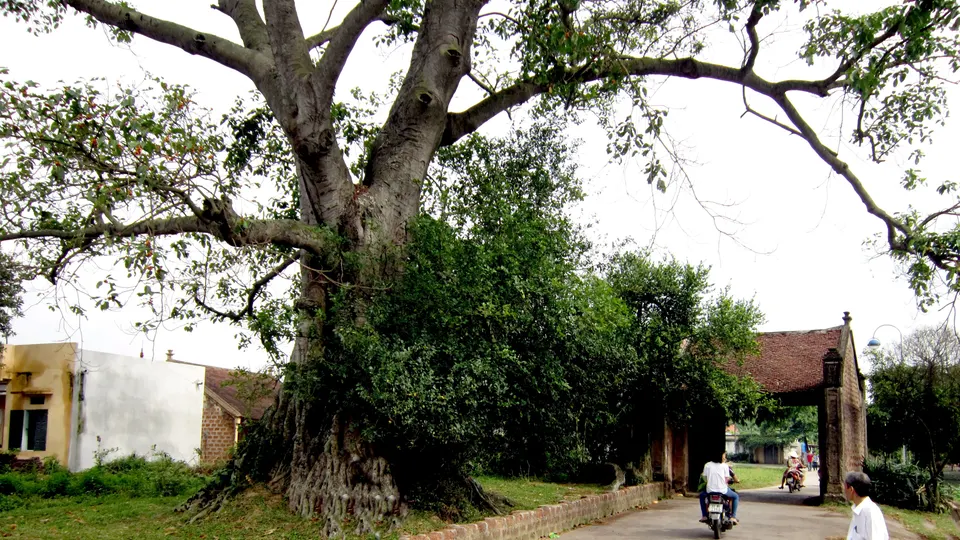
What you see. VietnamPlus, quoting the national news agency in 2023, describes 956 old houses between 100 and 400 years old, walls and fences of rough laterite blocks (a red-brown iron-rich stone cut from the local ground), a giant banyan tree, a village well and the Mong Phu (Mông Phụ) communal house with big black ironwood pillars (VietnamPlus). Duong Lam is called “the land of two kings”, Phung Hung and Ngo Quyen, who led risings against Chinese rule in the 8th and 10th centuries, and has temples to both. Vietnam Airlines’ guide also points visitors to Mia pagoda among the rice fields.
Tradition and today. People still live in these houses, and the village has had to balance tourism with daily life: Bao Van Hoa (Báo Văn hóa) reported about 700,000 visitors between 2014 and 2019 when Hanoi recognised it as a city tourist site. Walk quietly, ask before entering a courtyard, and remember that many families now open their homes as homestays, which VietnamPlus notes has turned a former day-trip stop into somewhere people stay.
Getting there. Sources give 40–50 km from central Hanoi; Vietnam Airlines’ guide gives about 60–90 minutes by car and lists city bus routes to Son Tay followed by a short motorbike-taxi ride, but its route numbers are inconsistent, so check the current number before you go.
A realistic day plan: arrive mid-morning, walk the lanes and the communal house, have lunch in the village, visit the kings’ temples or Mia pagoda in the afternoon, and be back in Hanoi by early evening. Since July 2025 the village belongs to Hanoi’s new Son Tay ward.
Perfume Pagoda: a pilgrimage best timed to the festival
The Perfume Pagoda (Chua Huong), properly the Huong Son complex of temples and cave shrines in the limestone hills south-west of Hanoi, is a religious site first and an excursion second. Its most sacred shrine sits inside Huong Tich cave.

What the day involves. Vietnam Pictorial describes the site as about 60 km south-west of the capital, reached by an hour-long ride in a rowing boat on the Yen stream to the foot of the mountain, followed by a climb of hundreds of stone steps from Thien Tru pagoda to the cave, or a cable car for those who prefer it. It is a full day, and a physical one.
When to go. The festival opens on the sixth day of the first lunar month. In 2026 the festival season ran from 18 February to 11 May, with the opening ceremony on 22 February, and on peak days in past years the site has drawn 45,000–50,000 visitors a day (Bao Van Hoa). Outside the festival, the site is quieter but loses the atmosphere of a living pilgrimage. If you go in season, go on a weekday and avoid the first days after Tet.
Is it too rushed? As a day trip it is fine; the crowds, not the distance, set the pace. Dress for a temple (covered shoulders and knees) and wear shoes that grip on wet steps.
Which day trip suits which season?
The North has four seasons, and they change the answer more than people expect. VNAT gives April to June or September to November as Ha Long Bay’s best months, and April to June or September to December for Hanoi (VNAT).

- June to August: hot, humid and stormy. VNAT warns that tropical storms can cancel Ha Long cruises, so choose Ninh Binh or Bat Trang for a day trip, and keep any bay trip flexible.
- December to March: cool to cold, misty and cloudy around Hanoi and on the bay. Mist suits the karst, but take a warm layer for any boat. This is also the Perfume Pagoda’s season, which starts after Tet.
- Late May: the rice turns gold at Tam Coc, the best moment for Ninh Binh’s fields; in 2026 the province timed its tourism week, opening on 23 May, to the ripening, Bao Van Hoa reported.
- Any month: Bat Trang works in rain and heat because much of it is indoors; Duong Lam is pleasantest in the cooler months.
Our Vietnam weather by month guide sets the northern seasons against the rest of the country.
Before you book a day trip from Hanoi: a checklist
A good day trip from Hanoi is mostly about not overfilling it. Check these before you pay.

- Pick one main sight per day. One boat trip in Ninh Binh, one cruise in Ha Long, one village. Combining Ninh Binh and Ha Long in a day is not realistic, and Sa Pa is too far for a day trip at all: see our guide to getting from Hanoi to Sa Pa by night train, bus or van.
- Use the cautious road time. Sources disagree, especially for Ha Long; plan on the longer figure and add time for hotel pick-ups.
- Give Ha Long a night if the bay matters to you, and book a boat whose operator explains what happens if the authorities cancel sailings.
- Check the calendar. Tet and the Perfume Pagoda festival bring crowds; Tam Coc’s golden-rice weeks draw the biggest crowds of the year.
- Check bus numbers and timetables close to the date. City bus routes and rail times change, and the figures on this page are as given by the sources named above.
- Dress for temples at Hoa Lu, Duong Lam and the Perfume Pagoda: shoulders and knees covered.
- Stay longer if you can. If a day feels too short, turn Ninh Binh or Ha Long into an overnight within a week in North Vietnam, or browse more of the North.
Frequently asked questions
Can you combine Ninh Binh and Ha Long Bay in one day from Hanoi?
No. Vietnam Airlines' guides give about 1.5–2 hours from Hanoi to Ninh Binh and 2.5–3.5 hours to Ha Long Bay, in different directions, so one day leaves time for only one of them; pick Ninh Binh for a single day and give Ha Long a night.
Do Ha Long Bay boats still run in storm season?
Not always. Vietnam's national tourism authority warns that summer tropical storms can cancel Ha Long Bay cruises, and in early July 2026, ahead of Storm Maysak, Quang Ninh moved to halt overnight boats and night-time tours on the bay, VOV reported. Between June and August, keep a Ha Long trip flexible or choose Ninh Binh.
Are Trang An boat routes ever closed after heavy rain?
Yes, briefly. After heavy rain on 31 July 2026 the Trang An management board closed route 3 because cave water rose above the safe level, kept routes 1 and 2 running, and reopened route 3 on 2 August, CafeF and Znews reported.
How do I get to Bat Trang from Hanoi by bus?
Vietnam Airlines' guide lists city bus no. 47 from Long Bien bus station to Bat Trang, about 40 minutes, against 20–30 minutes by car for the roughly 13 km. Check the route number close to your date, as city bus routes change.
When is the next Perfume Pagoda festival?
The Perfume Pagoda (Chua Huong) festival opens on the sixth day of the first lunar month and runs into the third lunar month; in 2026 it ran from 18 February to 11 May. As of November 2026 the site is out of festival season, so check the 2027 dates once the organisers publish them.
Key sources
- A guide to boat tours in Ninh Binh · Vietnam National Authority of Tourism (vietnam.travel)
- Đường đến Hạ Long (routes to Hạ Long) · Ha Long Bay Management Board (halongbay.com.vn), updated 7 November 2024
- Resolution 1656/NQ-UBTVQH15 on the reorganization of commune-level administrative divisions of Hanoi · National Assembly Standing Committee, 16 June 2025 (LuatVietnam English)
- A full-day journey to discover Hanoi's timeless Bat Trang pottery village · Hanoi Times
- Duong Lam first Vietnamese ancient village to become national relic · VietnamPlus (VNA), 25 January 2023
- Lễ hội truyền thống du lịch Chùa Hương năm 2026 có gì mới? · Báo Văn hóa, 6 February 2026
- Weather and climate in Vietnam · Vietnam National Authority of Tourism (vietnam.travel)
- Trang An Landscape Complex · UNESCO World Heritage Centre
All 23 sources and further reading
- Khai mạc Tuần Du lịch Ninh Bình 2026 · Báo Văn hóa, 23 May 2026
- Trang An named Vietnam's first UNESCO-recognized mixed heritage · Tuổi Trẻ News, 24 June 2014
- Resolution 202/2025/QH15 on the reorganization of provincial-level administrative divisions · National Assembly of Vietnam, 12 June 2025 (LuatVietnam English)
- Vietnam adds Quang Ninh and Bac Ninh to its centrally governed cities · VietnamNet, 25 August 2026
- How to get from Hanoi to Ninh Binh · Vietnam Airlines travel guide
- Hanoi to Halong Bay · Vietnam Airlines travel guide
- Bat Trang Ceramic Village · Vietnam Airlines travel guide
- Duong Lam Ancient Village · Vietnam Airlines travel guide
- Go through centuries of ceramic history at Hanoi's Bát Tràng museum · Saigoneer, 15 March 2023
- Hà Nội công nhận xã Bát Tràng là điểm du lịch · Thời báo Tài chính Việt Nam, 29 July 2019
- Đưa Làng cổ Đường Lâm trở thành điểm du lịch tiêu biểu của Thủ đô và cả nước · Báo Văn hóa, 23 November 2019
- Huong Pagoda – a 'must-see' destination in spring · Vietnam Pictorial (VNA), 21 April 2017
- Quảng Ninh siết an toàn trước bão số 1, tạm dừng tàu lưu trú trên vịnh Hạ Long · VOV, 3 July 2026
- Từ hôm nay, Tràng An tạm dừng tuyến tham quan này: Du khách chú ý · CafeF, 31 July 2026
- Tràng An mở lại tuyến tham quan sau thời gian tạm dừng · Znews, 2 August 2026
Keep exploring
 North Vietnam · Travel Ninh Binh (Ninh Bình): How Many Days, Boats and Tickets Ninh Binh: how many days you need, Trang An or Tam Coc boats, 2026 ticket prices, when the rice turns gold, the Hoa Lu capital, what to eat and a 2-day plan.
 North Vietnam · Travel Ha Long Bay (Hạ Long) or Lan Ha Bay: Which to Choose How Ha Long Bay and Lan Ha Bay differ: what the drowned limestone karst is, UNESCO status since 1994 and 2023, floating villages then and now, and when to go.
 North Vietnam · Travel Hanoi: How Many Days, What to See and When to Go Hanoi travel guide for 2026: how many days and where to stay, Noi Bai airport, walking-street hours, the new low-emission zone, Train Street and where to eat.
 North · Central · South · Travel Vietnam in One Week: Which Region to Pick, 3 Routes 7 days in Vietnam? Pick North, Centre or South. Day-by-day routes, transfer times, 2026 train and ticket prices, and a table to choose by month and airport.