Central Vietnam · Travel
My Son (Mỹ Sơn): Is It Worth It, Tickets and How to Visit
Is My Son worth a half day from Hoi An? Ticket prices as of 2026, the best months and hours, and how to read the Cham towers, war damage and restoration.
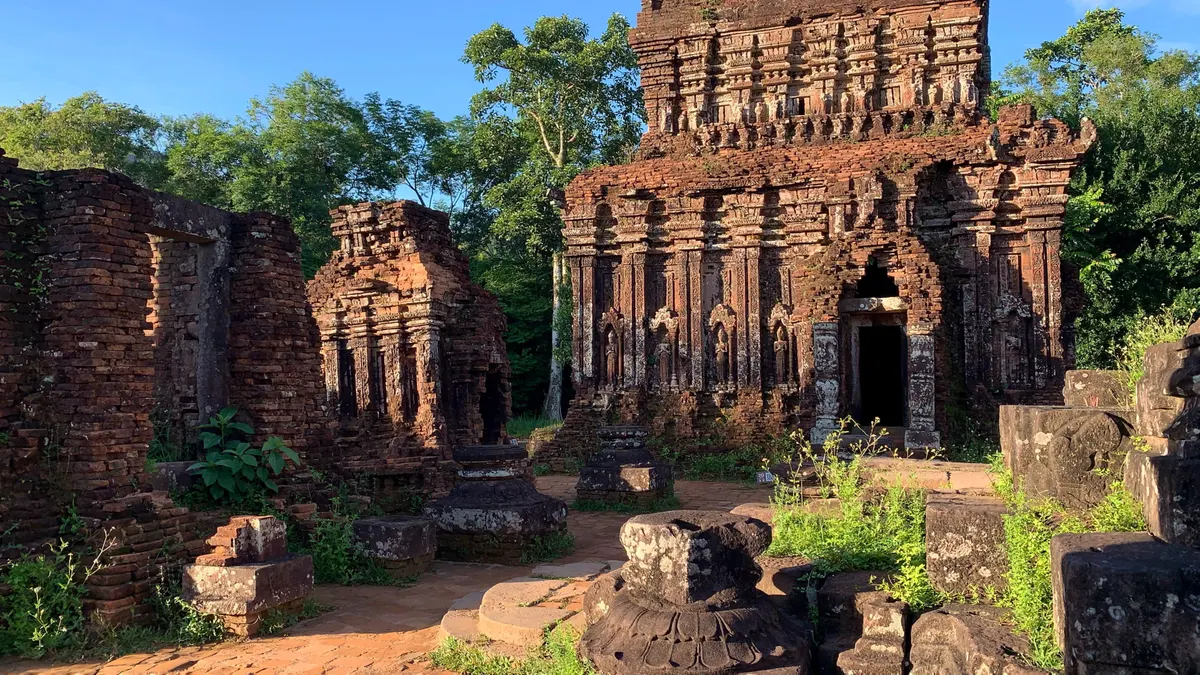
Is My Son worth the trip? For most visitors to Hoi An, yes, as a half day that starts early: it is the fullest surviving record of the Champa kingdom’s temple architecture, and in 2025 it drew 431,538 visitors, 392,461 of them from abroad, according to figures its management board gave Tuoi Tre (Tuổi Trẻ) in January 2026. Come for what the ruins explain, not for size.
My Son (Thánh địa Mỹ Sơn, “My Son Sanctuary”) is a group of ruined brick temple-towers in a closed, forested valley about 40 km inland from Hoi An. For most of its existence it was the religious and political heart of Champa, the Indianised kingdom that held the coast of Central Vietnam long before it became Vietnamese. UNESCO lists it as a World Heritage Site because its towers show, unusually clearly, how Indian Hindu architecture was adapted in Southeast Asia between the 4th and 13th centuries (UNESCO).
It is not Angkor. The towers are smaller, many are broken, and some groups are little more than foundations and bomb craters. What makes My Son worth the trip is knowing how to read it: what a tower was for, why the groups have letters instead of names, why the brickwork still puzzles experts, and what the war and the restorers did to what you see. This guide covers that, then how to visit without melting in the midday heat.
My Son at a glance
| Where | My Son village, Thu Bon (Thu Bồn) commune, Da Nang (Đà Nẵng) city (until July 2025 Duy Phu (Duy Phú) commune, Duy Xuyen (Duy Xuyên) district, Quang Nam (Quảng Nam) province) |
| What it was | Main religious centre of the Champa kingdom; temples above all to Shiva |
| Age | First temple 4th century (wood); surviving brick towers from roughly the 7th to the 13th century |
| Size | About 70 structures in eight groups, plus extensive buried remains |
| UNESCO | World Heritage Site since December 1999 |
| Distance | About 40 km from Hoi An (Hội An), about 70 km from central Da Nang |
| Best time | Early morning; February–April for the most comfortable weather |
| Ticket (as of Nov 2026) | 150,000 VND foreign visitors, 100,000 VND Vietnamese (Da Nang tourism portal); a single 250,000 VND price was announced as planned in January 2026, so check at the gate |
| Visitors | 431,538 in 2025, 392,461 of them international (management board, January 2026) |
| Pair with | The Museum of Cham Sculpture in Da Nang, which holds many of the site’s finest carvings |
Since 1 July 2025 the former Quang Nam province has been part of Da Nang city, which is why My Son now has a Da Nang address (Resolution 202/2025/QH15). The sanctuary itself has not moved, and older maps and signs may still say Quang Nam.
What was My Son, and why is it in this valley?
The story begins with a god and a king. In the 4th century King Bhadravarman founded a wooden temple here to Shiva-Bhadresvara (Bhadreśvara), a form of Shiva whose name echoes the king’s own. After it was destroyed, King Sambhuvarman rebuilt it in the early 7th century and renamed the god Sambhu-Bhadresvara, again folding the king’s name into the deity’s (Quan doi Nhan dan). That pairing of ruler and god is a useful key to the site, which UNESCO describes as Champa’s religious and political capital for most of the kingdom’s existence.
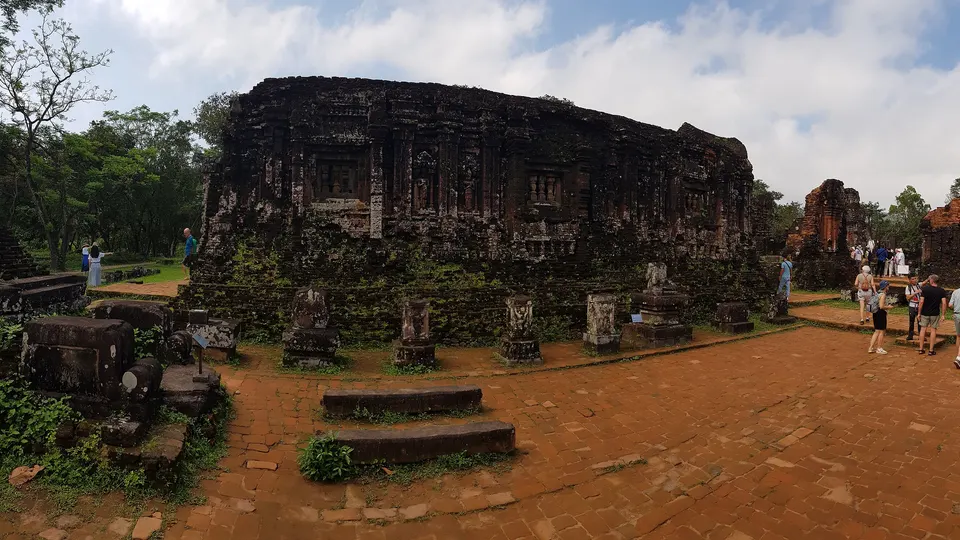
That is also why the dates can look confusing. UNESCO describes a culture flourishing here from the 4th to the 13th century, but the earliest temples were wooden and are gone. The brick towers you see today were built from about the 7th century onwards, in several styles that archaeologists use to date them. Groups were added, rebuilt and repaired over six centuries, so walking through My Son is a walk through changing Cham taste, not a single plan.
The valley location makes sense once you see it. The sanctuary lies in a closed bowl of hills about 2 km across, west of the old Cham capital of Simhapura at Tra Kieu (Trà Kiệu) and inland from the trading coast near Hoi An. A remote, enclosed valley kept the sanctuary apart from the busy coast. The same seclusion later made it a wartime base, with consequences we come to below.
How do you read the towers and their letters?
Most structures follow the same idea. At the centre of each group stands a kalan, the main tower-sanctuary, which held the god’s image or a linga, the stylised emblem of Shiva. Around it sit smaller buildings: a gate tower, a long hall (mandapa) where pilgrims were received and offerings and ritual dances performed for the gods, and storehouses, all inside a brick wall, according to the Da Nang tourism portal.
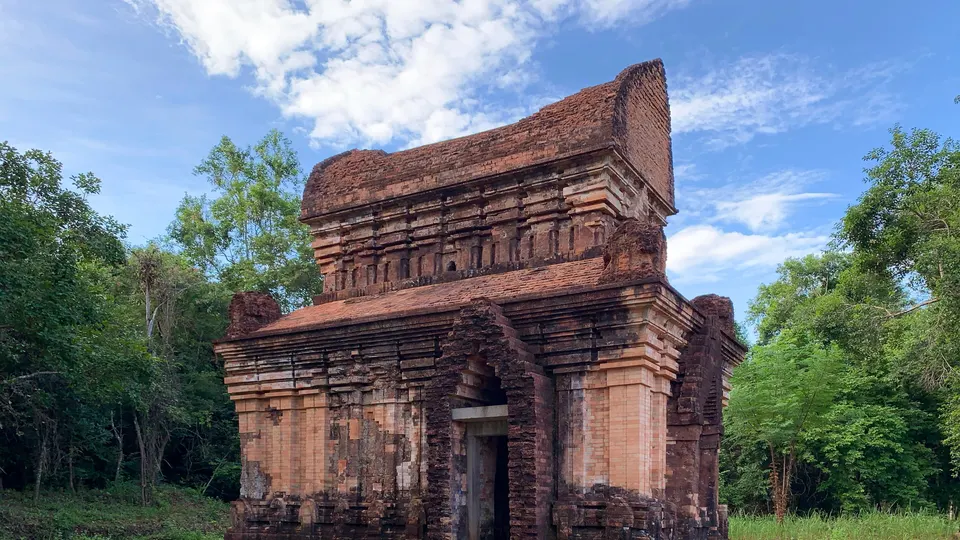
The labels on site, such as A1, B5, E7 or G1, come from the French. French soldiers came across the ruins in 1885, and French archaeologists, among them Louis Finot and Henri Parmentier, explored and documented them from 1895 into the early 1900s. They created the lettering and numbering system that is still used to identify each tower (World Monuments Fund). UNESCO notes that Parmentier’s records remain the basis for judging how authentic each monument is today. So when your ticket map says “Group B”, that is a century-old French filing system, not a Cham name.
What to look for:
- Brick and carving together. The towers are fired brick, fitted so tightly that the walls themselves could be finely carved, with stone pillars and sandstone reliefs. Look closely at pilasters and false doors for floral and figural detail cut into brick.
- Linga and yoni. The pedestal (yoni) and the post (linga) inside a sanctuary represent Shiva. Indian restorers found a Shiva linga inside tower A10, and a monolithic linga-yoni found during their work has been recognised as a national treasure.
- Absences. Many of My Son’s sculptures are no longer on site; a large collection is displayed in the Museum of Cham Sculpture in Da Nang, so empty sanctuaries are normal.
Why are the Cham bricks still a puzzle?
Look at an intact Cham wall and you will see almost no mortar between the bricks. The joints are so fine that the wall can be carved as if it were a single block. How the Cham achieved that has been argued over for a long time, and experts still do not agree.
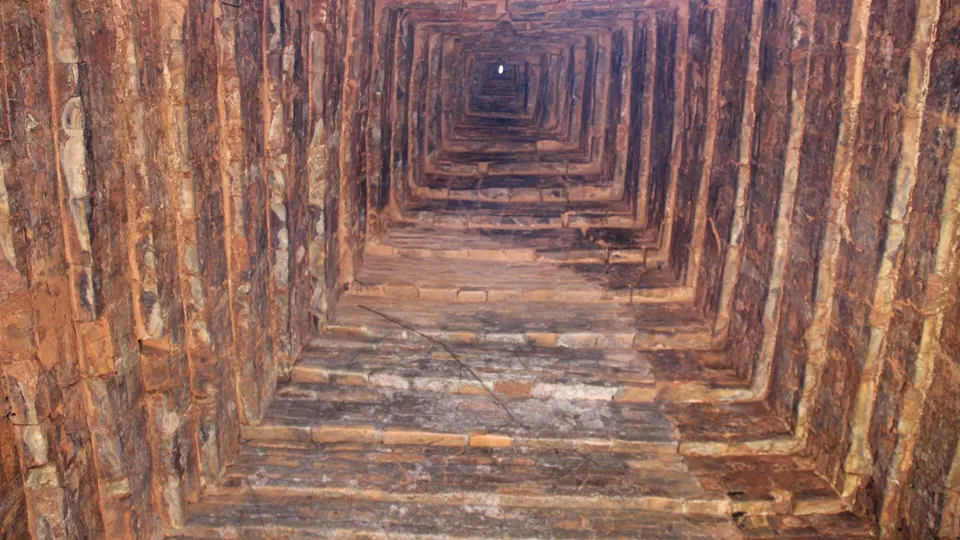
The leading working answer comes from the Italian-led restoration of group G. Researchers analysed the bricks and found that resin from the dau rai (dầu rái) tree (Dipterocarpus alatus, also used in boat-building) contains a chemical resembling the towers’ binder, and that the same chemical appears inside the old bricks. But the team was careful: they said they had not identified the ancient adhesive itself, and rejected press reports claiming the mystery was solved (Tuoi Tre). An Italian restorer told Tien Phong (Tiền Phong) in 2010 that they regarded the resin only as a “compatible” material, not proof of what the Cham used.
In 2015 VnExpress reported that experts still had not found how Cham bricks or their binder were made, which limits every restoration. Popular theories about how the towers were built circulate widely in Vietnam; none of them is settled. Treat any guide who tells you the answer with confidence as offering one view among several.
What happened to My Son in the war?
My Son’s seclusion made it useful to fighters, and that is what nearly destroyed it. The surrounding Duy Xuyen area was a battleground from 1965 to 1972. According to the World Monuments Fund, the valley served as a Viet Cong field headquarters, and a US bombing raid in 1969 destroyed the most important temple and damaged several others. The national tourism authority identifies the lost tower as A1, a 24-metre temple destroyed by US bombs in 1969.
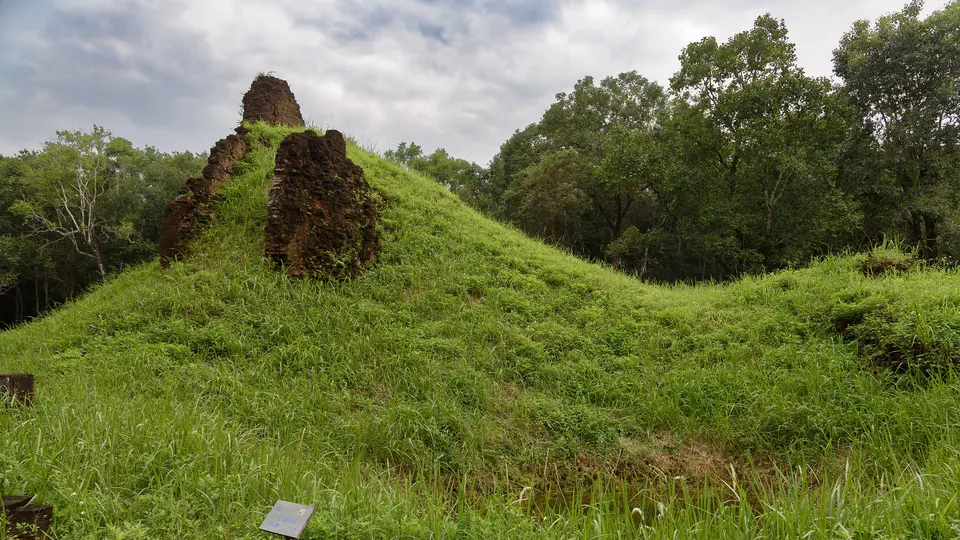
Damage was not limited to one group. UNESCO records that temples suffered in the Second World War, the First Indochina War and above all the Second Indochina War. VnExpress describes group F as the worst damaged after the war, and Viet Nam News reports that tower F3 collapsed from wartime bomb damage.
Stay on the paths. UNESCO notes that unexploded ordnance has been cleared from the four main monument areas since 1975, but much remains in the buffer zone and has held back research and restoration elsewhere. Keep to marked routes and follow site signs.
Who restored My Son, and how much is original?
Restoration here has always been international, and each team left a slightly different mark. Knowing who worked where helps you understand why some towers look rough and patched, others crisp and new.
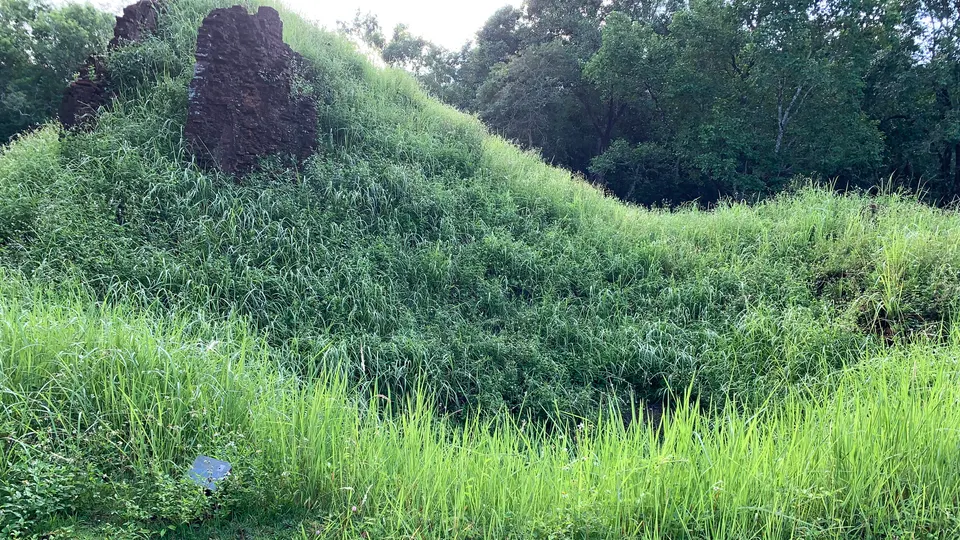
- Poland, 1980s. Under a Vietnam–Poland programme, a subcommittee for restoring Champa monuments was set up in 1980, led by the Polish architect Kazimierz Kwiatkowski (“Kazik”). Polish teams cleared and reinforced towers in groups B, C and D in the early 1980s. Kwiatkowski worked on Vietnamese heritage, including Hoi An and Hue (Huế), for 17 years and died in Hue in 1997 while restoring a temple in the citadel.
- Italy and UNESCO, 1997–2013. Italian experts studied Cham materials from 1997, then a UNESCO–Vietnam–Italy project restored group G, a 12th-century group built under King Jaya Harivarman that was close to collapse. It reopened in June 2013. Its methods were then used on tower E7, finished in 2015, though some Vietnamese experts criticised the smoothed replacement bricks as too sharp and new-looking.
- India, 2017–2022. The Archaeological Survey of India conserved groups A, H and K, completing the work in December 2022 (Embassy of India). In 2024 archaeologists also uncovered a sacred pathway leading to tower K.
- India again, 2025–2029. Indian experts began restoring groups E and F in February 2025, starting with F1, with work scheduled until 2029. For 2026 the management board said the work would concentrate on tower F1 and the related parts of group E, and that it would ask India to consider restoring tower A’ next (Bao Van hoa (Báo Văn hóa), 31 January 2026), so expect scaffolding around groups E and F when you visit.
UNESCO judges the earlier French and Polish interventions as relatively minor and not harmful to authenticity. The debate today is about how far to rebuild. Vietnamese heritage experts have argued for keeping restoration to a minimum and making new brick distinguishable from old, so that visitors can tell which is which. When you see a wall that looks too crisp, it probably is new, and that is intentional.
Do the Cham still worship at My Son?
Not in the way they once did. The Cham people still live in Vietnam, but most of the communities that keep the old temple rites are far south of here, in the former Ninh Thuan (Ninh Thuận) and Binh Thuan (Bình Thuận) provinces, since July 2025 part of Khanh Hoa (Khánh Hòa) and Lam Dong (Lâm Đồng) provinces. Their great temple festival, Kate (Katê), honours ancestors and deities and is held at towers such as Po Klong Garai and Po Rome in former Ninh Thuan and Po Sah Inu in Phan Thiet (VTV). Those communities also keep Cham manuscripts and can still read the old scripts. For how My Son fits with the other Cham towers and the living Cham community, see our guide to Champa heritage.
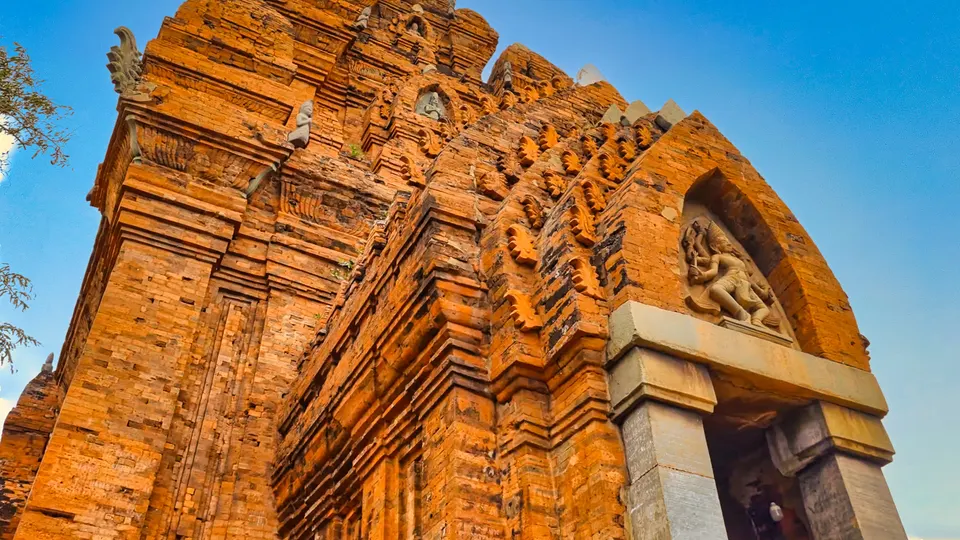
My Son today is managed as a heritage site. The city’s tourism portal asks visitors not to hold unauthorised rituals or worship there, and none of our sources documents regular Cham worship at My Son. That is the clearest contrast between tradition and today: at Po Klong Garai the towers are still a living ritual space once a year, while at My Son the ritual life survives mainly as heritage and performance.
The dance show. The management board has staged Cham dance for visitors for more than ten years, now with seven shows a day, according to Bao Van hoa in November 2025. The mandapa halls once hosted ritual dances for the gods; today’s show is a performance for visitors, not a ceremony. A night programme under the towers has also been tried; check locally whether one is running.
| My Son | Po Klong Garai | Binh Dinh (Bình Định) towers | |
|---|---|---|---|
| Where | Thu Bon commune, Da Nang (former Quang Nam) | Near Phan Rang, Khanh Hoa (former Ninh Thuan) | Around Quy Nhon, Gia Lai (former Binh Dinh) |
| Age | 4th–13th century; brick towers from about the 7th | Late 13th–early 14th century | 11th–15th century |
| What you see | About 70 structures in eight groups, many ruined | Four towers; main tower 20.5 m | 14 surviving towers, e.g. Banh It (Bánh Ít), Duong Long (Dương Long), Thap Doi (Tháp Đôi) |
| Worship today | Heritage site; rituals not permitted without authorisation | Used for Cham rituals during Kate | Not covered by our sources |
| Why go | The fullest record of Champa’s sacred architecture | A Cham temple still in ritual use | Tall, well-preserved later towers |
How do you visit My Son: tickets, timing and getting there
Getting there. My Son is about 40 km from Hoi An and about 70 km from central Da Nang. Small-group and private tours run from both towns, or you can go independently. Allow a morning: the drive, a walk around the main groups, and time to sit in the shade. On a short trip it fits well as the last morning before a flight from Da Nang, as in our five-day plan for Hue, Hoi An and Da Nang.
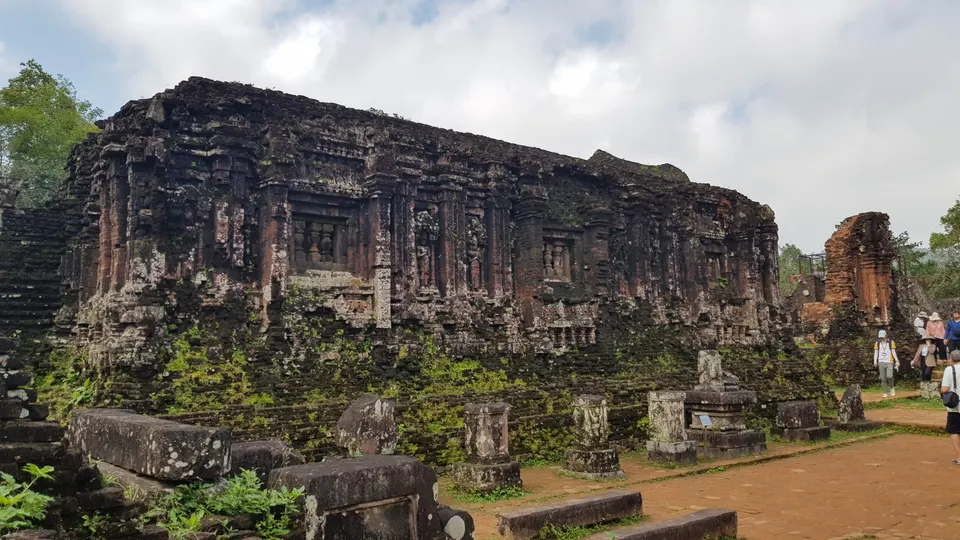
Go early. The valley is hot, humid and has little shade. The Da Nang tourism portal advises visiting early in the morning to avoid the midday summer heat, and names February to April as the most pleasant months. The rainy season runs roughly from September to January, when the valley can flood (Da Nang Fantasticity). If you are travelling in October or November, check the forecast before you set off.
Tickets. Da Nang’s official tourism portal lists the gate price, which covers entry and site services, at 150,000 VND for foreign visitors and 100,000 VND for Vietnamese. That price had stood for about ten years, and on 30 January 2026 the management board said it planned a single 250,000 VND ticket for both groups, bundled with new experiences, subject to the city council’s approval. We could not confirm by November 2026 whether the new price had taken effect, so carry enough cash for either and check at the gate. Tours from Hoi An and Da Nang usually include the ticket; ask when you book.
Which time to go. Choose by season first, then by hour:
| When | Weather (Da Nang tourism portal) | What it means for your visit | Suits |
|---|---|---|---|
| February–April | Cool, dry, green valley | The most comfortable months; still go early | First-time visitors, photographers |
| May–August | Dry but hot, little shade | Arrive at opening and leave by late morning | Travellers who must come in summer |
| September–January | Rainy season; paths slippery, valley can flood | Check the forecast; trips can be cut short | Flexible travellers with a back-up day |
| Any season, early morning | Coolest hours, soft light | Walk the main groups before the heat and the tour buses | Everyone |
Rain and floods. In November 2025, during the late-season floods in Central Vietnam, the management board cleared trees near the restoration site at groups E and F, put up flood warning signs and named low bridges on the site’s roads as places it would close when water rose (Bao Van hoa, 7 November 2025). If you visit in October or November, check the forecast and ask your hotel or tour operator whether the road is open.
Prepare your eye first. If you can, visit the Museum of Cham Sculpture in Da Nang before My Son; seeing the carved pedestals and gods first makes the empty sanctuaries easier to picture.
On site.
- Dress modestly, as you would for any temple.
- Do not touch, climb or carve on the towers; old brick is fragile and some towers are under restoration.
- Keep to marked paths because of unexploded ordnance in the wider area.
- Bring water, a hat and sun protection.
A simple plan. Leave Hoi An early, walk the main groups in the cooler hours, catch a dance show if the timing works, and be back in Hoi An for lunch. My Son also fits a longer trip through Central Vietnam: see our Central Vietnam hub to link it with Hoi An, Da Nang and Hue.
Frequently asked questions
Is My Son worth visiting from Hoi An?
For most visitors, yes, as a half-day trip early in the morning. My Son is about 40 km from Hoi An and holds the fullest surviving record of Champa's sacred architecture, but many towers are ruined, so it rewards visitors who read up first rather than those expecting an Angkor-sized site.
How much is the My Son ticket in 2026?
Da Nang's official tourism portal lists 150,000 VND for foreign visitors and 100,000 VND for Vietnamese, including the site services. The My Son management board said in January 2026 that it planned a single 250,000 VND ticket for everyone, so check the current price at the gate.
What time should I go to My Son?
Go early in the morning. Da Nang's tourism portal advises arriving early to avoid the midday heat and calls February to April the most pleasant months; the valley has little shade.
Can My Son flood in the rainy season?
Yes. From about September to January heavy rain can flood the valley and the access road. In November 2025 the management board put up flood warnings and named low bridges on the site's roads as flood points, so check the forecast before a trip in October or November.
Which province is My Son in now?
My Son is in Da Nang. Since 1 July 2025, when the former Quang Nam province merged into Da Nang city, its address has been My Son village, Thu Bon commune, Da Nang.
Key sources
- My Son Sanctuary · UNESCO World Heritage Centre
- Discovering My Son Sanctuary in Quang Nam · Quân đội Nhân dân (People's Army Newspaper)
- My Son · World Monuments Fund
- Relic restoration and preservation must go hand in hand · Tuổi Trẻ News, 27 June 2013
- Press release on completion of conservation and restoration of A, H and K temples at My Son Sanctuary · Embassy of India, Hanoi, 20 December 2022
- Cham people in Ninh Thuan and Binh Thuan celebrate Kate Festival · VTV, 28 September 2019
- Mỹ Sơn Sanctuary · Đà Nẵng Fantasticity (Đà Nẵng city tourism portal)
- Resolution 202/2025/QH15 on the reorganization of provincial-level administrative divisions · LuatVietnam (text of the National Assembly resolution)
All 31 sources and further reading
- Mysterious beauty of the oldest sanctuary in Vietnam · VietNamNet
- Mysteries of My Son sanctuary unveiled through restoration · VietNamNet, 21 July 2019
- My Son Sanctuary · Vietnam National Authority of Tourism, 21 May 2009
- Hoàn tất trùng tu tháp Chăm E7 ở Mỹ Sơn · VnExpress, 3 August 2015
- Viết lại chuyện ngàn năm · Tiền Phong, 15 December 2010
- Hợp tác hiệu quả từ việc trùng tu khảo cổ học phế tích đền tháp Chăm tại Mỹ Sơn · Báo Văn hóa, 7 December 2018
- Restored My Son temples inaugurated (G Group) · UNESCO World Heritage Centre, 23 June 2013
- Italy helps My Son World Heritage restoration · Vietnam National Authority of Tourism, 22 December 2010
- Polish architect remembered for role in preservation of Hue ancient citadel · Quân đội Nhân dân, 20 March 2017
- Vietnam, India post sound outcomes in renovating My Son Sanctuary · Vietnam National Authority of Tourism, March 2022
- Indian experts assist in restoring ancient towers at UNESCO-listed My Son Sanctuary in Vietnam · Tuổi Trẻ News, 21 March 2025
- Revival of last abandoned ancient towers in Mỹ Sơn · Việt Nam News, 10 April 2025
- Po Klong Garai Towers · Vietnam National Authority of Tourism
- Mysterious Cham towers in Binh Dinh · Vietnam National Authority of Tourism, 24 October 2012
- My Son Sanctuary dubbed Angkor Wat of Vietnam · Vietnam National Authority of Tourism, 5 August 2022
- Đánh thức đêm di sản Mỹ Sơn bằng sắc màu văn hóa Chăm · Báo Văn hóa, 12 November 2025
- Múa dưới tháp Chăm · VnExpress, 25 March 2022
- Mỹ Sơn Sanctuary receives ancient Chăm script books · Việt Nam News, 1 December 2019
- Mỹ Sơn áp dụng vé tham quan đồng giá 250.000 đồng · Tuổi Trẻ, 30 January 2026
- Năm 2026, đa dạng loại hình sản phẩm, dịch vụ mới tại Mỹ Sơn · Báo Văn hóa, 31 January 2026
- Thêm nhiều sản phẩm mới tại Mỹ Sơn · Báo Văn hóa, 11 February 2026
- Rà soát, đánh giá tình trạng di sản Hội An, Mỹ Sơn sau mưa, lũ · Báo Văn hóa, 7 November 2025
- Khu Đền Tháp Mỹ Sơn (tickets and visiting advice) · Đà Nẵng Fantasticity (Đà Nẵng city tourism portal), 26 September 2025
Keep exploring
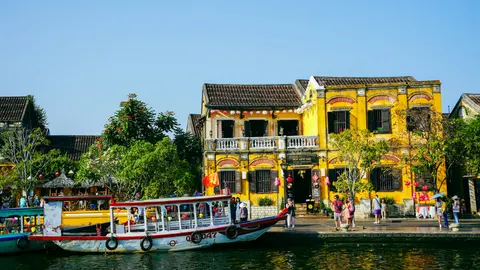 Central Vietnam · Travel Hoi An (Hội An): How Many Days, What to See, When to Go How many days Hoi An needs, what the 80,000 or 120,000 dong ticket covers, lantern nights, where to eat, beaches, flood months and getting there from Da Nang.
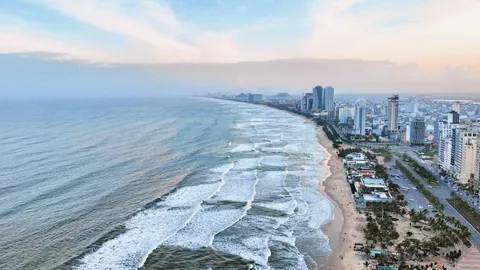 Central Vietnam · Travel Da Nang (Đà Nẵng): What to Do, Where to Stay, How Long Da Nang travel guide: the best things to do, whether to stay in Da Nang or Hoi An, a 2–4 day plan with Hue, what to eat and when the rains usually come.
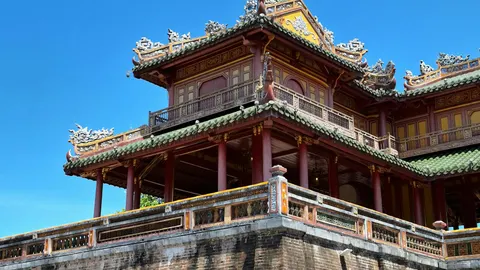 Central Vietnam · Travel Hue (Huế): How Many Days, What to See, 2026 Tickets How many days Hue needs, which Citadel sights and royal tombs to pick, 2026 ticket prices, the flood months to avoid and where to eat in the old royal capital.