South Vietnam · Culture
Cholon (Chợ Lớn), Saigon's Chinatown: Which Halls to Visit
Cholon, Saigon's Chinese quarter: which community built each assembly hall, Binh Tay market, the night street in 2026 and a half-day walking route.
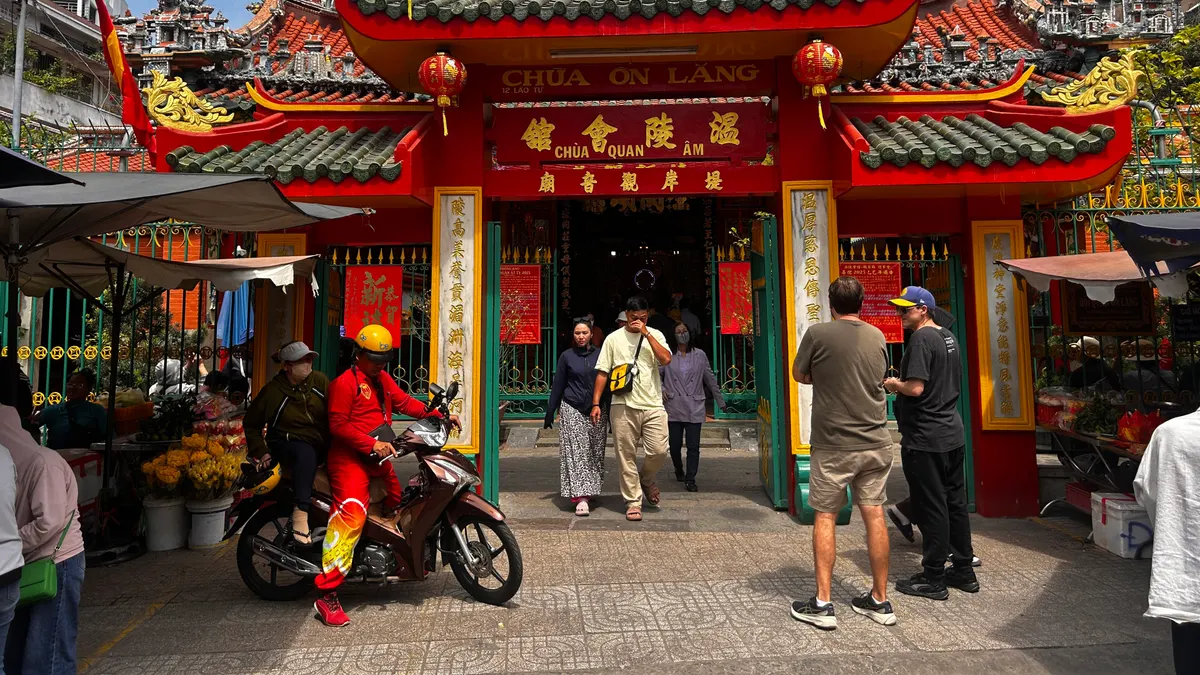
As of November 2026, Cholon (Cho Lon), the old Chinese quarter of Ho Chi Minh City, is best seen as a cluster of community temples and one great market rather than as a district: since 1 July 2025 its historic core has been split between Cho Lon, Cho Quan and An Dong wards, which replaced District 5, and Binh Tay ward in former District 6 (Resolution 1685). The key to understanding it is that each temple, or assembly hall (hoi quan, hoi quan), was built by people from one home region of southern China, so the halls differ in deity, style and story.
This page explains who built what, where it sits today and how to see it in half a day. For the city as a whole, start with our Ho Chi Minh City guide and the South Vietnam hub; for a full day that combines Cholon with the rest of Saigon, see day 2 of Saigon in 3 days.
Cholon at a glance
| What it is | Saigon’s historic Hoa (ethnic Chinese) trading quarter, a separate French-era city until 1931 |
| Where it is now | Cho Lon, Cho Quan and An Dong wards (former District 5) and Binh Tay ward (former District 6), since 1 July 2025 |
| Main sights | Seven national-relic assembly halls and temples; Binh Tay market (city-level relic since 2017) |
| Who lives there | More than 35% of Binh Tay ward’s residents are Hoa (SGGP, October 2025) |
| How long | One hour for two halls on Nguyen Trai street; half a day with Binh Tay market |
| Best time | Morning, when the market and temples are busiest; evenings only for the night street |
| New since 2025 | Weekend heritage tours of Binh Tay market (from 29 Nov 2025); Cholon night street (officially from 2026) |
| Food | Covered on our where to eat in Saigon page |
What is Cholon, and where is it on today’s map?
Cholon began as a refuge. The Chinese merchant town at Cu Lao Pho, near today’s Bien Hoa, was wrecked in the fighting between the Tay Son and Nguyen Anh in 1776 and 1782, and its traders moved down the river to the canals west of Saigon, where they built a market so large that Vietnamese simply called the area “the big market”, Cho Lon (VTC News). The Chinese residents used another name, De Ngan (Đề Ngạn), “the embankment”.
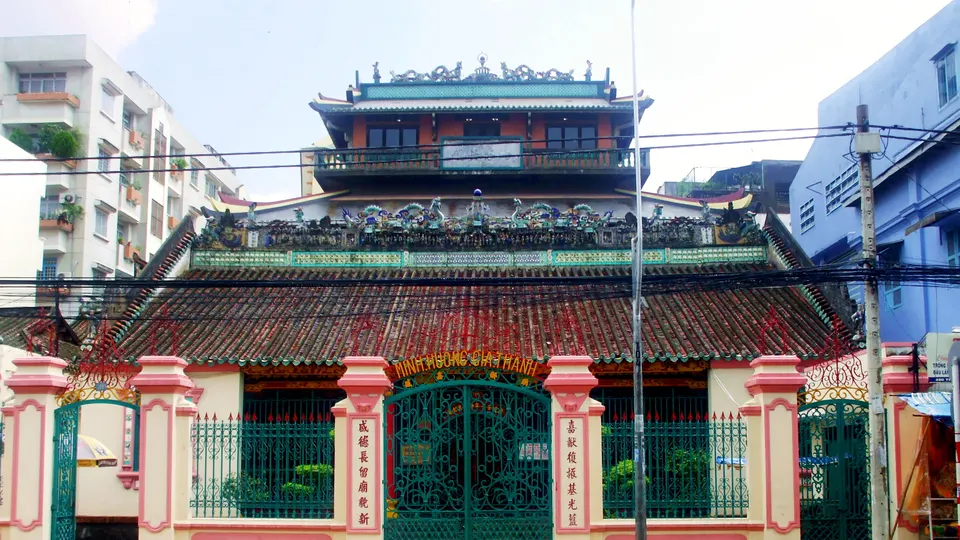
The French made Cholon a city of its own in 1879, the rice-trading twin of administrative Saigon, and merged the two into a single Saigon–Cholon region in 1931, VTC News notes. Rice milling and export made it rich, and its communities built the halls you still see. An older layer survives too: the Minh Huong Gia Thanh communal house at 380 Tran Hung Dao belongs to the Minh Huong, descendants of earlier Chinese settlers who became Vietnamese subjects; their village was formally founded in 1789 and the house received its name from Emperor Gia Long in 1808, PLO reports.
Today’s map follows the 2025 reform. Former District 5 wards 11 to 14, where almost all the halls stand, became Cho Lon ward; wards 1, 2 and 4 became Cho Quan, and wards 5, 7 and 9 became An Dong. Binh Tay market’s old wards 2 and 9 of District 6 became Binh Tay ward. Many signs and listings still use the old addresses, so search by street and house number.
Which assembly hall was built by which community?
A hoi quan is three things at once: a temple, a meeting house and, historically, the office that looked after new arrivals from the same home region. In 1871 the French administration regrouped Cholon’s Chinese into five congregations (bang), and the halls became their seats, according to the District 5 culture office’s page on the Nhi Phu temple (Quan 5 Xin Chao). That is why the halls look similar but feel different: the deity, the roof style and the festivals follow the home region.
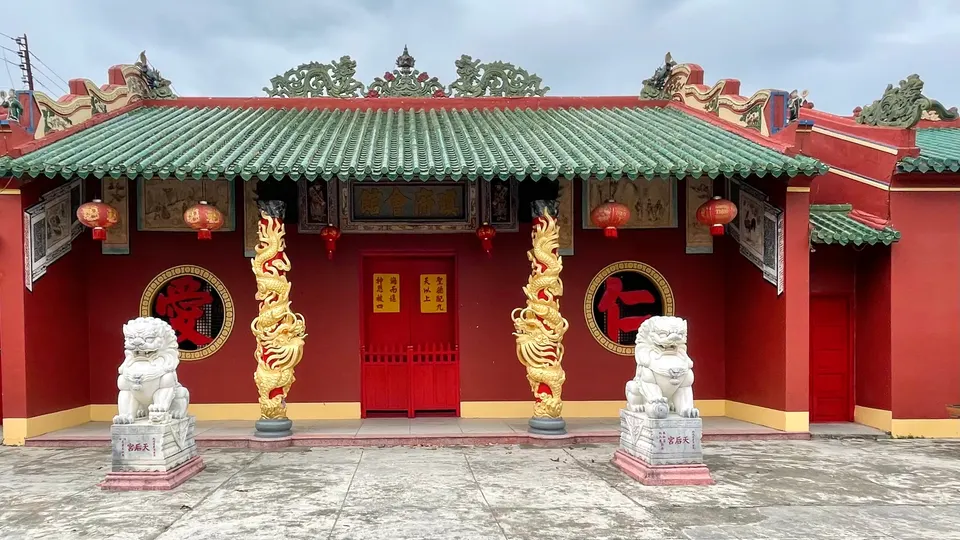
| Hall (popular name) | Built by | Main deity | Address (ward since 2025) | National relic since |
|---|---|---|---|---|
| Thien Hau temple (Tue Thanh hall) | Cantonese from Guangzhou | Thien Hau, goddess of the sea | 710 Nguyen Trai (Cho Lon) | 1993 |
| Nghia An hall (Quan De temple) | Teochew | Quan Cong (Guan Yu) | 678 Nguyen Trai (Cho Lon) | 1993 |
| Ha Chuong hall | Hokkien from Zhangzhou | Thien Hau | 802 Nguyen Trai (Cho Lon) | 2001 |
| On Lang hall (Quan Am temple) | Hokkien from Quanzhou | Thien Hau, with Quan Am popular with visitors | 12 Lao Tu (Cho Lon) | 2002 |
| Nhi Phu temple (Ong Bon temple) | Hokkien from Quanzhou and Zhangzhou together | Ong Bon (Ban Dau Cong), a guardian spirit | 264 Hai Thuong Lan Ong (Cho Lon) | 1998 |
| Quynh Phu hall | Hainanese | Thien Hau | 276 Tran Hung Dao (Cho Lon) | 2001 |
| Minh Huong Gia Thanh (communal house) | Minh Huong, descendants of earlier Chinese settlers | Village spirits and founding officials | 380 Tran Hung Dao (Cho Lon) | 1993 |
How to choose: for the sea goddess and the classic Cholon temple, Thien Hau; for carving and a warrior god, Nghia An; for the finest Hokkien stone and woodwork, Ha Chuong; for the busiest, most devotional atmosphere, On Lang; for a quieter courtyard, Nhi Phu or Quynh Phu. Hoi An has a similar set of halls, described in our Hoi An guide; Cholon’s still serve working congregations.
The Nguyen Trai Street halls: Thien Hau, Nghia An and Ha Chuong
Three of the best-known halls stand on Nguyen Trai street, a short walk apart. Thien Hau temple at No. 710 was built by Cantonese settlers from Guangzhou; its founding year is not known, but a large bronze bell is dated 1830, PLO notes, and the district culture office lists repairs from 1828 to 1998. Look up at the walls and roof ridges: the ceramic reliefs re-create scenes from Chinese classics such as Journey to the West, the district culture office notes.
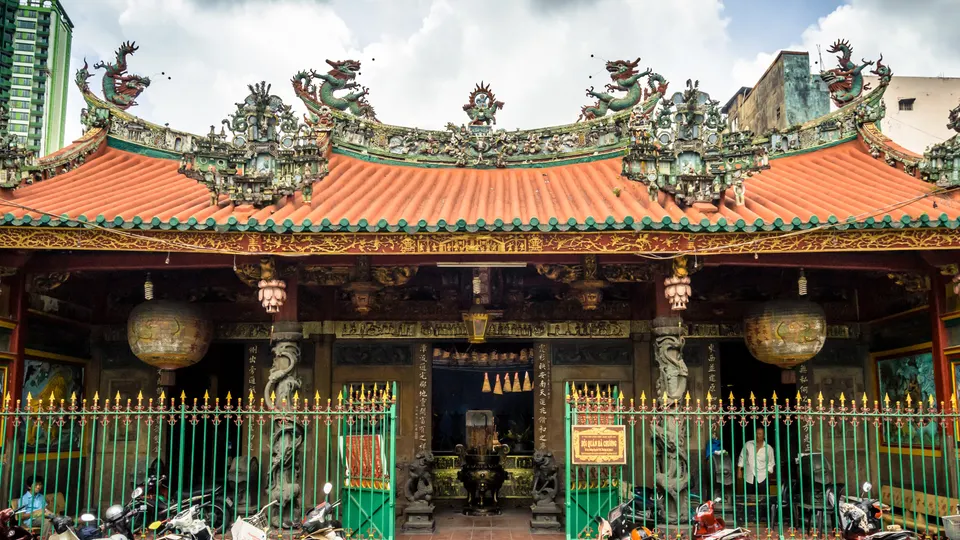
Nghia An hall at No. 678, a few doors away, belongs to the Teochew community and is also called the Quan De temple, because its main altar honours Quan Cong, the general who stands for loyalty; a carved gilt screen over the entrance dates from 1903 (Tuoi Tre). Its side wings held offices for the Teochew and Hakka communities, and the city recognised it as a tourist site on 23 October 2024. The district listing gives its hours as 8 am to 5 pm daily.
Ha Chuong hall at No. 802 was the seat of the Hokkien from Zhangzhou. No one knows when it was built, but a couplet dated 1809 records a repair, so it is older; stone columns carved with carp leaping the dragon gate frame its entrance, and its two biggest days are the Thien Hau festival on the 23rd day of the third lunar month and the offering to wandering souls in the seventh month, the district culture office says.
On Lang and Nhi Phu: the Hokkien temples off Nguyen Trai
Nearby, the On Lang hall at 12 Lao Tu is the temple most visitors call the Quan Am pagoda. It was built by Hokkien families from Quanzhou, has been repaired six times between 1828 and 2017, and became a national relic on 30 December 2002 (Quan 5 Xin Chao). Its main altar is Thien Hau’s, yet the hall is best known by the name of the bodhisattva Quan Am, and Hokkien families as well as many other visitors come here to pray.
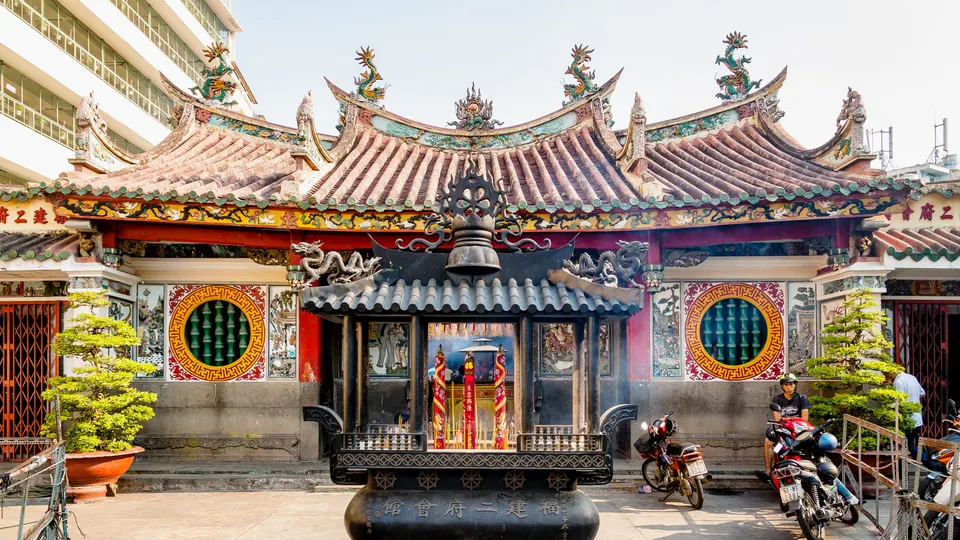
Nhi Phu, the “two prefectures” temple at 264 Hai Thuong Lan Ong, was founded jointly by the Quanzhou and Zhangzhou communities to honour Ong Bon, a guardian spirit, and is still widely called the Ong Bon temple. It became the Hokkien congregation’s hall after the 1871 regrouping. The Quynh Phu hall of the Hainanese at 276 Tran Hung Dao, founded in 1824, is the other quiet stop; its west wing housed a school the community founded, now a public high school.
Binh Tay market: what is there today?
Binh Tay is the market that gave modern Cholon its centre. The rice trader Quach Dam paid for a new market on reclaimed land in the late 1920s; VTC News dates its opening to 1928, while Tuoi Tre says it marked 95 years in 2025, so the exact year depends on the source. It combines a Chinese tiled roof and clock tower with a concrete frame, and it has been a city-level architectural relic since 2017.
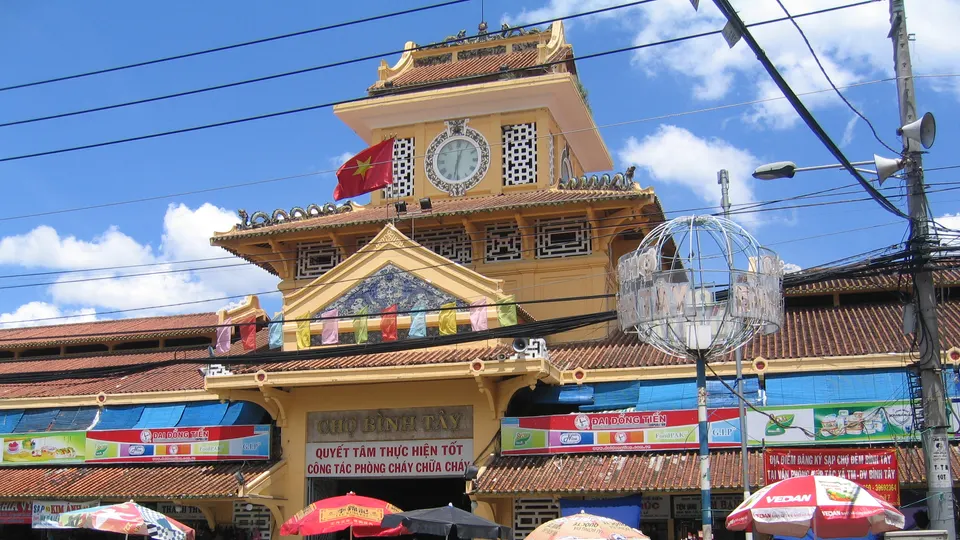
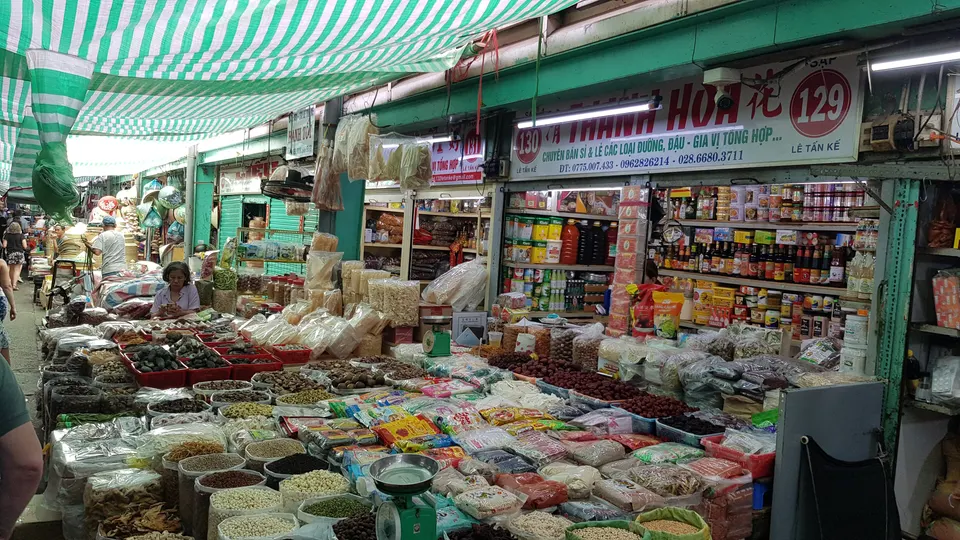
It is still a working wholesale market with more than 2,000 traders, and more than 35% of Binh Tay ward’s residents are Hoa, SGGP reported in October 2025. On 29 November 2025 the market’s management launched a weekend-morning heritage tour, Cham vao dau xua (“Touching the old traces”), with stories of Quach Dam, a lion dance and small workshops such as painting lion heads and folding lucky-money envelopes (SGGP). Come in the morning, look at the dried-goods and spice stalls, and remember that many traders sell in bulk. If you want a central market instead, compare it with Ben Thanh market.
Is the Cholon night street worth an evening?
Only if you are already in Cholon at night. The ward opened a night street on the sidewalks around Binh Tay market on a trial basis from 1 December 2025 and officially from 1 January 2026, with food trucks and carts along Nguyen Huu Than and Thap Muoi streets from 6 pm to midnight, Tuoi Tre reported. At a relaunch ceremony on 24 April 2026 it had 38 food points and about 800 visitors a day (Tuoi Tre).
The honest picture is mixed. A month after the official opening, Znews found few food carts, mostly drinks, and thin weekday crowds; visitors liked the open space and the lit-up market but missed Chinese food. For a Cholon dinner, the noodle and dessert shops in our Saigon food guide are the surer bet, and the wonton and Teochew styles of hu tieu are the dish to look for.
A half-day route and how to behave in the halls
A simple order works for most visitors, starting by taxi or ride-hailing from the centre in the morning:
- Binh Tay market for an hour, while trade is busiest.
- Hai Thuong Lan Ong and Nhi Phu temple, walking along the city’s main traditional-medicine street, the wholesale hub for southern Vietnam’s herbal trade, the district culture office says; before Mid-Autumn the nearby lantern street fills up, see our Mid-Autumn Festival guide.
- On Lang (Quan Am) hall on Lao Tu street.
- Ha Chuong, Thien Hau and Nghia An along Nguyen Trai, ending at Thien Hau.
- Quynh Phu and Minh Huong Gia Thanh on Tran Hung Dao if you still have energy.
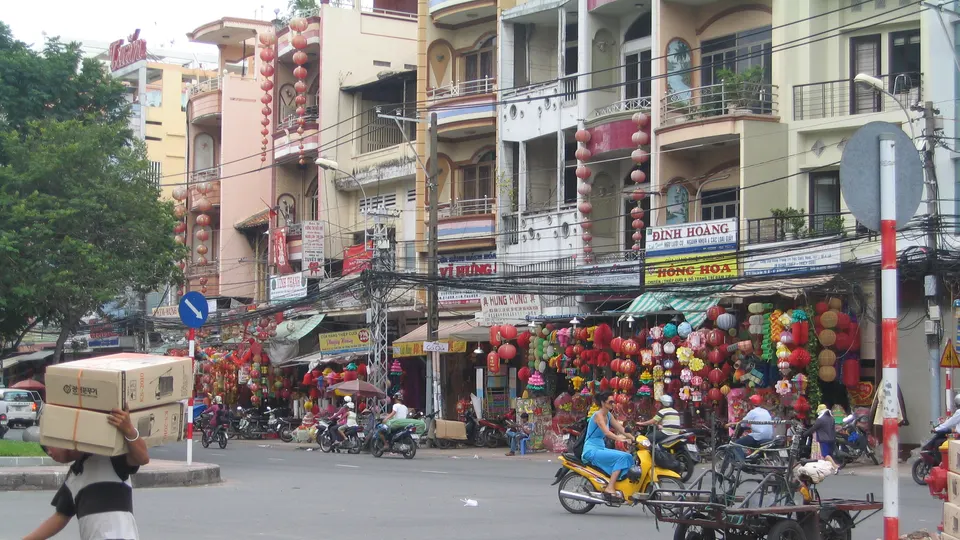
These are working places of worship. Dress modestly, keep your voice low, step around people who are praying, ask before photographing anyone at an altar, and do not climb on the stone lions or touch the altars. Buying incense is welcome but never required. The busiest days are the deity festivals and the first full moon after Lunar New Year, Nguyen Tieu, when halls such as Nghia An and Quynh Phu hold lion and dragon dances; our page on Tet and Chinese New Year explains how the Hoa celebration differs, and our Tet 2027 in Saigon guide gives the 2027 dates, including the Lantern Festival on 20 February. If you would like to stay nearby, Cholon is one of the areas compared in where to stay in Saigon.
Frequently asked questions
Is Cholon still District 5?
Not officially. Since 1 July 2025 the old districts of Ho Chi Minh City are gone: the temple streets of Cholon are in Cho Lon ward and Binh Tay market is in Binh Tay ward, although many signs, maps and websites still show the old District 5 and District 6 addresses.
Which temple in Cholon should I visit if I only have an hour?
Go to Thien Hau temple at 710 Nguyen Trai, the Cantonese hall of the sea goddess, then walk to Nghia An hall at 678 Nguyen Trai, the Teochew temple of Quan Cong. Together they show the two most common deities of Cholon's halls.
Is the Cholon night street worth going to?
Only if you are already in Cholon in the evening. The night street around Binh Tay market runs from 6 pm to midnight and had 38 food stalls at its official launch on 24 April 2026, but Znews reported thin crowds and mostly drink carts on weekdays in January 2026.
Can I take a tour of Binh Tay market?
Binh Tay market's management launched a weekend-morning heritage tour, Cham vao dau xua ('Touching the old traces'), on 29 November 2025, with stories of the founder Quach Dam and small craft workshops. Ask at the market office before you go, because later schedules were not published.
Key sources
- Nghị quyết 1685/NQ-UBTVQH15 về sắp xếp các đơn vị hành chính cấp xã của Thành phố Hồ Chí Minh năm 2025 · Standing Committee of the National Assembly (text via Hoatieu), June 2025
- Vì sao gọi là Chợ Lớn? · VTC News, 14 July 2026
- Hội quán Nhị Phủ (Nhi Phu Guildhall) · Quan 5 Xin Chao, District 5 Office of Culture, Science and Information, 2025
- Hội quán Ôn Lăng (On Lang Guild Hall) · Quan 5 Xin Chao, District 5 Office of Culture, Science and Information, 2025
- Khám phá 3 hội quán lâu đời ở Sài Gòn · Tuổi Trẻ, 30 June 2020
- Gìn giữ bản sắc Bình Tây giữa lòng đô thị hiện đại · Sài Gòn Giải Phóng (SGGP), 24 October 2025
- Chợ Bình Tây tấp nập đón khách cả ngày và đêm · Sài Gòn Giải Phóng (SGGP), 29 November 2025
- TP.HCM ra mắt phố đêm Chợ Lớn hoạt động từ 18h đến 0h · Tuổi Trẻ, 24 April 2026
All 18 sources and further reading
- Hội quán Hà Chương · Quan 5 Xin Chao, District 5 Office of Culture, Science and Information
- Hội quán Tuệ Thành (Tue Thanh Guildhall) · Quan 5 Xin Chao, District 5 Office of Culture, Science and Information, 2025
- Hội quán Nghĩa An · Quan 5 Xin Chao, District 5 Office of Culture, Science and Information, 2024
- Hội quán Quỳnh Phủ (Quynh Phu Guildhall) · Quan 5 Xin Chao, District 5 Office of Culture, Science and Information, 2025
- Đình, chùa cổ của người Minh Hương ở Sài Gòn · Pháp Luật TP.HCM (PLO)
- Phố đêm Chợ Lớn ở phường Bình Tây hoạt động từ 1-12 · Tuổi Trẻ, 24 November 2025
- Phố đêm Chợ Lớn đìu hiu · Znews, 30 January 2026
- TP.HCM có thêm một phố đêm du lịch · VnEconomy, November 2025
- Phố Đông y (traditional-medicine street) · Quan 5 Xin Chao, District 5 Office of Culture, Science and Information
- Chợ Lớn · Wikipedia
Keep exploring
 South Vietnam · Travel Ho Chi Minh City (Saigon): How Many Days and What to See Ho Chi Minh City (Saigon) explained: the 2025 merger and new wards, how many days to stay, Metro Line 1, Long Thanh airport, palace and museum tickets.
 South Vietnam · Travel Saigon in 3 Days: A Day-by-Day Plan for First Visits Saigon (Ho Chi Minh City) in 3 days: palace and war museum, Cho Lon and Vinh Khanh, then metro or a day trip. With 2026 tickets, ward names and what is closed.
 South Vietnam · Food Where to Eat in Saigon: Which Area for Which Meal Where to eat in Saigon by meal and area: pho in District 1, noodles in District 3, Vinh Khanh seafood, Cho Lon night street, plus 2026 MICHELIN picks.