South Vietnam · Food
Com Tam (Cơm Tấm) in Saigon: What to Order, What It Costs
Com tam is Saigon's broken rice plate: what suon, bi and cha mean, what a plate costs in 2026 press reports, and where the MICHELIN Bib Gourmand pick is.
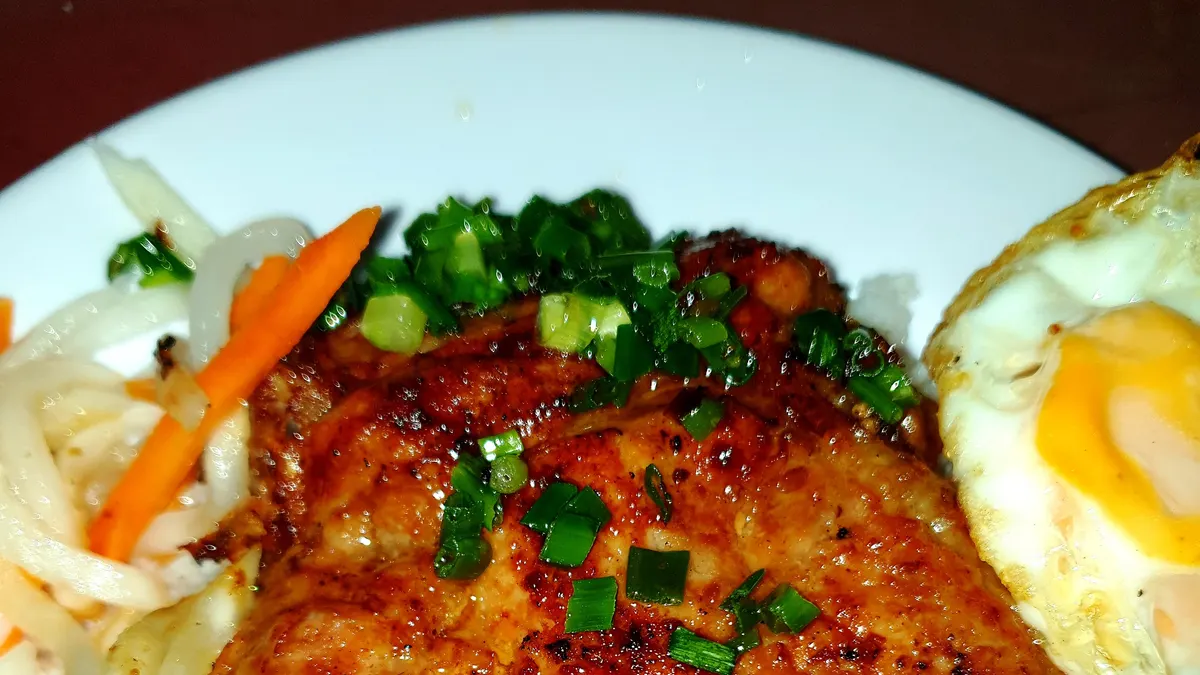
Com tam (Cơm tấm) is Ho Chi Minh City’s broken rice plate, and the order to know is suon bi cha: a charcoal-grilled pork chop, shredded pork skin and steamed egg meatloaf over broken rice, with sweet-sour fish sauce poured on top. Press reports from October 2025 to July 2026 put a plate at well-known Saigon stalls at roughly 40,000–80,000 VND, and as of November 2026 Com Tam Ba Ghien in Phu Nhuan still holds a Bib Gourmand in the MICHELIN Guide Vietnam 2026.
Com tam is broken rice, and it is the plate that Ho Chi Minh City thinks of as its own. Com (Cơm) means cooked rice and tam (tấm) means the small pieces of grain that break during drying and milling. A standard plate puts a charcoal-grilled pork chop, shredded pork skin and a slice of steamed egg meatloaf on a mound of that rice, with scallion oil, pickles and a jug of sweet-sour fish sauce to pour over everything. Vietnam’s national tourism board calls it “one of the few dishes that originated in Ho Chi Minh City” (vietnam.travel).
Many of the city’s best-known dishes arrived from elsewhere: pho (phở) from the North, hu tieu (hủ tiếu) from Chinese and Khmer kitchens. Com tam is the one Saigon claims as home-grown, and the MICHELIN Guide describes it as a symbol of pride for the city’s people. That is why it sits at the centre of Saigon’s food culture.
Com tam at a glance
| Part | Vietnamese | What it is | What it does on the plate |
|---|---|---|---|
| Broken rice | com tam (from gao tam (gạo tấm)) | Grain fragments left from drying and milling, soaked and then steamed or boiled | Cooks dry and separate, not sticky, so it soaks up sauce and fat |
| Grilled pork | suon nuong (sườn nướng) | A pork chop or rib, marinated (fish sauce, sugar, garlic, often lemongrass or honey) and grilled over charcoal | The centrepiece: sweet, smoky, caramelised |
| Pork skin | bi (bì) | Boiled pork skin and meat cut into thin strands, tossed with roasted rice powder (thinh (thính)) | Chewy texture and a toasty smell |
| Egg meatloaf | cha trung (chả trứng) | Minced pork steamed with egg, glass noodles and wood ear mushroom, often glazed with yolk | Soft, custardy contrast to the grilled meat |
| Fried egg | trung op la (trứng ốp la) | A sunny-side-up egg, optional | A runny yolk that dresses the rice |
| Scallion oil | mo hanh (mỡ hành) | Chopped spring onion in hot oil | Fragrance and richness for plain rice |
| Pickles and vegetables | do chua (đồ chua) | Pickled daikon and carrot (sometimes papaya or lotus stem), cucumber, tomato | Crunch and sourness that cut the fat |
| Fish sauce | nuoc mam pha (nước mắm pha) | Fish sauce mixed with sugar, garlic and chilli, sometimes pineapple juice | Poured over the whole plate; VnExpress International calls it the “spirit of the dish” |
What is on the plate, and what each part does
A plate of com tam is built in layers, and each part has a job. The rice comes first. It is not ordinary rice but the fragments left over from drying and milling, and properly cooked it should be dry and not sticky. VnExpress International calls the sweet fish sauce “the spirit of the dish”, and notes that the pickles of daikon, carrot or lotus stem are there because their crunch and sourness cut through the fattiness of the meat (VnExpress International).
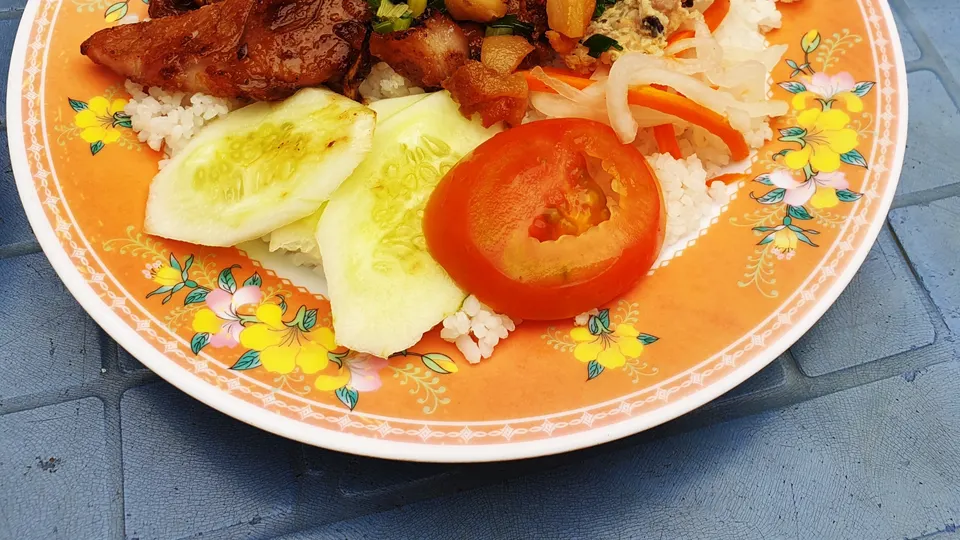
- Suon nuong (grilled pork). Usually a pork chop, though some shops grill ribs on the bone. The MICHELIN Guide describes a marinade of fish sauce, lemongrass, garlic and sugar; other cooks add honey for a glossy, crisp outside. The meat is grilled over charcoal; at some street stalls the cook trims the charred edges with scissors before it goes on the plate.
- Bi (shredded pork skin). Pork skin is boiled to remove the fat, cut into fine strands with some lean meat and mixed with thinh, roasted rice powder. It adds a dry, chewy, slightly toasty texture.
- Cha trung (egg meatloaf). Minced pork, egg, glass noodles (bun tau (bún tàu)) and wood ear mushroom are steamed in a tray, then brushed with egg yolk and steamed again so the top turns golden.
- Trung op (Trứng ốp) la (fried egg). Many diners add a sunny-side-up egg; the order cơm tấm sườn trứng means pork chop and egg.
- Mo hanh (scallion oil). Spring onion softened in hot fat, spooned over the rice. On the cheapest plates, rice with scallion oil and fish sauce was the whole meal.
- Do (Đồ) chua and fresh vegetables. Pickles, plus slices of cucumber and tomato.
- Nuoc mam (fish sauce). A sweet, sour and garlicky fish sauce, usually from a jug on the table. Some shops also serve a small bowl of soup on the side.
Why is com tam made with broken rice?
Because broken rice was the cheap rice. When paddy is dried and milled, some grains break. Whole grains fetched a better price, and the fragments were sold for little, kept by the farmers who grew them or used as animal feed. The national tourism board says those broken grains “were not fit for sale, so farmers would save and eat them”, and Vietnam (Việt Nam) News, quoting elderly Saigonese, says broken rice was considered inferior and was eaten in bad seasons when there was not enough good rice. Tuoi Tre (Tuổi Trẻ) News adds that old milling machines broke many grains and that poor workers collected them for their daily meals (Tuoi Tre News).
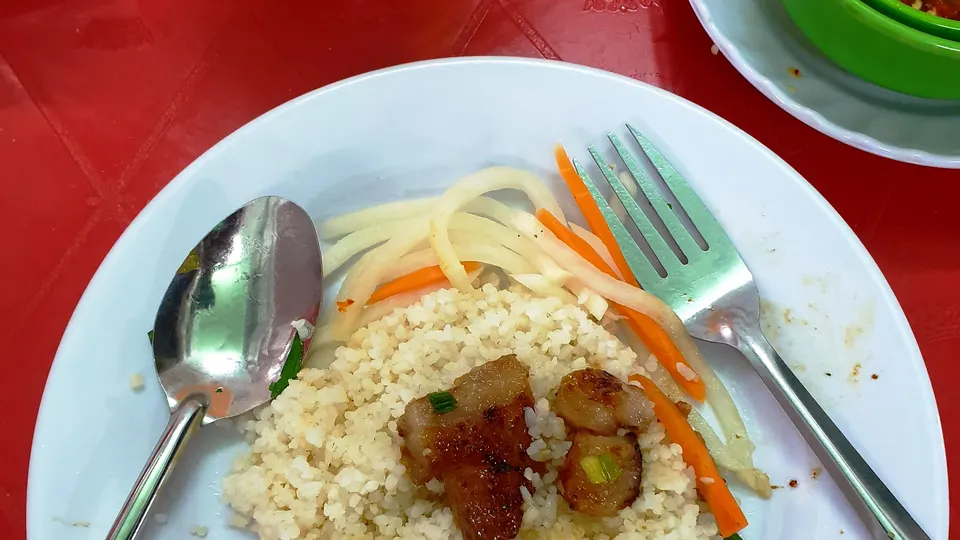
Beyond that, the story is debated, and no one can name an inventor. A Tuoi Tre feature writer notes that Vietnamese food references do not record when com tam began, and quotes an elderly Saigon resident who says it already existed before 1945. The main accounts:
- A Mekong Delta workers’ dish. The writer and researcher Son Nam (Sơn Nam) describes com tam as a dish of the working class in the Mekong Delta, which came to the cities with migrant workers.
- A Saigon adaptation. Son Nam is also cited by Vietnam News for the view that during the city’s urbanisation in the first half of the 20th century, Saigon cooks made the dish more suitable for foreign customers by adding grilled pork chops, shredded pork skin and steamed egg meatloaf, and served it on a plate with a spoon and fork.
- A named vendor. The MICHELIN Guide repeats one popular story, while noting that many versions exist: in the 1930s, when Saigon was growing as a port, a woman known as Ma Hai sold rice that blue-collar workers found too expensive, switched to cheap broken rice to keep the price down, added scallion oil, bi and cha (chả), and later grilled pork chops after French customers asked for them. It is best read as a popular story rather than documented history.
What the accounts agree on is the direction of travel. Com tam started as a filling plate for people who could not afford better rice, and gained its grilled pork and other toppings as the city grew richer.
Chop, ribs or Long Xuyen style: how com tam varies
The core plate hardly changes, but the toppings do. According to VnExpress International, the original serving was rice, scallion oil and shredded pork skin, and pork chops were for well-off families; fried eggs and chicken became common later. Today menus add Chinese sausage (lap xuong (lạp xưởng)), braised pork, shrimp, char siu or grilled pork rolls, and the most ordered plate is still suon bi cha (sườn bì chả).
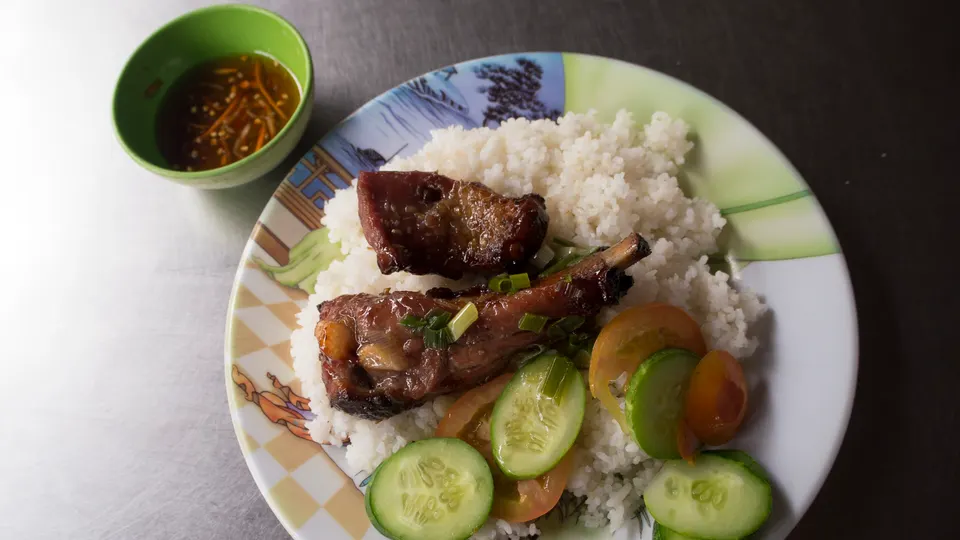
- Chop or rib. Most plates use a pork chop. Some stalls grill a rib piece with the bone still attached, which a VnExpress columnist watched the cook cut into three, and some shops sell a double plate with both chop and rib.
- Com tam Long Xuyen (Cơm tấm Long Xuyên). In this version from Long Xuyen (Long Xuyên), a Mekong Delta city in An Giang province, the grilled pork is replaced by caramelised braised pork and boiled egg, both sliced into thin strips and moistened with the braising sauce. The fish sauce is thicker and sweeter, and the rice is a smaller, firmer broken grain called com tam nhuyen (cơm tấm nhuyễn) (Saigoneer). A few shops in Ho Chi Minh City specialise in it.
- North and abroad. Com tam is now sold across Vietnam and overseas, but it is above all a Southern dish. A Tuoi Tre writer says it did not appear in Hanoi before 1990, and a Vietnam News reviewer notes that the Southern fish sauce is noticeably sweeter than its more pungent Northern cousin.
When and where Saigon eats com tam
In the past com tam was eaten only for breakfast; today it is sold at almost any hour, from street stalls to restaurants (Vietnam News). It still opens many people’s day, alongside the city’s other street breakfast, the loaded Saigon banh mi; our guide to Vietnamese breakfast by region shows how Saigon’s morning compares with Hanoi’s and Hue’s. The national tourism board calls it the city’s go-to breakfast, and some long-running family stalls, such as one on Vo Van Tan (Võ Văn Tần) Street that VnExpress International profiled in 2019, sell only from early morning until noon.
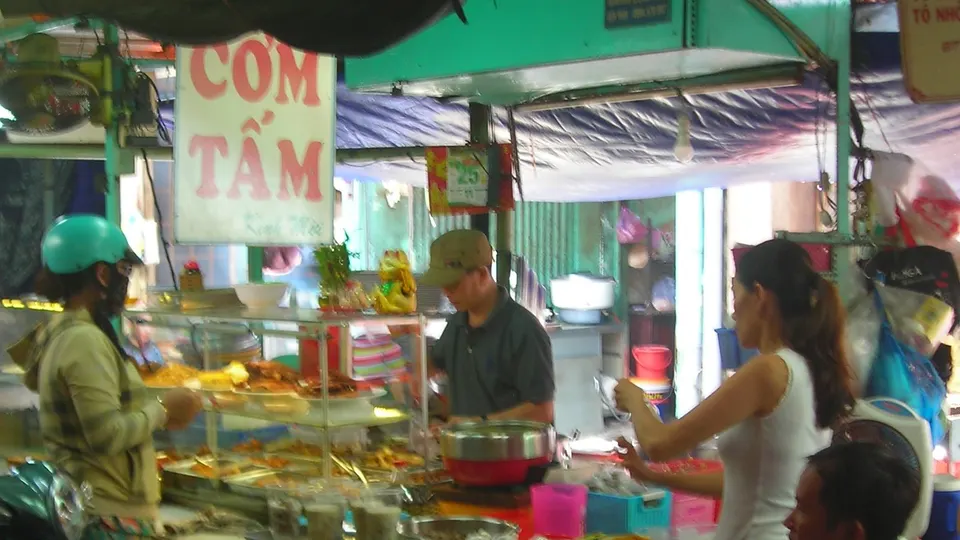
The setting runs from the pavement to air-conditioned restaurants. The typical stall has a charcoal grill and low plastic tables and stools on the sidewalk. A VnExpress columnist who eats at a street corner in the old District 1 describes these stalls as the backbone that has fed generations of students, office workers and labourers. At the other end, branded restaurants serve the same plate with more toppings and higher prices. The same low stools hold up the city’s sidewalk coffee culture.
Night is its own category. Com tam dem (Cơm tấm đêm) (night broken rice) feeds night-shift workers, market traders and people heading home late. Two long-running night shops have nicknames to match: com tam ma (cơm tấm ma) (“ghost broken rice”) in a lane off Dinh Tien Hoang (Đinh Tiên Hoàng) Street, and cơm tấm âm phủ (“underworld broken rice”), which VietNamNet described in 2023 as a sidewalk stall in the former District 6 that its owner started about 37 years earlier for night workers and vendors from a nearby market. To plan meals around the city’s food areas, see where to eat in Saigon, area by area.
Prices depend more on the shop and the toppings than on the time of day. The most recent Vietnamese press reports put a standard plate at roughly 40,000–80,000 VND, and a special cut costs more. Use this to pick a stop by when you are hungry:
| Where | Best for | Price reported | Hours reported | Source |
|---|---|---|---|---|
| Com tam ma, in a lane off Dinh Tien Hoang Street (Gia Dinh ward) | Late-night eating | 40,000–80,000 VND a plate | 4pm to 4am, now also at lunchtime | VietNamNet, Oct 2025 |
| Com tam so 1 Nguyen Trai (No. 1 Nguyen Trai Street) | An early breakfast | 50,000–80,000 VND a plate | 6am to noon; the shop sells for six months, then rests for six | CafeF, Jul 2026 |
| Com tam Que Mai, Tung Thien Vuong Street (Phu Dinh ward) | Trying suon canh buom, a double rib cut open like butterfly wings | 50,000 VND for the butterfly rib plate | Not stated | VietNamNet, Apr 2026 |
| Com Tam Ba Ghien, 84 Dang Van Ngu Street (Phu Nhuan ward) | A MICHELIN Bib Gourmand plate | MICHELIN’s lowest price tier; no figure given | Daily 9am to 9:30pm | MICHELIN listing, checked Nov 2026 |
Prices and hours at small stalls change often, so treat these as a guide and check on the day.
From workers’ plate to MICHELIN: com tam then and now
For most of its history com tam was a poor family’s meal: a few small tables by the roadside, rice with scallion oil and sweet-sour fish sauce, and meat only for those who could pay. Tuoi Tre’s feature remembers old stalls on what was then Ho Van Nga (Hồ Văn Ngà) Street (now Le Thi Hong Gam) and Tran Quy Cap (Trần Quý Cáp) Street (now Vo Van Tan). Over the decades the dish moved from roadside stalls and markets into restaurants, then beyond Saigon and overseas.
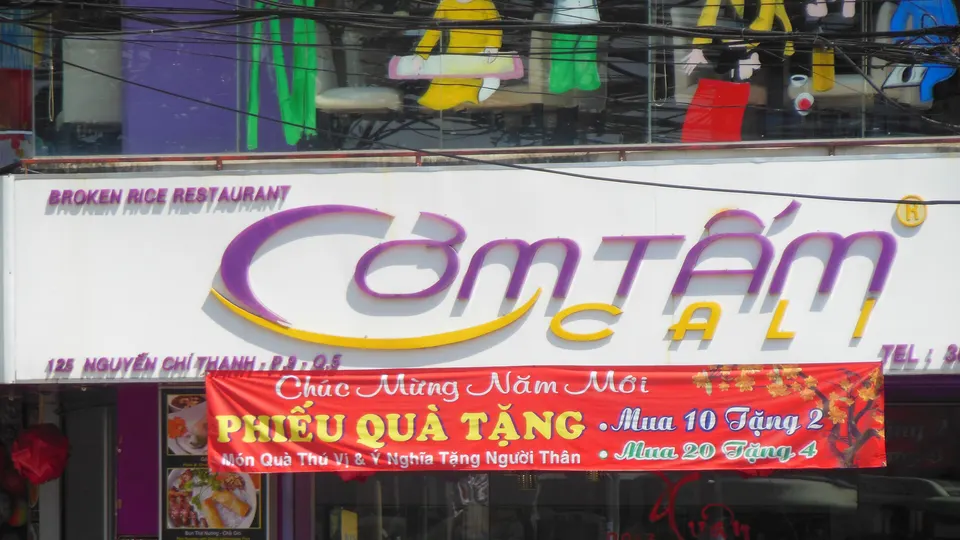
Some changes are easy to see:
- More on the plate. As living standards rose, the grilled pork moved from a luxury to the default, and menus grew to include chicken, shrimp, sausage and braised pork. Com Tam Thuan Kieu (Cơm Tấm Thuận Kiều), which VnExpress says became famous in the 1970s, was among the first to sell the full suon bi cha plate.
- Restaurants and brands. Restaurants that specialise in broken rice, such as Com Tam Cali and Com Tam Thuan Kieu (both named by Tuoi Tre News), now sit alongside the street stalls, and Vietnam News describes air-conditioned restaurants charging well above street prices.
- International recognition. When the MICHELIN Guide first covered Vietnam in 2023, it gave a Bib Gourmand to Com Tam Ba Ghien (Cơm Tấm Ba Ghiền) in Phu Nhuan (Phú Nhuận), the only com tam specialist on the list (MICHELIN Guide). It still holds that Bib Gourmand in the 2026 edition. The award started a public debate: Tuoi Tre News reported diners who thought the plate too expensive for what had always been a cheap dish, and regulars who said the huge pork chop made it fair value.
The cheap plate has not disappeared. Rice, scallion oil, pickles and sweet-sour fish sauce are still the base of every serving, and, as Vietnam News notes, cheap street-side stalls with their own flavours still sell it alongside the restaurants.
Recognition has continued. The fourth MICHELIN Guide Vietnam, announced in June 2026, listed 193 restaurants and eateries, 72 of them with a Bib Gourmand, Tuoi Tre News reported, and Ba Ghien is still among the Bib Gourmands on its 2026 listing page. In May 2026 Tuoi Tre reported that com tam suon (broken rice with grilled pork) ranked 29th, with four stars, in the food website TasteAtlas’s list of the 76 best pork dishes in Asia.
How to order and eat com tam
Ordering is simple once you know the words for the toppings. Shops build each plate to order, so name the toppings you want, or point at them.
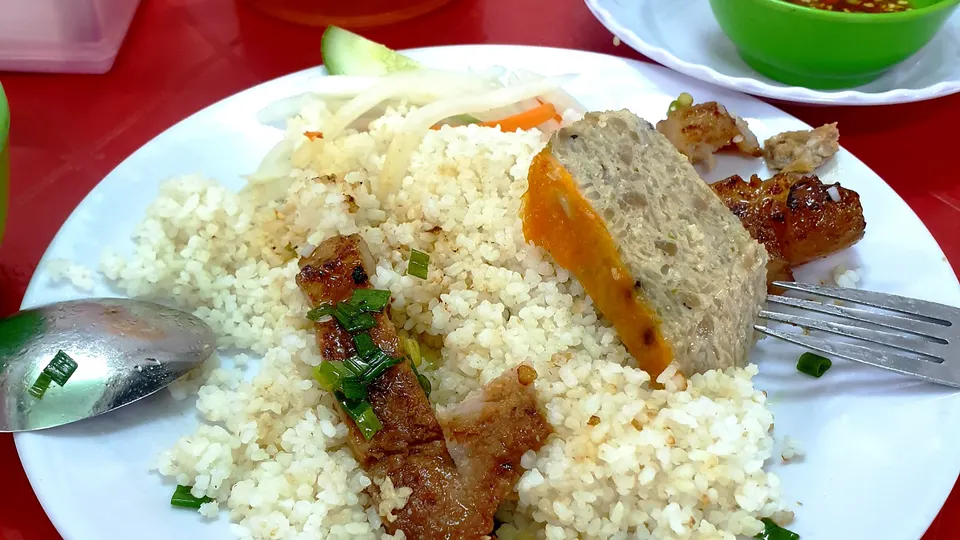
- Choose your toppings. Com tam suon (Cơm tấm sườn) is rice and pork chop. Suon bi cha is the classic trio of pork chop, shredded skin and egg meatloaf, also called sa bi chuong (sà bì chưởng) in Saigon slang. Suon trung (Sườn trứng) or suon op la (sườn ốp la) adds a fried egg. On some menus a plate marked dac biet (đặc biệt) (special) adds extra toppings; at Ba Ghien (Ba Ghiền), Tuoi Tre News reported, it adds a meatball, a fried egg and Chinese sausage.
- Ask for extras if you like. Them mo hanh (Thêm mỡ hành) means extra scallion oil, them do chua (thêm đồ chua) extra pickles. A small bowl of soup is often available on the side.
- Use a spoon and fork. Most shops set out a spoon and fork rather than chopsticks, a habit that dates from when com tam began to be served European-style on a plate.
- Pour the fish sauce over the rice. The sauce is not only a dip. Diners spread it over the rice and toppings; the national tourism board recommends “a generous amount”. Add chilli to taste.
- Expect a big plate. Portions at popular shops can be large; at Ba Ghien many diners share one plate or take half home.
One word helps in any Southern rice shop: here a dia (dĩa) is a plate, not a fork as in the North (more in our guide to Vietnamese accents by region).
If you like the grilled pork, compare com tam with Hanoi’s bun cha, where the same idea of charcoal-grilled, sweet-marinated pork goes into a bowl of dipping broth with noodles. For the soup that changed most on its way south, see Hanoi vs Saigon pho. Our South Vietnam hub covers the region, and the food section has more regional dishes.
Where to try cơm tấm in Ho Chi Minh City
MICHELIN Guide pick
Cơm Tấm Ba Ghiền · Cơm tấm Ba Ghiền
Ho Chi Minh City · Phú Nhuận ward (former Ward 10, Phú Nhuận district)
84 Đặng Văn Ngữ Street
A Bib Gourmand in the MICHELIN Guide Vietnam 2026 and the guide's only cơm tấm specialist since its first Vietnam edition in 2023. A family shop opened in 1995, known for a very large pork chop marinated in a house sauce and grilled over charcoal, served with pickled radish and sweet-and-sour fish sauce.
Order: Sườn bì chả (pork chop, shredded pork skin and egg meatloaf). One plate is a big portion; many diners share.
Listed in: MICHELIN Guide Vietnam 2026, MICHELIN Guide (2023), Tuổi Trẻ News (2023) · checked November 2026
Addresses and details can change; check before you go. We do not accept payment for listings.
Frequently asked questions
How much does com tam cost in Saigon in 2026?
Recent Vietnamese press reports put a plate at well-known Saigon stalls at about 40,000–80,000 VND: CafeF reported 50,000–80,000 VND at Com tam so 1 Nguyen Trai in July 2026, and VietNamNet reported 40,000–80,000 VND at the night shop com tam ma in October 2025. Extra toppings or special cuts cost more.
Is Com Tam Ba Ghien still in the MICHELIN Guide?
Yes. As of November 2026, Com Tam Ba Ghien at 84 Dang Van Ngu Street in Phu Nhuan ward holds a Bib Gourmand in the MICHELIN Guide Vietnam 2026, and its listing gives daily hours of 9am to 9:30pm. It has been the guide's com tam specialist since the first Vietnam edition in 2023.
Where can I eat com tam late at night in Saigon?
Night broken rice (com tam dem) shops stay open after midnight. VietNamNet reported in October 2025 that com tam ma, in a lane off Dinh Tien Hoang Street in Gia Dinh ward, grills and sells from 4pm until 4am.
Should I eat com tam with chopsticks or a spoon and fork?
Most Saigon com tam shops set out a spoon and fork, because the dish came to be served European-style on a plate. Chopsticks are not wrong, and nobody will mind.
Key sources
- 4th Michelin Guide Vietnam features 193 establishments, still overlooks banh mi · Tuổi Trẻ News, 5 June 2026
- Bún chả, cơm tấm sườn vào top những món thịt heo ngon nhất châu Á · Tuổi Trẻ, 21 May 2026
- Eating like a local in Ho Chi Minh City · Vietnam National Authority of Tourism (vietnam.travel)
- What Is Cơm Tấm? An Introduction to Ho Chi Minh City's Famous Broken Rice Dish and the Best Place to Get It · MICHELIN Guide, 25 Jul 2023
- Saigon has a gem called com tam · Tuổi Trẻ News, 18 Jan 2018
- Broken rice is the flavour of the south · Việt Nam News, 21 Dec 2020
- Broken rice: The evolution of a classic Vietnamese dish · VnExpress International, 1 Oct 2016
- Hẻm Gems: An alternative cơm tấm from Long Xuyên for thịt kho trứng fans · Saigoneer (first published 2024)
All 24 sources and further reading
- Lý do khiến giám đốc ở TPHCM bỏ việc để mở lại quán cơm tấm bình dân của mẹ · VietNamNet, 25 April 2026
- TP.HCM có tiệm cơm tấm "6 tháng bán, 6 tháng nghỉ", chủ quán 71 tuổi vẫn dậy từ 2 rưỡi sáng mỗi ngày · CafeF, 9 July 2026
- Cơm Tấm Ba Ghiền · MICHELIN Guide Vietnam 2026
- MICHELIN Bib Gourmand street food spots for cheap eats in Saigon · MICHELIN Guide, 6 Dec 2024
- Cơm tấm Sài Gòn: Từ bình dân đến sang trọng · Tuổi Trẻ, 21 May 2018
- Public opinion split on Com Tam Ba Ghien receiving Michelin recognition · Tuổi Trẻ News, 14 Jun 2023
- Some broken things don't need fixing – a 'cơm tấm' revelation · Việt Nam News
- Saigon family-run street stall makes broken rice a specialty · VnExpress International, 26 Aug 2019
- Sà bì chưởng – món ăn rất đỗi Sài Gòn · VnExpress, 28 Mar 2016
- Cơm tấm Sài Gòn · VnExpress (Jesse Peterson), 14 Aug 2021
- 'Cơm tấm ma' trứ danh Sài Gòn · VnExpress, 31 Oct 2015
- Com tam – a signature dish of Sai Gon · Vietnam News Agency (Vietnam Pictorial), 2 Aug 2021
- Quán cơm 'âm phủ' 37 năm bán lúc nửa đêm, khách nườm nượp ghé ăn · VietNamNet, 29 Aug 2023
- Quán cơm tấm ở TPHCM tên nghe đáng sợ, ngày nấu 3 bao gạo, khách ăn xuyên đêm · VietNamNet, 22 Oct 2025
- Best broken rice in Ho Chi Minh City · Vietnam Airlines travel guide
- Cơm tấm · Wikipedia (background; see its cited sources)
Keep exploring
 South Vietnam · Travel Ho Chi Minh City (Saigon): How Many Days and What to See Ho Chi Minh City (Saigon) explained: the 2025 merger and new wards, how many days to stay, Metro Line 1, Long Thanh airport, palace and museum tickets.
 North · Central · South · Food Hanoi vs Saigon Pho (Phở): Differences and How to Order Hanoi vs Saigon pho: a clear, spare Northern broth or a sweeter Southern bowl with herbs and sauces, plus Central styles, 2026 prices and MICHELIN picks.
 North Vietnam · Food Bun Cha (Bún Chả) in Hanoi: How to Eat It, What It Costs What bun cha is, why Hanoi eats it at lunch over charcoal smoke, how to eat it the local way, and how it differs from southern bun thit nuong.
 South Vietnam · Travel Mekong Delta: Which Area to Visit and Where to Base Which part of the Mekong Delta to visit and where to base: Can Tho, Ben Tre or Chau Doc, Cai Rang market hours, seasons, where to eat, new province names.