All three regions · Food
Banh Mi (Bánh Mì) by Region: Which Style to Try Where
Which banh mi to try where: Saigon's loaded roll, Hanoi's pate-led bread and beef stew, Hai Phong's stick-thin banh mi que, Hoi An's crisp roll, plus prices.
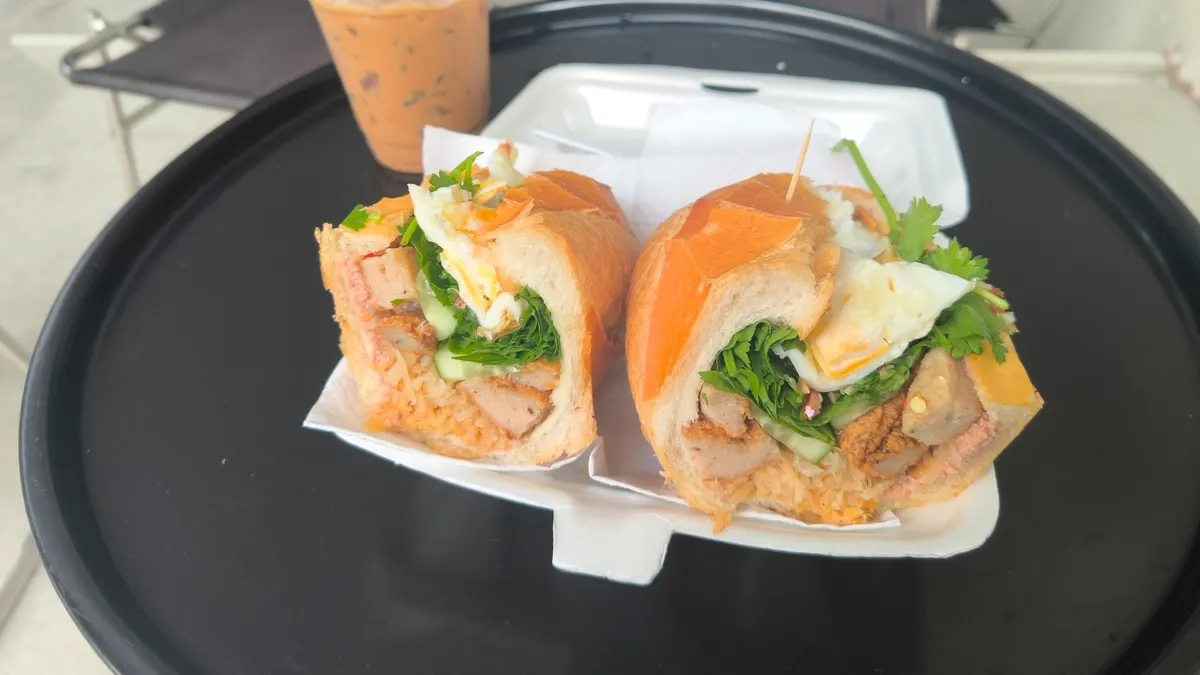
Which banh mi (bánh mì) to eat depends on the city: Saigon sells a big roll loaded with pate, cold cuts and pickles, Hanoi a leaner pate-and-butter roll or bread for dipping in beef stew, Hai Phong (Hải Phòng) a stick-thin roll holding only pate, and Hoi An (Hội An) a crisp, herb-filled sandwich with a sweet-and-sour chilli sauce. As of November 2026 the choice is yours rather than an inspector’s: the MICHELIN Guide Vietnam 2026, announced on 4 June 2026 with 193 establishments, again lists no banh mi shop in Vietnam, Tuoi Tre News and Znews reported. Plan by the clock instead, because several of the best-known stalls sell only in the morning and Hai Phong’s famous pate cart only at night.
Ask for a banh mi in Ho Chi Minh City and you usually get a fat, crackling roll split along its length and packed with pate (pâté), several kinds of cold cuts, pork floss, pickled carrot and daikon, cucumber, coriander, chilli and a spoonful of sauce. Ask for one in Hanoi and the traditional answer is a smaller, plainer affair: butter, liver pate, a meat or two, cucumber and a ground chilli sauce. In Hoi An the bread is famously crisp and the house sauce is the point. In the port city of Hai Phong, banh mi is a stick no wider than two fingers, holding nothing but pate.
All four are banh mi, which in Vietnamese simply means “wheat bread”. What changes is what each city put inside it, and that has a lot to do with who lived there, what they could buy and how they ate. This guide compares the main styles, explains where the filled sandwich came from, and shows how to order without guessing. For the same North–South story told through a soup, see our Hanoi vs Saigon pho guide; for more dishes, browse the Vietnamese food hub.
Banh mi by region at a glance
| Saigon (Ho Chi Minh City) | Hanoi | Hai Phong | Hoi An | |
|---|---|---|---|---|
| Typical name | Banh mi thit, banh mi Saigon | Banh mi pa-te; banh mi sot vang | Banh mi cay, banh mi que | Banh mi Hoi An, banh mi thap cam |
| Bread | Airy roll, often generously sized | Standard roll | Thin stick, about two fingers wide | Very crisp crust |
| Core filling | Pate, several cold cuts, pork floss | Liver pate and butter, one or two meats | Pate only | Pate, meats, egg, fresh herbs |
| Vegetables | Pickled carrot and daikon, cucumber, coriander | Cucumber, coriander; little else in the classic version | None | Herbs, cucumber, shredded green papaya |
| Sauce | Chilli and house sauce | Ground chilli sauce | Chi chuong (chilli, tomato, garlic, salt) on the side | House sweet-and-sour chilli sauce |
| How it is eaten | One big roll | A quick roll, or bread dipped in a stew or eaten from a pan | Several at a time, as a snack | One roll |
| Local twists | Roast pork, xiu mai meatballs, Chinese-style pha lau, pan-served chao | Beef stew (sot vang), pan-served chao | Charcoal-baked bread | Vegetarian and egg versions are common |
The table describes the common pattern. Every city now sells almost every style, and the sections below note the exceptions.
Saigon: the loaded banh mi thit
The style most visitors picture when they hear “banh mi” is Saigon’s banh mi thit (bánh mì thịt), “banh mi with meat”. Vietnam’s national tourism board lists its usual contents as several kinds of Vietnamese ham, char siu or fried pork, butter, pate, pork floss, pickled carrots, cucumber and coriander. Tuoi Tre’s history series describes the standard Saigon combination of the 1960s, sold by shops such as Hoa Ma (Hòa Mã) on Cao Thang (Cao Thắng) Street, in almost the same words: butter, pate, cold cuts, shredded pork floss, pickles and chilli-garlic.
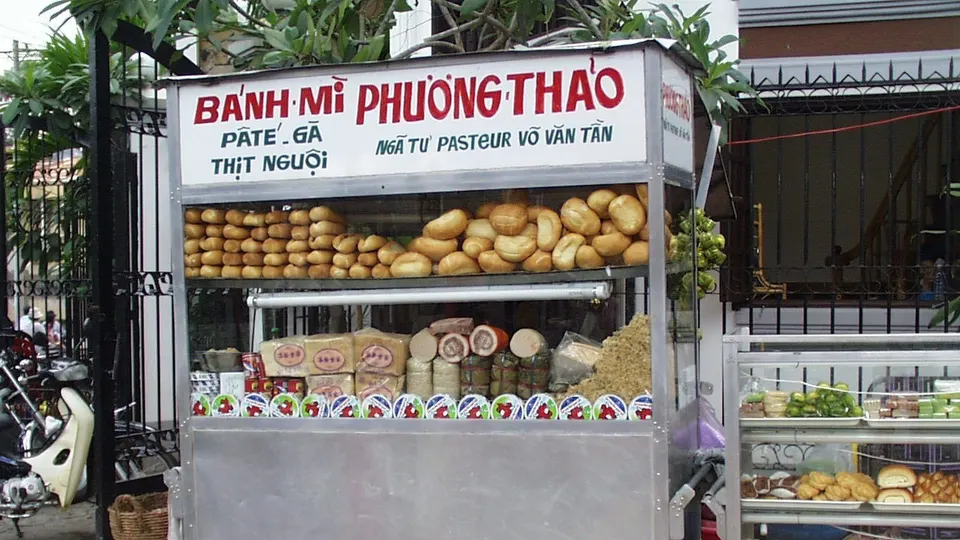
Why so much in one roll? Saigon’s banh mi absorbed the tastes of the communities that live in the city. According to Tuoi Tre, southerners came to like roast pork, xiu mai (xíu mại) meatballs, bi (shredded pork skin) and braised pork inside the bread, while Chinese-Vietnamese shops filled it with pha lau (phá lấu) offal stew, char siu, roast duck or grilled beef. That tradition is still trading: in Cho Lon, a family shop known as Banh Mi Tang (Tăng) still reheats its pate in decades-old ovens and serves its xiu mai the Chinese way, VOH reported in April 2026. Tuoi Tre dates the city’s best-known shop, Hoa Ma, to 1958, when a couple who had moved from Hanoi in 1954 opened it and, after a few years, began stuffing cold cuts, cha lua (chả lụa) and pate inside the loaf; that combination came to be called “bánh mì Sài Gòn” to set it apart from other styles.
From the 1980s, the paper adds, Saigon’s banh mi kept multiplying as people from all over Vietnam settled in the city. The extreme is the “super” banh mi: at Huynh Hoa (Huỳnh Hoa) on Le Thi Rieng (Lê Thị Riêng) Street, Vietcetera counts 13 ingredients in one roll (Vietcetera). If you like a sandwich that is a meal, Saigon is your city. If you are planning a visit, our Saigon eating guide by area and the Ho Chi Minh City guide are good next stops.
Hanoi: pate first, and bread you dip
Hanoi’s classic banh mi is the restrained one. Bao Lam Dong’s guide to Hanoi banh mi describes the traditional version as minimal: butter, rich liver pate and pork floss or ham, with cucumber and coriander, finished with the ground chilli sauce that is its signature. Tuoi Tre notes the same northern preference for pate, gio lua (pork roll), jambon and ruoc (dried pork floss).
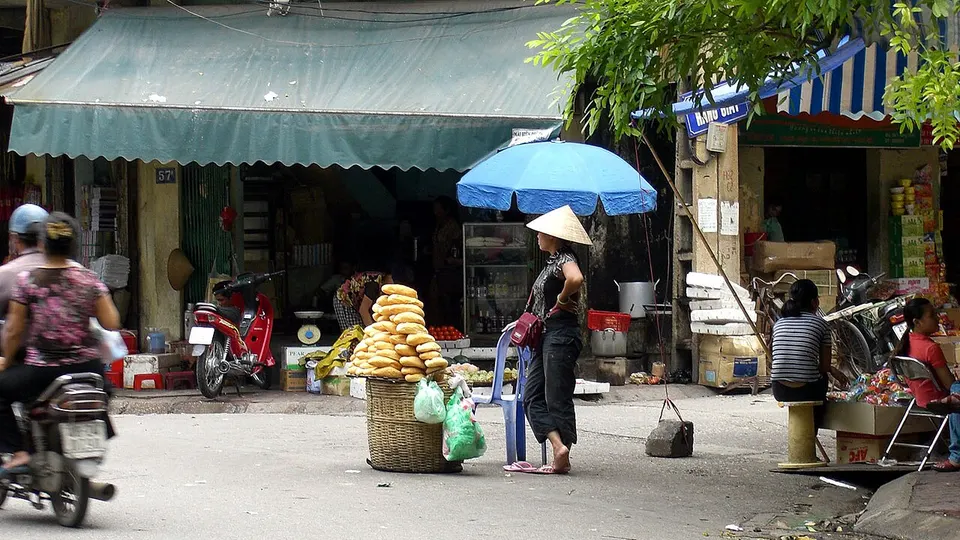
That plainness is partly history. Bread reached Hanoi early: Tuoi Tre cites an 1885 French article that already records a bread shop near today’s Trang Tien (Tràng Tiền) street, where European shops first opened. For decades bread was a breakfast for colonial officials, eaten with milk coffee; only after the Doi moi (Đổi mới) reforms of the late 1980s, the series says, did it become everyone’s quick meal. Hanoi’s famous pate shop Nguyen Sinh (Nguyên Sinh) opened in 1942 and, according to Znews, has traded in Ho Chi Minh City since the late 1970s.
The lean style is still easy to find. In the Old Quarter, a family stall on Hang Gai (Hàng Gai) street has sold banh mi since 1979 with homemade pate, char siu, pork floss, butter and a red pork sausage, and no pickles or herbs; it trades only in the morning (VietNamNet, April 2026). Our Old Quarter eating guide fits it into a morning route.
Hanoi also does things with bread that are not sandwiches at all. Banh mi sot vang (bánh mì sốt vang) is beef stewed in a spiced, wine-coloured sauce, served in a bowl with bread for dipping; at the well-known shop on Dinh Ngang (Đình Ngang) Street, beef tendon is stewed for a long time with five-spice and cardamom (VietnamPlus). And the rule of restraint is loosening: Tuoi Tre’s Hanoi writer notes that shops are now expected to offer at least five or seven fillings, and that Saigon’s “super” banh mi has become popular in the capital. Our Hanoi guide explains more of the city’s Northern way with food.
Hai Phong: banh mi cay, two fingers wide
The northern port city of Hai Phong has its own answer: banh mi cay (“spicy banh mi”), also called banh mi que (bánh mì que), “stick banh mi”. Vietnam News calls it the smallest of all banh mi, “only two fingers in width”, filled only with pate, with no meat or vegetables. The pate, made from pork and liver, should be smooth and slightly pink and taste of liver and garlic (Vietnam News).
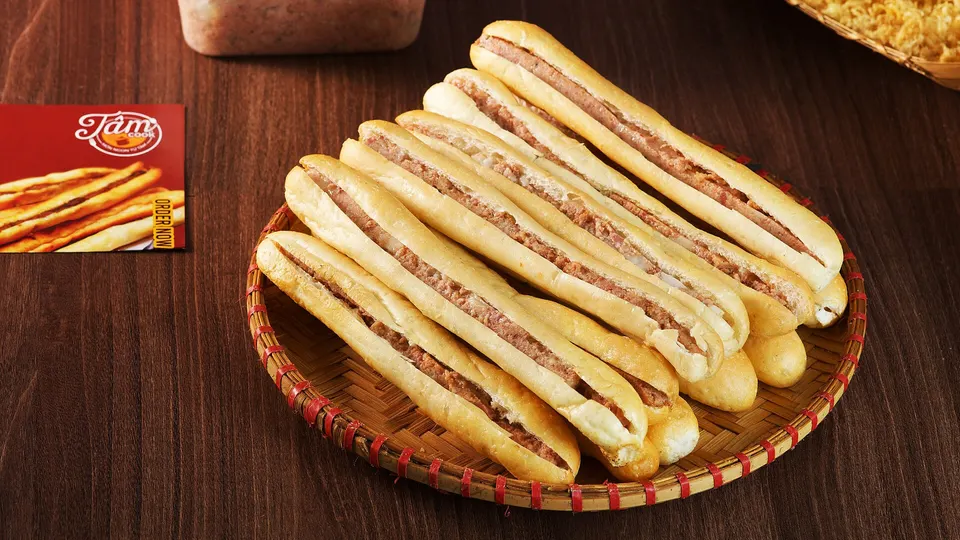
The heat comes from chi chuong (chí chương), a chilli sauce made from chilli, tomato, garlic and salt, which sellers keep on the side so you can choose how much to add. VietNamNet describes the bread as drizzled with oil and baked over charcoal until crusty. Because each stick is so small, people eat several at once; a local quoted by Vietnam News reckons five or six make a breakfast. It is also a late-night food: VnExpress’s 2023 guide to eating at night in Hai Phong lists an unsigned pate cart at the Cot Den (Cột Đèn) market crossroads that trades from 7pm to 3am, a corner VietNamNet also names for banh mi cay.
Who invented it is not settled. VietNamNet (2017) credits a woman named Hoang Thi Toan (Hoàng Thị Toàn), whose customers called her “Ba Gia” (“old lady”), a name she then gave her shop, and dates her recipe to about twenty years earlier; Vietnam News (2022) quotes a “Chính Hiệu Bà Già” shop whose family says it has sold the snack for nearly 40 years. Either way, banh mi que has spread: Hanoi shops now sell Hai Phong-style sticks, and VietNamNet lists several in the capital. If you are heading to the coast, our Cat Ba guide covers the islands off Hai Phong.
Hoi An: the sandwich a small town is known for
Hoi An, the old trading port in Central Vietnam (since July 2025 part of Da Nang (Đà Nẵng) city), has become a banh mi destination in its own right. The Vietnam Airlines travel guide describes what its best-known shops share: a crisp crust that does not shatter, rich pork-liver pate, plenty of fresh local herbs and vegetables, and a sweet-and-sour chilli sauce that each family makes its own way (Vietnam Airlines). Revealingly, the same guide lists a shop selling a soft, airy “Saigon-style” roll and notes that it is not the Hoi An kind.
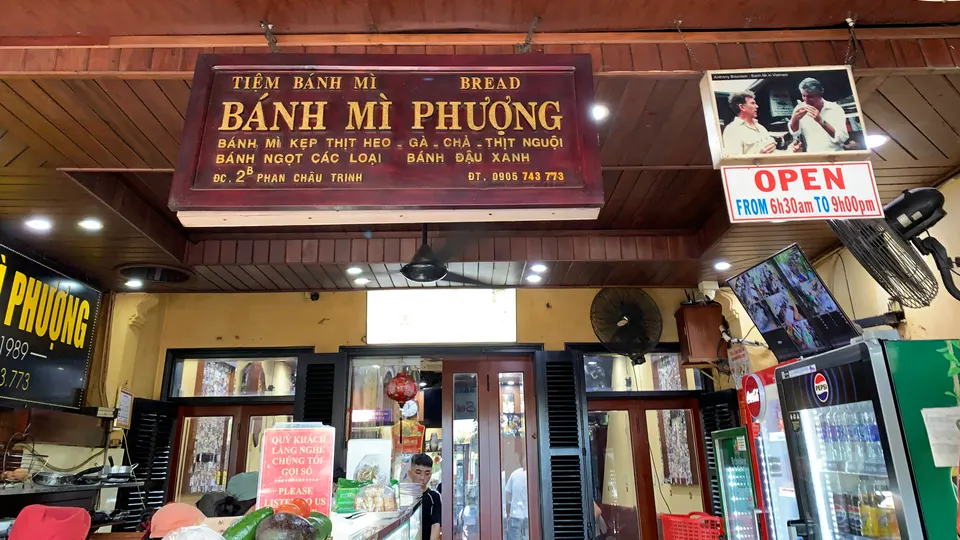
Two names dominate. Banh Mi Phuong (Bánh Mì Phượng) adds shredded green papaya and a family sauce, and the culture paper Bao Van Hoa says its fame spread abroad through international food programmes; the shop was briefly suspended after a food-poisoning outbreak in 2023 and reopened in January 2024 with tighter hygiene rules, KTSG Online reported. Madam Khanh (Khánh), about a kilometre from the central market, was opened in 1975 by Nguyen Thi Loc (Nguyễn Thị Lộc) and her husband, VnExpress International reported in August 2024; her daughter now runs it, selling six kinds of banh mi with a homemade sauce, plus vegetarian rolls with egg and tofu. A 2015 VietNamNet profile put the business at nearly 60 years old, so its starting date is not fully settled.
Hoi An is also one of the easiest places in Vietnam to find a vegetarian banh mi, with several dedicated shops. Our Hoi An guide covers the old town itself, where to eat in Hoi An maps the rest of the menu, and cao lau is the noodle dish to eat next.
Central Vietnam beyond Hoi An: fish cake and beef sausage
Bread came late to much of Central Vietnam. Tuoi Tre quotes a 1926 account saying that in Hue (Huế) and the central region banh mi was “still not common” among ordinary people. When it did catch on, the centre filled it with what it already ate well: Tuoi Tre notes that Central Vietnamese chose banh mi with cha bo (beef sausage) and cha ca (fish cake).
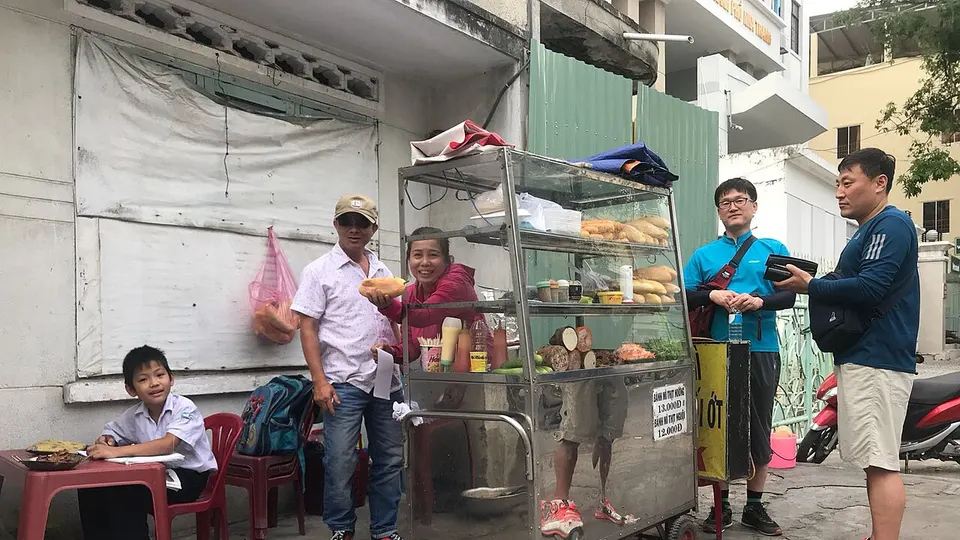
The fish-cake version is tied to the coast. Vietnam’s tourism board says fish cakes come from the seaside city of Nha Trang and were later put into banh mi, giving banh mi cha ca (bánh mì chả cá): springy fried fish cake with black pepper, herbs, cucumber and a garlic-chilli soy sauce (Vietnam Tourism). You will also find it in Saigon, but if you are in Nha Trang it is the local choice.
Banh mi chao: when the filling comes in a pan
One style crosses the North–South line: banh mi chao (bánh mì chảo), “pan banh mi”. Instead of being stuffed into the loaf, the filling arrives sizzling in a small iron pan, typically fried eggs with pate, sausage, ham or cha (chả), and you tear the bread and eat from the pan.
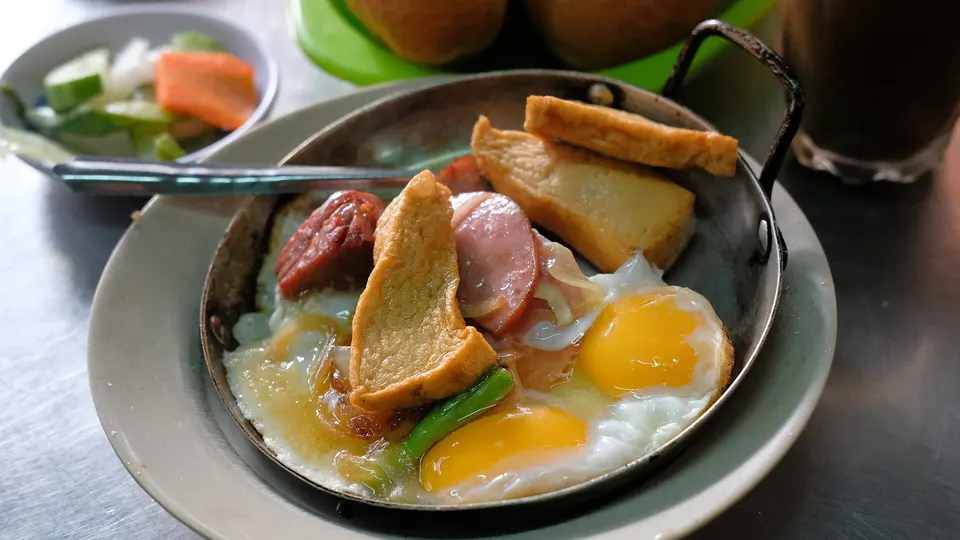
In Saigon, Hoa Ma has long served a pan of eggs, ham, two kinds of cha, sausage and salted pork belly to eat on the spot, as Tuoi Tre described in 2020. In Hanoi, Vietnam News called banh mi chao a newer trend there, with mashed potato, omelette and sweet sauces, and said the sauce is what sets one shop apart from another (Vietnam News). Order it when you have time to sit down; it is breakfast, not a snack to carry.
Where banh mi came from, and what is still debated
The bread itself is the uncontested part. Tuoi Tre’s history series says the French baguette was familiar in Vietnam’s cities by the end of the 19th century. Vietnamese first ate it in slices with soup, steak, fried eggs and milk coffee, then shortened the long loaf; the small roll first appeared in Saigon bakeries around the start of the 20th century, and the historian Erica J. Peters notes that by 1910 these “petit pain” were sold on the street as a breakfast to eat on the way to work.
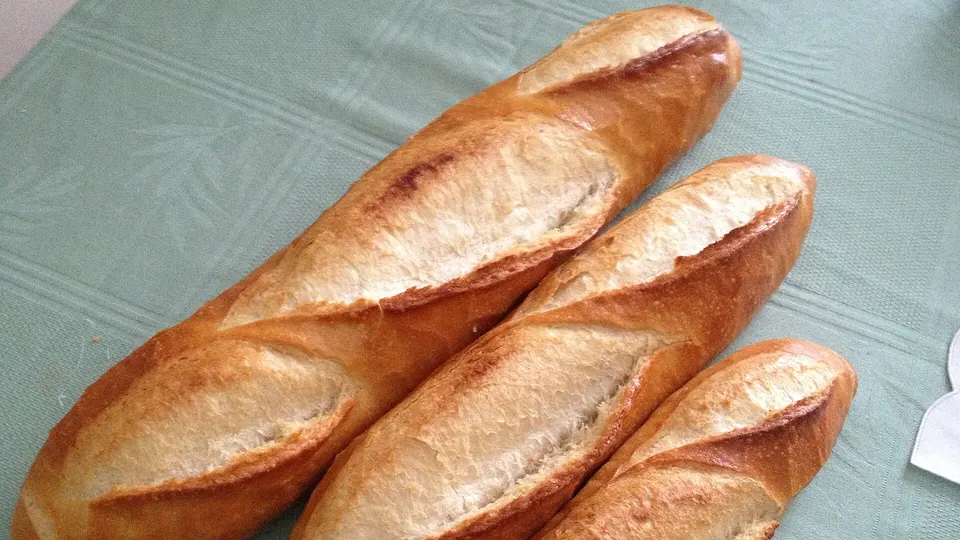
Two further claims recur in Vietnamese accounts. First, the lighter Vietnamese crumb: Tuoi Tre says that when imported wheat flour ran short during the First World War, bakers mixed in rice flour, giving a softer, cheaper bread, and it quotes a 1942 colonial decree that ordered rice and corn flour mixed into bread flour. Second, the filled sandwich: the same series says it appeared after the French left in 1954, when bakers made the crumb airier so the loaf could hold cold cuts, herbs and pickles, and it dates Hoa Ma to 1958 (Tuoi Tre). Yet another part of the series quotes southern novels from 1931 and 1941 in which characters already eat bread with Chinese sausage or a tin of pate. The safest reading is that bread with fillings existed before 1954, and that the generously layered “bánh mì Sài Gòn” took shape in the late 1950s and 1960s. Znews, for one, dates Hoa Ma only to “around the 1960s”. Two other accounts back 1958: Saigoneer, drawing on Roads & Kingdoms, says the banh mi “as we know it” was born after 1954 at Hoa Ma, whose northern-born owners shortened the loaf and moved the fillings inside it, and VietNamNet (May 2026) says the founders’ grandson still runs the shop.
After 1975 the sandwich travelled with Vietnamese emigrants. The word “banh mi” entered the Oxford English Dictionary on 24 March 2011, and Google marked the anniversary with a banh mi Doodle on 24 March 2020, VnExpress International reported. In 2022 a conference in Ho Chi Minh City, organised by Thanh Nien newspaper with chefs’ and tourism groups, proposed 24 March as a Vietnamese Banh Mi Day (VietNamNet); we found no official recognition of the day since. The city’s banh mi festival is a separate event, held in April: its fourth edition ran from 23 to 26 April 2026, Tuoi Tre News reported.
Planning a banh mi trail: when each style is sold
Banh mi is made to order at carts and counters, so the planning question is less where than when: several of the best-known stalls keep short hours, and Hai Phong’s famous pate cart only opens at night. The table brings together the timings the Vietnamese press has reported for the places on this page; hours change, so treat them as a guide.
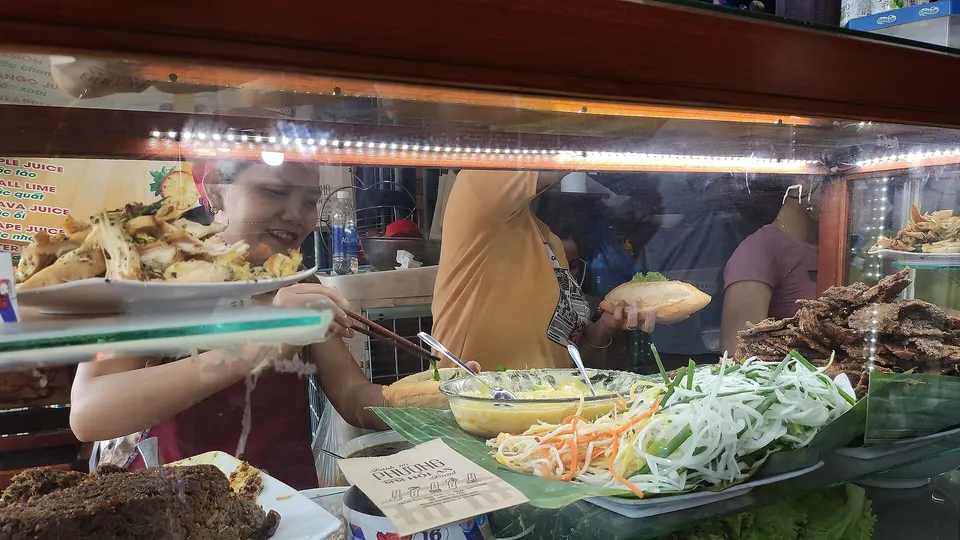
| Region | Style to look for | When it trades (as reported) | Good to know |
|---|---|---|---|
| Saigon | Loaded banh mi thit; banh mi chao to eat in | Hoa Ma: daily 6–11am (VietNamNet, May 2026) | Cho Lon’s Banh Mi Tang keeps the Chinese-style xiu mai and grilled pate |
| Hanoi | Lean banh mi pa-te; banh mi sot vang; banh mi dan to (bánh mì dân tổ), with all the fillings stir-fried in one pan | The Hang Gai stall: daily 5:15–10:15am (VietNamNet, April 2026); the dan to stall on Tran Nhat Duat (Trần Nhật Duật) street late at night and before dawn (Bao Lam Dong, November 2025) | Sot vang comes as a bowl of stew with bread on the side |
| Hai Phong | Banh mi cay or banh mi que | The unsigned pate cart at the Cot Den market crossroads: 7pm to 3am (VnExpress, December 2023) | People eat several sticks at once; the chi chuong chilli sauce is on the side |
| Hoi An | The mixed roll; vegetarian rolls | Madam Khanh: daily, about 8am to 7pm (VnExpress International, August 2024) | Some shops sell a softer “Saigon-style” roll, so check which bread you are getting |
| Central coast | Banh mi cha ca (fish cake) | No reliable timing found | The local choice in Nha Trang |
Whatever the city, eat it on the spot or on the way, while the crust is still crisp. For the words to use at the counter, from picking fillings to asking for less chilli or no pate, see our step-by-step guide on how to order banh mi.
Which banh mi suits you
Choose by what you like, not by which city claims to be the original.
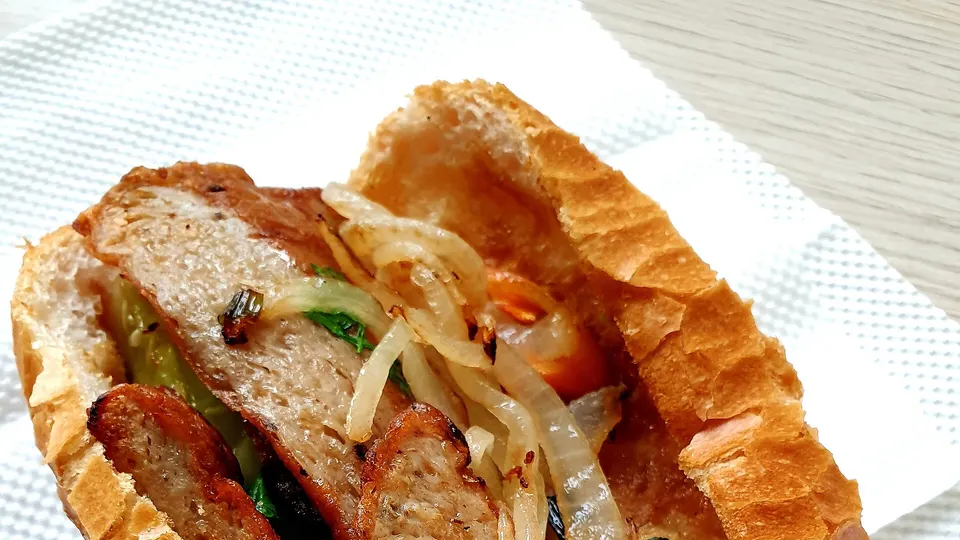
The prices are the latest the press has reported for one named shop per style; they change fast, so treat them as a guide.
| Pick | Who it suits | Price reported (shop, source) | Effort |
|---|---|---|---|
| Saigon banh mi thit, or a “super” roll such as Huynh Hoa’s | You want a full meal in your hand | VND42,000 for a filled roll at Hoa Ma (VietNamNet, May 2026) | Grab and go; Hoa Ma trades 6–11am |
| Hanoi banh mi pa-te | You love the bread and pate themselves | VND15,000 a roll at the Hang Gai stall (VietNamNet, April 2026) | Morning only; expect a queue by 7am |
| Hai Phong banh mi cay | Pate lovers who like to snack | No recent price found | Eat several sticks at once; the Cot Den cart trades at night |
| Banh mi chao, or Hanoi’s banh mi sot vang | You want a warm, sit-down breakfast | VND62,000–64,000 for a pan of banh mi op la at Hoa Ma (VietNamNet, May 2026) | Sit down to eat; not a snack to carry |
| Hoi An mixed or vegetarian roll | You like herbs and a sweet-sour kick | VND25,000–30,000 at Madam Khanh (VnExpress International, August 2024) | Grab and go; Madam Khanh opens about 8am–7pm |
| Banh mi cha ca | You prefer seafood | No recent price found | Grab and go; the local choice in Nha Trang |
One thing you will not find is a MICHELIN-listed banh mi in Vietnam: no shop made any list of the 2026 MICHELIN Guide Vietnam, announced on 4 June 2026 with 193 establishments, the fourth year running, even though banh mi shops abroad have been listed (Tuoi Tre News). The places below are local favourites recommended by Vietnamese and international press, not guide picks.
Where to try banh mi in Saigon, Hanoi and Hoi An
Local favourite
Bánh Mì Hòa Mã · Bánh mì Hòa Mã
Ho Chi Minh City · Bàn Cờ ward (former District 3)
53 Cao Thắng Street (at the entrance of the alley)
Opened in 1958 by a couple who had moved from Hanoi, and named by Tuổi Trẻ among Saigon's best-known bánh mì shops of the 1960s; VietNamNet (May 2026) says the founders' grandson, the third generation, runs it today. It is best known for eating in: a hot pan of eggs, ham, chả and sausage with bread on the side.
Order: Bánh mì chảo (ốp la đủ thứ) to eat on the spot, or a cold-cut bánh mì to take away.
Morning only: VietNamNet (May 2026) gives 6–11am daily, VND42,000 for a filled roll and VND62,000–64,000 for a pan of bánh mì ốp la.
Recommended by: Znews (2026), VietNamNet (2026), Tuổi Trẻ (2022) · checked November 2026
Local favourite
Bánh Mì Huỳnh Hoa · Bánh mì Huỳnh Hoa
Ho Chi Minh City · Former District 1
26 Lê Thị Riêng Street
The best-known example of Saigon's 'super' bánh mì: a roll packed with many fillings (Vietcetera counts 13 ingredients). Founded by Lê Kim Hoa, whose father ran a street stall nearby; the brand has more than 35 years of history.
Order: The house bánh mì with all the fillings.
This card means the original shop at 26 Lê Thị Riêng; other shops with similar names are not covered here.
Recommended by: Vietcetera (2025), Tuổi Trẻ News (2019) · checked November 2026
Local favourite
Bánh Mì Tăng · Bánh mì Tăng
Ho Chi Minh City · Chợ Lớn ward (former District 5)
822 Nguyễn Trãi Street, at the corner with Phùng Hưng Street
The Chinese-Vietnamese side of Saigon bánh mì: Znews (2026) lists it among the city's bánh mì shops more than 50 years old, known for grilled pâté and xíu mại meatballs in sauce, and VOH (2026) says the third generation still reheats the pâté in decades-old ovens and keeps the Chinese-style xíu mại.
Order: Bánh mì with grilled pâté, or bánh mì xíu mại.
Founding dates differ between sources (Znews 1950, VOH 1968), so the page gives none.
Recommended by: Znews (2026), VOH (2026) · checked November 2026
Local favourite
Bánh Mì Hàng Gai (Mrs Linh's stall) · Bánh mì Hàng Gai
Hanoi · Old Quarter, Hoàn Kiếm ward
Hàng Gai Street, on the pavement about 300 m from Hoàn Kiếm Lake
Hanoi's lean style in one roll: a family stall selling bánh mì since 1979, now run by Nguyễn Thị Linh, with homemade pâté, char siu, pork floss, butter and a red sausage of pork and pork skin, and no pickles or herbs. It trades only in the morning.
Order: The standard roll with everything; go early, before the 7–9am rush.
A pavement stall that moved a few dozen metres after Typhoon Yagi in 2024; sources give different house numbers, so look for the morning red-sausage stall on Hàng Gai. VietNamNet (April 2026) gives 5:15–10:15am daily and VND15,000 a roll.
Recommended by: VietNamNet (2026), VnExpress International (2025) · checked November 2026
Local favourite
Bánh Mì Sốt Vang Đình Ngang (Bánh Mì Trâm) · Bánh mỳ sốt vang Đình Ngang
Hanoi · Cửa Nam ward (former Hoàn Kiếm district)
30 Đình Ngang Street
Hanoi's dipping style: beef tendon stewed for a long time in a sauce scented with five-spice and cardamom, served in a bowl with bread to tear and dip. Recommended by VietnamPlus and by Báo Lâm Đồng's Hanoi bánh mì guide.
Order: Bánh mì sốt vang: one bowl of stew with bread.
Recommended by: Báo Lâm Đồng (2025), VietnamPlus (2023) · checked November 2026
Local favourite
Bánh Mì Phượng · Bánh mì Phượng
Hội An (Đà Nẵng city since July 2025) · Former Cẩm Châu ward
2B Phan Châu Trinh Street
Described by KTSG Online as world-famous; Báo Văn Hóa says its name spread abroad through international food programmes. Its rolls have a garlic-butter crust, pâté, cold cuts, char siu, chả, herbs, sweet-and-sour green papaya and a family sauce. After a food-poisoning outbreak in September 2023 it was suspended for about three months; it reopened in January 2024 with stricter hygiene checks on suppliers and same-day fillings.
Order: Bánh mì thập cẩm (the mixed roll).
Recommended by: Báo Văn Hóa (2025), KTSG Online (The Saigon Times) (2024), Vietnam Airlines travel guide, CNN Travel (2018) · checked November 2026
Local favourite
Bánh Mì Madam Khánh · Bánh mì Madam Khánh
Hội An (Đà Nẵng city since July 2025) · Hội An centre, about 1 km from Hội An Market
115 Trần Cao Vân Street
Hội An's other famous name, known as the 'banh mi queen' after its founder: VnExpress International (August 2024) says Nguyễn Thị Lộc and her husband opened it in 1975 and her daughter now runs it, selling six kinds of bánh mì with a homemade sauce plus vegetarian rolls.
Order: A house bánh mì with pork, or the vegetarian roll with egg and tofu.
Founding dates differ: VnExpress (2024) and CNN (2018) say 1975, VietNamNet (2015) 'nearly 60 years'. VnExpress International (August 2024) gave about 8am–7pm daily and VND25,000–30,000 a roll.
Recommended by: VnExpress International (2024), VietNamNet (2015), CNN Travel (2018) · checked November 2026
Addresses and details can change; check before you go. We do not accept payment for listings.
Frequently asked questions
Which banh mi should I try, Saigon or Hanoi style?
Try Saigon banh mi if you want a big roll carrying pate, several cold cuts, pork floss, pickles, herbs and sauce at once. Try Hanoi banh mi if you prefer a plainer roll centred on liver pate, butter and one or two meats with cucumber and chilli sauce, though many Hanoi shops now offer five or more fillings.
What time do the famous banh mi stalls open?
Many sell only in the morning: Hoa Ma in Saigon trades daily from 6 to 11am (VietNamNet, May 2026) and the Hang Gai stall in Hanoi from 5:15 to 10:15am (VietNamNet, April 2026). Hai Phong's unsigned pate cart at the Cot Den market crossroads works the other shift, 7pm to 3am (VnExpress, December 2023).
Is Hoi An banh mi different from Saigon banh mi?
It uses the same idea, but Hoi An's best-known shops are known for a very crisp crust, liver pate, fresh local herbs, green papaya and a house sweet-and-sour chilli sauce. Shops in Hoi An also sell a 'Saigon-style' soft roll, which shows how locals see the two as different.
Is banh mi que from Hanoi or Hai Phong?
Hai Phong. Vietnam News and VietNamNet both describe banh mi cay, or banh mi que, as the port city's own snack: a stick about two fingers wide, filled only with pate and eaten with a chilli sauce called chi chuong. Hanoi shops now sell Hai Phong-style sticks too, which is why some guides list it as a Hanoi dish.
Can I get a vegetarian banh mi in Vietnam?
Yes. Egg banh mi (banh mi trung or op la) is common everywhere, Hoi An has dedicated vegetarian banh mi shops, and Madam Khanh there sells meat-free rolls with egg and tofu (VnExpress International, August 2024). Ask for no pate, since the standard spread is pork liver.
Key sources
- Bánh mì Việt ký sự – Kỳ 3: Chiếc bánh chứa đầy tâm hồn Việt · Tuổi Trẻ, 8 Mar 2022
- Fact: Michelin Guide recognizes Vietnamese banh mi abroad but not in Vietnam · Tuổi Trẻ News, 6 Jun 2026
- 7 superb banh mi to try in Vietnam · Vietnam National Authority of Tourism (vietnam.travel)
- A spicy treat from Hải Phòng cuisine · Việt Nam News, 27 Sep 2022
- Hà Nội's tasty, filling and delicious 'bánh mỳ chảo' · Việt Nam News, 15 May 2016
- Điểm danh 5 địa chỉ bánh mỳ ngon nức tiếng tại Thủ đô Hà Nội · VietnamPlus, 24 Mar 2023
- Banh Mi Huynh Hoa: How 100K and 35 Years Built a Saigon Icon · Vietcetera, 16 Jan 2025
- Bánh mì Hội An · Vietnam Airlines travel guide
All 32 sources and further reading
- Bánh mì Việt ký sự – Kỳ 7: Đi tìm hương vị 'Banh mi Saigon' · Tuổi Trẻ, 12 Mar 2022
- Bánh mì Việt ký sự – Kỳ 8: Bánh mì Hà Nội, từ lầu son đến vỉa hè · Tuổi Trẻ, 13 Mar 2022
- MICHELIN Guide Vietnam 2026 ceremony (selection announced 4 June 2026) · MICHELIN Guide
- Tại sao bánh mì vẫn vắng mặt trong Michelin Guide? · Znews, 5 Jun 2026
- Queen of the scene: Madam Khanh's banh mi in Hoi An · VnExpress International, 7 Aug 2024
- This nearly 70-year-old banh mi shop remains a morning favorite in HCM City · VietNamNet, 26 May 2026
- Google goes banh mi with Doodle · VnExpress International, 24 Mar 2020
- Day of Vietnamese baguette to be observed on March 24 · VietNamNet, 11 Oct 2022
- Vietnamese banh mi festival 2026 draws flock of visitors in Ho Chi Minh City · Tuổi Trẻ News, 24 Apr 2026
- The saga of the bánh mì (after Roads & Kingdoms) · Saigoneer, 29 Jun 2016
- The banh mi you shouldn't overlook in Ho Chi Minh City · Tuổi Trẻ News, 11 Jun 2019
- Taking a salty, spicy bite of Hai Phong cuisine · VietNamNet, 24 May 2017
- Ăn đêm ở Hải Phòng · VnExpress, 5 Dec 2023
- Bánh mì Hà Nội: Cẩm nang các hàng ngon nức tiếng Thủ đô · Báo Lâm Đồng, 2 Nov 2025
- 8 tiệm bánh mì tồn tại trên 50 năm tại TP.HCM · Znews, 21 Apr 2026
- Bánh mì Hòa Mã hơn 60 năm: Ngon hay không chỉ là khái niệm · Tuổi Trẻ (from Phụ Nữ Online), 9 Sep 2020
- Đến Hội An ăn gì khi món ăn trở thành di sản phi vật thể? · Báo Văn Hóa, 4 Dec 2025
- Bánh mì Phượng trở lại phục vụ du khách tại Hội An · KTSG Online (The Saigon Times), 9 Jan 2024
- Hoi An's queen of banh mi · VietNamNet, 31 May 2015
- Hoi An's best banh mi · CNN Travel, 2018
- Những thương hiệu bánh mì đặc trưng ở TPHCM cùng hội ngộ ở Lễ hội Bánh mì Việt Nam lần thứ 4 · VOH (Voice of Ho Chi Minh City), 13 Apr 2026
- A 47-year-old banh mi stall keeps its soul in Hanoi's Old Quarter · VietNamNet, 2 Apr 2026
- Hanoi's 'cheapest banh mi' costs $0.46 · VnExpress International, 27 Jun 2025
- Resolution 202/2025/QH15 on the reorganisation of provincial-level administrative units · National Assembly of Vietnam (via LuatVietnam)
Keep exploring
 North · Central · South · Food How to Order Banh Mi (Bánh Mì): Fillings, Sauces, Prices How to order banh mi in Vietnam: what goes in the roll, filling names in plain English, phrases like khong cay, 2024–26 prices and how to pick a safe stall.
 North · Central · South · Food Hanoi vs Saigon Pho (Phở): Differences and How to Order Hanoi vs Saigon pho: a clear, spare Northern broth or a sweeter Southern bowl with herbs and sauces, plus Central styles, 2026 prices and MICHELIN picks.
 South Vietnam · Food Where to Eat in Saigon: Which Area for Which Meal Where to eat in Saigon by meal and area: pho in District 1, noodles in District 3, Vinh Khanh seafood, Cho Lon night street, plus 2026 MICHELIN picks.
 Central Vietnam · Travel Hoi An (Hội An): How Many Days, What to See, When to Go How many days Hoi An needs, what the 80,000 or 120,000 dong ticket covers, lantern nights, where to eat, beaches, flood months and getting there from Da Nang.
 North Vietnam · Travel Hanoi: How Many Days, What to See and When to Go Hanoi travel guide for 2026: how many days and where to stay, Noi Bai airport, walking-street hours, the new low-emission zone, Train Street and where to eat.