Central Vietnam · Travel
Da Nang Airport to Hoi An: Taxi, Grab or Bus? 2026 Costs
Da Nang airport to Hoi An: taxi, Grab or Xanh SM, the 120,000-dong 01SB airport bus or city bus 02. Pick-up points, November 2026 fares and night arrivals.

For most travellers the easiest way from Da Nang (Đà Nẵng) airport to Hoi An (Hội An) is a car: an airport taxi from the rank, a Grab or Xanh SM (Green SM) app car, or a car booked through your hotel, which covers the 29 km or so in roughly 45 minutes to a little over an hour. The cheapest is the 01SB airport bus at 120,000 dong a seat, a small daytime minibus that ends at the Cua Dai pier car park rather than at your hotel; from Da Nang city, the public bus is route 02. As of November 2026, Grab adds a 10,000-dong airport operation fee to pick-ups at Da Nang airport, in force since 10 November 2026, on top of the airport access fee (Grab guide).
Vietnam’s national tourism authority puts the airport about 5 km from Da Nang’s centre and 29 km from Hoi An Ancient Town. Since 1 July 2025 Hoi An has itself been part of Da Nang city, after the former Quang Nam province merged into it, but the trip is the same. This page compares each option with fares only where an official or press source gives them, with dates, then explains how to use each one from the international terminal (T2) and the domestic terminal (T1) or from a hotel in Da Nang, what changes when you land at night and where you will actually be dropped in Hoi An. For the town itself, start with our Hoi An guide.
Da Nang airport to Hoi An at a glance
Fares are one way. Each figure carries its source and date; where sources differ we show both. Da Nang airport’s own transport page lists the taxi rank, the app pick-up areas and the buses (Da Nang airport).
| Option | Where you board | Fare reported (source, date) | Time and hours | Best for | Watch out |
|---|---|---|---|---|---|
| Airport taxi | Rank outside arrivals near pillar 3, same for both terminals | Metered; fare chart at the terminal and pillar 2 (airport page); “upwards of 450,000 dong” to Hoi An (VNAT guide, undated) | About 45 min to a little over an hour; whenever flights arrive | Late arrivals, families, heavy luggage | Use the rank, not someone who approaches you |
| Grab, Xanh SM and other apps | T1: Point A under the viaduct or car park opposite (Grab, Oct 2026); T2: spots 6–7 under the viaduct (Grab, 2025) | Shown in the app; plus airport access fee 9,000 dong for 30 min and 10,000-dong airport operation fee (Grab and CafeF, Nov 2026) | As above | A price agreed before you ride | Needs mobile data; match the plate before you get in |
| Airport bus 01SB (Hai Van) | T1 pillar 2, T2 pillars 7 and 8 | 120,000 dong (DanangBus route sheet; airport page) | Daytime only: 07:30–16:00 on the airport page; trips follow flights (DanangBus) | Solo travellers in daylight | 10-seat minibus; ends at Cua Dai pier car park |
| City buses 06 + 02 | 06 at the terminals, change at the Viet Han university bus station | 06: 15,000–22,000 dong; 02: 8,000–30,000 dong by distance (DanangBus) | 06 until about 19:00; 02 until 17:50 | Very tight budgets, light luggage | Slow, a change of bus, last 02 before 6 pm |
| Hotel car or shuttle | Driver meets you at arrivals | 250,000–350,000 dong fixed for a hotel car (VNAT guide, undated); agree in advance | Any time | First night in Vietnam, night flights | Agree where the driver will wait |
How to decide. One person with a backpack landing in the daytime: the 01SB bus if its timing suits, otherwise an app car. Two or more people, a big suitcase or a flight after about 4 pm: an airport taxi or app car, which takes you to the edge of the old town or to your hotel and splits the fare. Families and anyone landing late: a car booked through the hotel. Our guide to getting around Vietnam explains how the same choices work elsewhere, and our Da Nang guide helps if you are deciding whether to stay in Da Nang or Hoi An at all.
Airport taxi: where the rank is and what it costs
A taxi from the rank is the simplest choice at any hour. Da Nang airport says its taxi stands are just outside the arrival hall, near pillar 3 in the public arrivals area at the second car lane, and that the taxi pick-up point is the same for both terminals.

Which companies. The airport lists Mai Linh, Tien Sa, VinaSun, Hai Van, Datranco, Danang Taxi and Xanh SM, the electric taxi firm, among the taxis that serve it, and says airport staff can help you book.
What it costs. The airport does not publish a fixed price to Hoi An: it points passengers to a fare chart at the terminal and at pillar 2, and asks them to check with staff for routes not on it. Vietnam’s national tourism authority, in an undated guide, puts a metered taxi to Hoi An at “upwards of 450,000 VND”. Treat both as a guide and look at the chart before you set off.
How long it takes. Da Nang’s tourism portal gives about 15 minutes from the city centre to the Marble Mountains and about 30 minutes from there to Hoi An along the coast road, and Green SM put the airport-to-Hoi An trip at a little over an hour when it launched its airport service in 2023. Plan on 45 minutes to a little over an hour.
Step by step. Walk out of arrivals to the rank near pillar 3, check the fare chart, show the driver your hotel’s name and address, make sure the meter starts, and pay what the meter shows at the end.
Grab or Xanh SM: where the car picks you up
App cars work well from Da Nang airport, but they do not wait at the arrivals door, and the pick-up points have moved several times. Grab’s latest notice for the domestic terminal (T1), in force from 19 October 2026, sends GrabCar to Point A, the vehicle lane under the viaduct, or to Points B and C in the car park opposite (Grab).
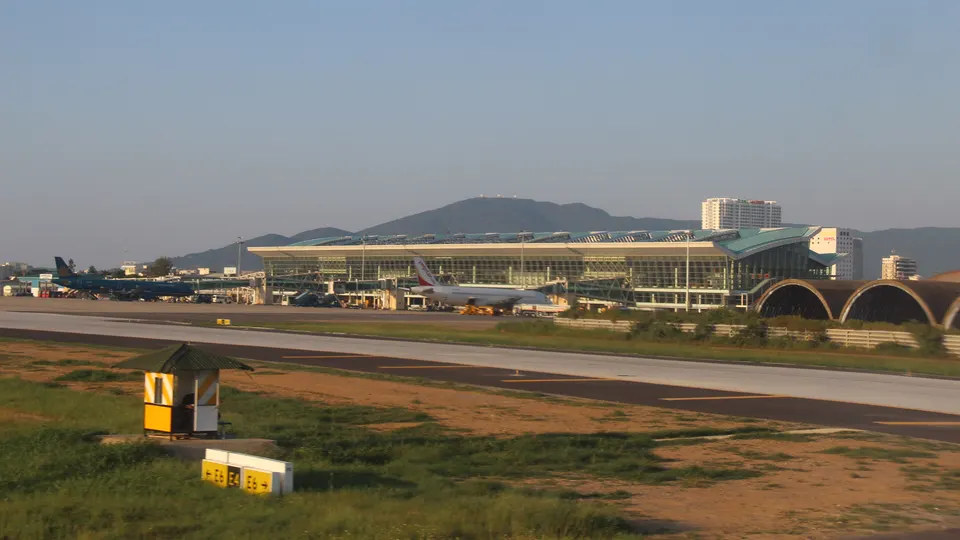
International terminal (T2). Grab’s passenger guide, dated January 2025 and last updated in November 2026, gives spots 6 and 7 under the viaduct in front of the terminal. The airport’s own page tells app users at T2 to go to pillar 3 in the public arrivals area and then to the pick-up spot in front of the glass building in the parking area. Follow the signs and the map in the app, which shows the current point.
Domestic terminal (T1). Besides the pick-up points above, Grab has trialled booking by PIN code there since 30 June 2026: you get a code and a time to reach the pick-up area and connect to a driver already waiting. Grab warns that airport security rules can make drivers take longer to reach you, and drivers may not stop for more than three minutes, so be at the point when you book.
What you pay. The app shows the fare before you book. On top, Grab’s guide says passengers pay the airport access fee of 9,000 dong for the first 30 minutes and 4,000 dong per further 30 minutes, and from 10 November 2026 a 10,000-dong airport operation fee, including VAT. CafeF reported on 5 November 2026 that Grab applies this fee at Da Nang, Tan Son Nhat, Cam Ranh and Phu Quoc in place of a platform fee that could reach 19,000 dong. Xanh SM’s taxis also wait at the official rank.
Step by step. Get mobile data before you leave the terminal (our SIM and eSIM guide explains the options), book once you have your bags, set the pick-up to the right terminal, walk to the point the app shows, and match the plate and driver’s name before you get in. How the apps compare across Vietnam is in our guide to using Grab in Vietnam.
Is there a bus from Da Nang airport to Hoi An?
Yes, two ways: a direct airport minibus, 01SB, and a much cheaper but slower pair of city buses. Neither runs at night.

Route 01SB, airport to Hoi An. As of November 2026, Da Nang’s bus information site lists route 01SB, “Sân Bay Đà Nẵng – Hội An”, in service since 25 September 2025 and run by a branch of the Hai Van transport company with three 10-seat Hyundai Solati minibuses. A seat costs 120,000 dong, with half price for people with disabilities and children under six, and the operator’s sheet says trips follow the flight schedule (DanangBus). Da Nang airport’s transport page, which is undated, lists the same 120,000-dong “Hai Van Bus” from 07:30 to 16:00 daily, stopping at T1 pillar 2 and T2 pillars 7 and 8, and gives its phone numbers: +84 915 472 525 and 1900 6763.
The route runs along the coast road past the Danang International Convention Centre on Vo Nguyen Giap and The Ocean Estates on Truong Sa, then into Hoi An by Ly Thuong Kiet, Tran Nhan Tong and Cua Dai streets to the car park of the Cua Dai pier; the airport page also names a stop at 497 Hai Ba Trung. The end is on the eastern side of town towards the beach, so unless your hotel is near a stop, you will still need a short taxi or app ride.
City buses 06 and 02. For the cheapest trip, take city bus 06 from the terminals (same stops as 01SB) to its last stop at the Viet Han university bus station, then change to route 02, which calls there on its way to Hoi An. The airport gives 06 at 15,000 dong to halfway and 22,000 dong for the full route, from 05:30 to 19:00; Da Nang’s tourism portal says it has used electric buses since 25 January 2026 and runs every 30 to 60 minutes. Route 02 costs 20,000 or 30,000 dong from there, depending on distance, and its last trips leave before 6 pm (next section). With a suitcase and two buses this is slow, and you need dong in small notes; our money and tipping guide explains cash and cards.
From Da Nang city or a beach hotel to Hoi An
From a hotel in the city or on the beach, the choice is the same as at the airport minus the airport fees: an app car or taxi, a hotel car, or the public bus. The bus to Hoi An is now route 02, not LK02: Da Nang merged LK02 into route 02 from 18 July 2025, running from the central bus station to Cua Dai (Bao Van Hoa).
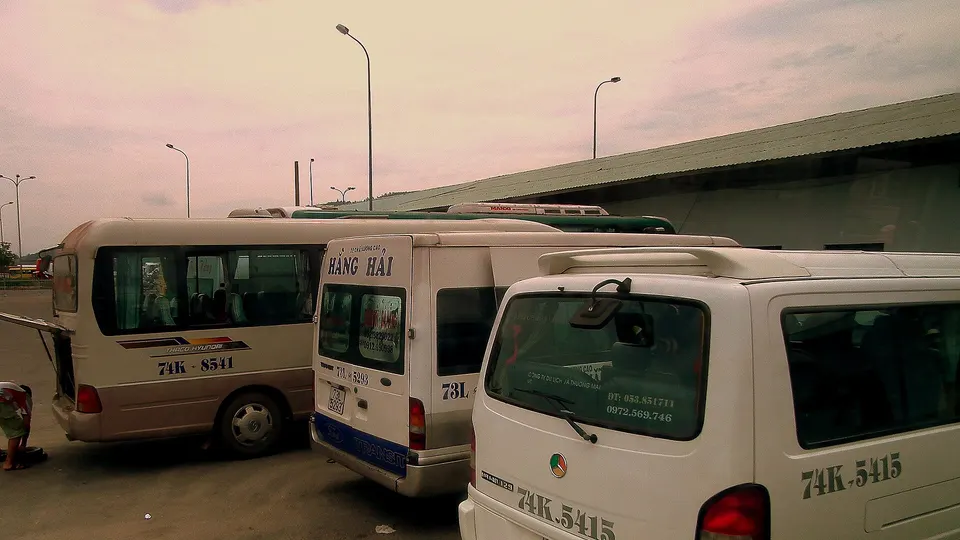
Route 02 in brief. According to DanangBus’s route sheet, with a new timetable from 1 November 2026:
| Route 02 | Details |
|---|---|
| Ends | Da Nang central bus station, 97–99 Cao Son Phao; Cua Dai inland-waterway car park, Hoi An |
| Main stops in Da Nang | City administrative centre on Tran Phu; 2/9 Street; Le Van Hien; Viet Han university bus station; on the way back, Bach Dang Street opposite Han Market |
| Main stops in Hoi An | Hoi An bus station on Nguyen Tat Thanh; Ly Thuong Kiet; Tran Nhan Tong; Cua Dai Street |
| Hours | About 5:15 to 17:50 (an August 2026 listing on the city’s tourism portal gave about 4:45 to 18:00) |
| Frequency | Every 15–30 minutes, 60 runs a day |
| Journey time | About 90 minutes end to end; about 70 minutes from the city administrative centre to Cua Dai |
| Fare | 8,000 dong up to 10 km, 20,000 dong for 10–25 km, 30,000 dong beyond 25 km |
| Buses | Electric, 30 places (19 seated) |
The route goes south through the city by 2/9 Street and Le Van Hien, not along the beach. If you are staying in a beach hotel on the coast road, an app car or taxi is usually more practical; the 01SB minibus does pass the coast road on its airport runs, but its times follow flights, so call Hai Van before counting on it.
Stopping on the way. The coast road passes the Marble Mountains, about 30 minutes from Hoi An by the city’s tourism portal, which makes them an easy stop if you hire a car for the transfer; our Marble Mountains guide explains how long to allow.
Hotel car or shuttle: is it worth booking ahead?
For a first night in Vietnam or a late flight, a car booked through your hotel is the least stressful option: the driver has your name and address, the price is agreed in advance, and nobody needs mobile data.

Price. Vietnam’s national tourism authority says a hotel can arrange a car to Hoi An at a fixed price of 250,000 to 350,000 dong, in a guide that carries no date; hotels set their own prices, so ask what yours charges and whether tolls, waiting time and late-night pick-ups are included. The same guide mentions shared shuttle vans from the airport to Da Nang and Hoi An, but we found no dated official timetable for them; if you book one, get the meeting point and time in writing.
Where you meet. Ask whether the driver will wait inside the arrivals hall with a sign or in the car park, and get a phone number. Tour coaches pick up in front of the arrivals hall at T1 and near pillar 8 at T2, the airport says.
Arriving late at night
Both bus options stop in the afternoon or early evening, so after dark your choices are the taxi rank, an app car or a car you booked in advance.

Timing. The airport lists the 01SB minibus until 16:00 and city bus 06 until about 19:00, and route 02 stops around 17:50, so a flight landing after mid-afternoon effectively rules out the bus. After that, the taxi rank, an app car or a car booked in advance are the options.
Money and data. The national tourism authority notes there is no ATM in the immigration area at Da Nang, so have some dong or a card ready, and buy a SIM or set up an eSIM before you leave the terminal if you want to use an app.
Arriving in Hoi An after dark. If you land in the evening, your car may reach Hoi An while the old town is still car-free, until 21:30 in summer and 21:00 in winter. Tell your hotel your flight number, ask where the car can stop, and keep its phone number handy.
Where will you be dropped in Hoi An?
Close to your hotel, but not always at the door. During the pedestrian hours, from 9:00 to 21:30 in summer and to 21:00 in winter, the old town is a “walking and cycling town”, and Phan Chau Trinh Street joins it from 17:30 (Hoi An heritage centre). Cars stop at the edge and you walk the last stretch.
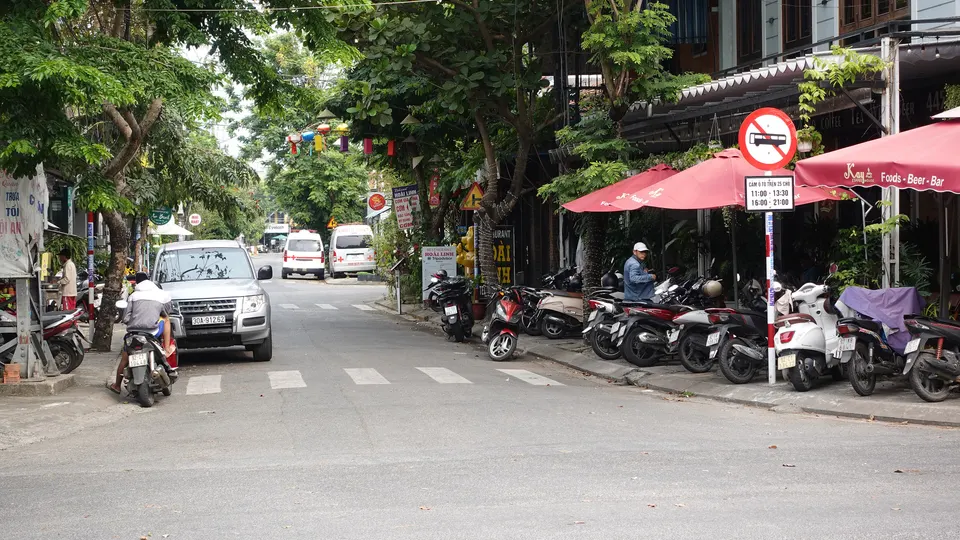
Where cars stop. When Hoi An made its ticket compulsory in May 2023, it added ticket points at the Bach Dang riverside wharf and in the car park in front of the Hoi An theatre, and moved some pick-up points to Phan Chau Trinh Street, Sai Gon Giai Phong reported. Both are on the edge of the old town, so they make practical points to be dropped and to walk in from. You need the old-town ticket to walk the core streets; our guide to the Hoi An ticket explains what it covers and where it is checked.
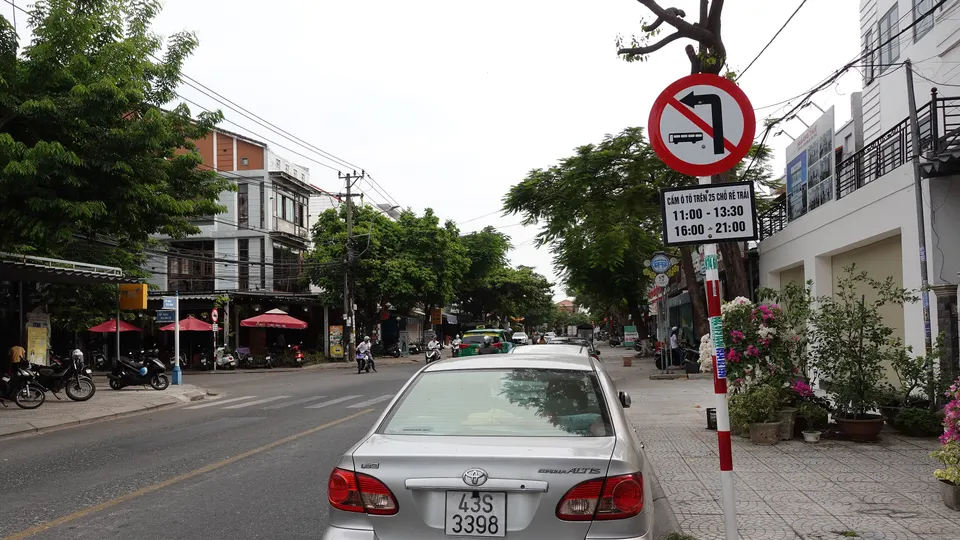
Larger vehicles. In 2018 Hoi An banned vehicles of 25 seats or more from the junctions leading into the old town at peak times, Bao Van Hoa reported, and signs photographed on Mac Dinh Chi and Hai Ba Trung streets in April 2026 still bar vehicles of more than 25 seats from 11:00 to 13:30 and 16:00 to 21:00. An ordinary taxi, app car or hotel car has far fewer seats, so this limit does not apply to it, but a group transfer in a big coach may stop further out.
Staying by the beach instead. If you have booked at An Bang or Cua Dai, the car goes straight to the coast and the old-town hours do not matter; our guide to the Hoi An beaches compares them.
Common mistakes and documented scams
Most of the problems reported at Da Nang airport began with someone who approached the traveller, not with the rank or the app.
- Letting a stranger “help” with your app booking. In December 2022 an unlicensed driver waiting at the terminal took a South Korean visitor’s phone, cancelled her Grab booking and drove her to her hotel on Bach Dang Street himself, charging 120,000 won, about 2.1 million dong and around ten times the usual price. He returned the money and was fined 11 million dong, Nhan Dan reported.
- Paying invented extras. In March 2023 a South Korean woman told police that a GrabCar driver who had agreed 378,000 dong from Da Nang to Hoi An then demanded another 350,000 dong as a “parking fee”; the city announced a special team against unlicensed drivers at the airport (VnExpress International). The airport fees Grab lists are small and shown in the app; do not pay a “parking fee” a driver adds at the end.
- Waiting at the arrivals door for an app car. App cars use the pick-up points above, so a driver at the door offering to be “your Grab” is not one.
- Looking for bus LK02 or “Bus No. 1”. Many guides still give these. LK02 became part of route 02 in July 2025, and LK01 is the Da Nang–Hue bus, not Hoi An’s.
- Believing “there is no bus”. Some recent guides say so; route 02 and the 01SB airport minibus both run, though only in the daytime.
- Expecting the car to reach an old-town door in the evening. During pedestrian hours it cannot; agree the drop-off point with your hotel.
Before you land: a checklist
A few minutes on the plane saves most of the trouble at the kerb.

- Terminal: international flights arrive at T2 and domestic flights at T1, linked by a covered walkway; the taxi rank is shared, but app pick-up points and bus stops differ.
- Arrival time: landing before mid-afternoon, the 01SB minibus is realistic; later, plan on a taxi, an app car or a hotel car.
- Cash and data: some dong for a bus or taxi, and mobile data for an app.
- Address: your hotel’s name, street and phone number, and whether it lies inside the car-free old town.
- Ticket: if you will walk into the old town on arrival, budget for the old-town ticket.
- Coming from Hue instead? Our Hue to Hoi An guide compares the train, the Hai Van Pass and the road; our five-day Hue, Hoi An and Da Nang plan fits the transfer into a trip, and the Central Vietnam hub shows what else is nearby.
Frequently asked questions
What time is the last bus from Da Nang airport to Hoi An?
Da Nang airport lists the 01SB Hai Van minibus to Hoi An from 07:30 to 16:00, and the city route 02 to Hoi An runs only until about 17:50 under its 1 November 2026 timetable. If you land later, take the taxi rank, a Grab or Xanh SM car, or a car booked through your hotel.
Is there a bus from Da Nang airport to Hoi An?
Yes. Route 01SB, run by Hai Van, links the airport with the Cua Dai pier car park in Hoi An for 120,000 dong a seat. The airport lists it from 07:30 to 16:00, and Da Nang's bus operator says trips follow the flight schedule, so confirm times before you rely on it.
How much is a Grab from Da Nang airport to Hoi An?
The app shows the fare before you book; add the airport access fee (9,000 dong for the first 30 minutes) and Grab's 10,000-dong airport operation fee from 10 November 2026. VnExpress reported one Da Nang–Hoi An GrabCar fare agreed at 378,000 dong in 2023.
Can a taxi drop me at my hotel in Hoi An old town?
Only outside the pedestrian hours. From 9:00 to 21:30 in summer and 21:00 in winter cars cannot drive into the old town core, so drivers stop at its edge; ask your hotel in advance where cars can reach.
Is bus LK02 still running from Da Nang to Hoi An?
No, not under that number. From 18 July 2025 Da Nang merged LK02 into route 02, which runs from the central bus station to Cua Dai via Hoi An. LK01 is the Da Nang–Hue bus.
Key sources
- Lộ trình tuyến (route sheets: 01SB Sân bay Đà Nẵng – Hội An, 02 Bến xe Trung tâm – Cửa Đại, 06) · DanangBus (Da Nang public bus information), checked 14 November 2026
- Transport from the airport · Da Nang International Airport, checked 14 November 2026
- Đà Nẵng điều chỉnh, hợp nhất tuyến xe buýt số 02 và 21 từ ngày 18.7 · Báo Văn Hóa, 17 July 2025
- Tuyến LK01: Đà Nẵng – Huế (tuyến buýt không trợ giá) · Da Nang city portal (danang.gov.vn), 2020
- Grab thông báo về phương thức đặt xe qua mã PIN và các khu vực đón xe tại sân bay Đà Nẵng (Ga quốc nội) · Grab Vietnam, 29 June 2026 (updated 19 October 2026)
- Hướng dẫn đón GrabCar tại sân bay Đà Nẵng · Grab Vietnam, 23 January 2025 (updated November 2026)
- Announcement of the visiting in Hoi An Ancient Town · Hoi An Centre for Cultural Heritage Management and Preservation, 28 January 2026
- Da Nang to crack down on taxi scams targeting foreign tourists · VnExpress International, 22 March 2023
All 19 sources and further reading
- Các tuyến xe buýt kết nối sân bay Đà Nẵng · DanangBus, 7 April 2026
- Xe buýt Đà Nẵng: lộ trình, giá vé, giờ chạy và cách di chuyển · Danang Fantasticity (Da Nang city tourism portal), 21 August 2026
- Danh thắng Ngũ Hành Sơn · Danang Fantasticity (Da Nang city tourism portal), August 2025
- Đà Nẵng hợp nhất 2 tuyến xe buýt nối tỉnh Quảng Nam cũ · Pháp Luật TP.HCM, 17 July 2025
- Từ 10/11/2026, tất cả người dùng Grab có tin vui · CafeF, 5 November 2026
- Triển khai dịch vụ Xanh SM Airport tại sân bay quốc tế Đà Nẵng · Green SM (Xanh SM), 25 August 2023
- Ngày đầu Hội An soát vé theo phương án mới: Du khách và đơn vị lữ hành ủng hộ · Sài Gòn Giải Phóng, 15 May 2023
- Nạn kẹt xe 'bức tử' Hội An · Báo Văn Hóa, 11 June 2018
- Đà Nẵng xử phạt tài xế 'xe dù' 'chặt chém' du khách · Nhân Dân, February 2023
- Resolution 202/2025/QH15 on the reorganisation of provincial-level administrative units · National Assembly of Vietnam (via LuatVietnam), 12 June 2025
- A traveller's guide to Vietnam's airports · Vietnam National Authority of Tourism (vietnam.travel), checked 14 November 2026
Keep exploring
 Central Vietnam · Travel Hoi An (Hội An): How Many Days, What to See, When to Go How many days Hoi An needs, what the 80,000 or 120,000 dong ticket covers, lantern nights, where to eat, beaches, flood months and getting there from Da Nang.
 Central Vietnam · Travel Da Nang (Đà Nẵng): What to Do, Where to Stay, How Long Da Nang travel guide: the best things to do, whether to stay in Da Nang or Hoi An, a 2–4 day plan with Hue, what to eat and when the rains usually come.
 North · Central · South · Travel Grab vs Green SM in Vietnam: Which App to Use, Fares Grab or Green SM (Xanh SM) in Vietnam? Which app wins for bikes and cars in 2026, dated fares, foreign phones, card or cash, airport pick-ups, Be and taxis.
 Central Vietnam · Travel Hoi An (Hội An) Ticket 2026: Price, Sites, How to Buy Hoi An old town ticket as of November 2026: 80,000 or 120,000 dong, same for everyone, valid up to 3 days. Sites it opens, who enters free, where to buy.