Central Vietnam · Travel
Hoi An Beaches: An Bang or Cua Dai? Which to Choose in 2026
An Bang or Cua Dai? Compare Hoi An's beaches by distance, facilities and safety, with Cua Dai's rebuilt sand as of November 2026, swimming months and Tan Thanh.

Go to An Bang (An Bàng) for the closest, liveliest beach afternoon from Hoi An (Hội An) old town, and to Cua Dai (Cửa Đại) for space, resorts and a newly rebuilt beach. As of November 2026, Cua Dai has wide sand again: Tuoi Tre reported on 2 November that both coastal protection projects were basically complete, with a swimming beach about 60 m wide, and on 9 November the city’s own paper said contractors were finishing the last items, with handover due by 31 December 2026 (Bao Da Nang).
Hoi An has two beaches most visitors choose between, and the answer is simpler than the forums suggest. An Bang is the closer, livelier one: a fishing village with thatched huts, loungers and cafes on the sand, a short bicycle ride from the old town. Cua Dai, a little further east where the Thu Bon (Thu Bồn) river meets the sea, is the broad, resort-lined beach that lost much of its sand after 2014 and has just been rebuilt.
This page helps you pick one, using dated reports rather than old blog photos: what each beach is like, how far the erosion went after the storms of late 2025 and what the 2026 works changed, the quieter stretches at Tan Thanh (Tân Thành) and Ha My (Hà My), which months are safe for swimming, and what lifeguards and past accidents tell you. For the old town itself, its history and how many days to stay, read our Hoi An guide.
Hoi An beaches at a glance
Distances are to the old town and vary by source and by where you start; the condition column is as reported in November 2026.
| An Bang | Cua Dai | Tan Thanh | Ha My | |
|---|---|---|---|---|
| Distance | About 3–5 km | About 4–5 km east | Just south of An Bang | Further north, towards Da Nang |
| Character | Village beach, fishing boats, busy cafe strip | Wide beach at the river mouth, lined with resorts | Smaller stretch between the two, guesthouses and cafes | Relatively untouched, fewer people |
| Facilities | Thatched huts, loungers, restaurants, cafes, toilets, showers | Rental loungers, shaded huts, changing huts, resorts, water sports | Fewer; check on arrival | Seafood restaurants; few public facilities reported |
| Erosion (Nov 2026) | Hit by the late-2025 storms; an emergency embankment covers the Tan Thanh–An Bang stretch | Rebuilt: breakwaters, groynes and new sand; works being handed over | Badly eroded in 2025; same emergency embankment | No erosion reported in our sources |
| Rescue team | Yes | Yes | Not reported | Not reported |
| Ward since 2025 | Hoi An Tay | Hoi An Dong | Hoi An Tay | Dien Ban Dong |
| Cham Islands boats | No; ride to Cua Dai pier | Speedboats from Cua Dai pier, about 20–30 min; 150,000–200,000 VND per person (VnExpress, Apr 2026) | No | No |
| Suits | First-timers, cyclists, people who want food and drinks on the sand | Families who want space, resort guests, sunrise | Avoiding the An Bang crowds | A quiet day with a car or scooter |
How to decide. For one easy beach afternoon from the old town, go to An Bang. If you are staying at a resort on the coast, or want more room and a calmer, newly rebuilt beach, go to Cua Dai. Tan Thanh and Ha My are for a second beach day, not a first.
Names on maps. Under the 2025 reorganisation, Quang Nam (Quảng Nam) province merged into Da Nang (Đà Nẵng), and the new city kept the Da Nang name from 1 July 2025 (Vietnam Government News). Official signs now show Hoi An Dong (Hội An Đông) ward for Cua Dai and Hoi An Tay (Hội An Tây) ward for Tan Thanh and An Bang; everyone still says “Hoi An beach”.
An Bang: the easy, lively choice
An Bang is the beach most visitors reach first. Vietnam Airlines’ travel guide puts it about 3 km from the old town and lists thatched umbrellas, loungers, beachfront restaurants and cafes, toilets and showers, plus a rescue team on duty; Da Nang’s official tourism portal gives about 5 km and describes a working fishing community whose round bamboo basket boats still sit on the sand.

What it is like. The portal describes white sand, clear water, leaf huts with hammocks and a strip of international-style cafes and bars, with resorts nearby, and suggests local food such as clam porridge, chao ngheu (cháo nghêu), and filter coffee by the sea. It is the most social of the Hoi An beaches, and it became more so while Cua Dai was eroding: VnExpress reported in 2025 that foreign tourists had moved to An Bang during those years and were only now going back to Cua Dai.
Why it is busy. It is close, it has the most places to eat and sit, and the road from the old town runs through rice fields, which makes it an easy bicycle trip.
What to watch for. An Bang is not sheltered water. Both documented drownings of foreign tourists at Hoi An beaches in our sources happened here (see the safety section), and the late-2025 storms opened new erosion spots along it. Choose your patch near the rescue team, not just the cafe you like.
Cua Dai: wide sand, resorts and a beach rebuilt
Cua Dai is the original Hoi An beach, at the mouth of the Thu Bon river. Da Nang’s tourism portal puts it about 5 km east of the old town and lists stand-up paddleboarding, surfing and jet skis; Vietnam Airlines’ guide adds rental loungers, shaded huts, changing huts and a row of resorts and restaurants, and describes weekdays as quiet.

What it is like now. In November 2026 VietNamNet described “a broad ribbon of sand lined with green coconut palms and beachfront resorts”, a stepped concrete seawall with a promenade above it, sun loungers and thatched umbrellas back on the sand, small traders on the promenade and basket boats resting on the beach; residents and visitors were swimming even outside the peak season (VietNamNet). VietnamPlus, the national news agency’s site, called it a beach that had once faced being wiped out.
Why choose it. More space, newer sand and gentle water behind the new breakwaters, and resorts right on the beach. It is also where boats leave for the Cham Islands (see below).
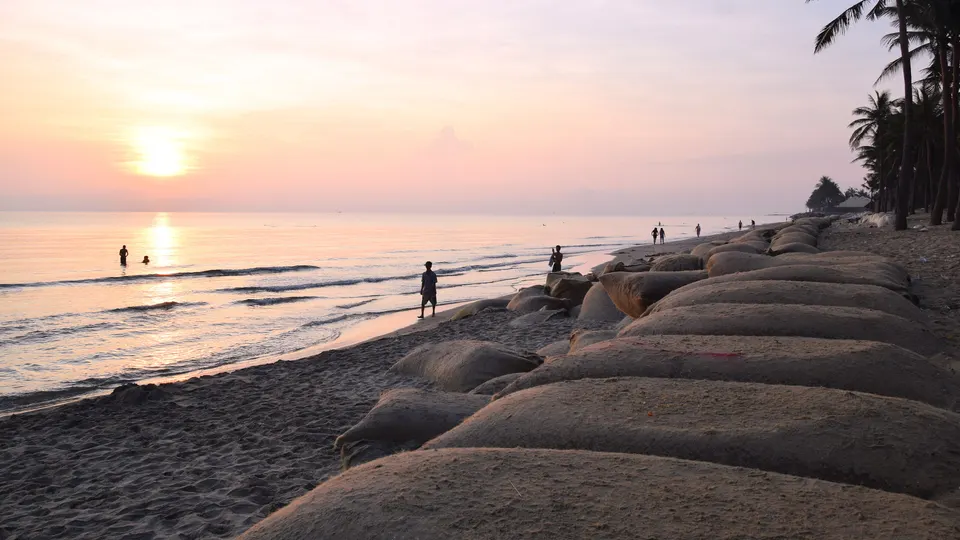
What has changed. Older blog posts show Cua Dai lined with sandbags. That picture is out of date, but so are posts that call it “fully restored” before 2025: the beach was damaged again in the storms of late 2025, and the latest works were still being handed over in November 2026. The next section has the dates.
Is Cua Dai still eroded? What happened from 2014 to 2026
Short answer: as of November 2026, Cua Dai has a wide beach again, but it is a protected, engineered beach, and the stretch north towards An Bang was still being reinforced in 2026.
| When | What happened | Reported by |
|---|---|---|
| From 2014 | Severe erosion begins at Cua Dai; the sand strip keeps shrinking and businesses put up sandbags | Tuoi Tre, VietNamNet |
| June 2020 – Sept 2024 | About 550 billion VND spent on a 2.3 km underwater breakwater about 250 m offshore; a 2.3 km stretch gets its sand back | Bao Da Nang (from VnExpress), April 2025 |
| March 2025 | A 982 billion VND coastal protection project starts, funded by French Development Agency loans, EU grants and the local budget | VnExpress International, Tuoi Tre |
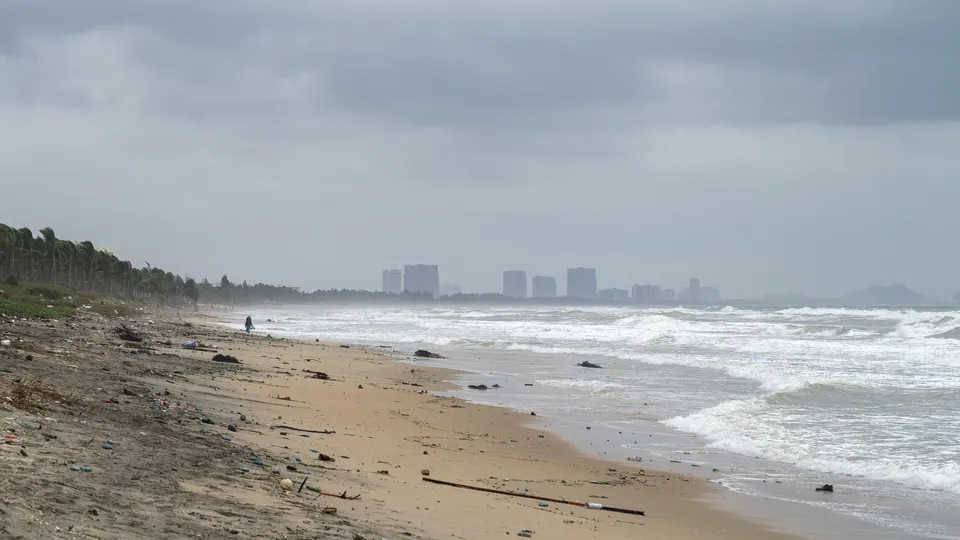
| Oct – Nov 2025 | Storms and record rain erode about 8 km of coast between Cua Dai and An Bang; a beach bar is destroyed and waves cut 6–7 m cliffs behind businesses; swimming is banned in erosion zones | VnExpress International |
| December 2025 | Nearly 3.5 km of coast in the two Hoi An wards is eroded; Cua Dai is cut back 3–5 m | Dtinews, citing Da Nang’s civil defence department |
| April – June 2026 | Da Nang orders an emergency embankment package of about 498 billion VND, including about 1,950 m of the Hoi An coast, to be built before the 2026 storm season | Tuoi Tre News, Nhan Dan |
| November 2026 | Both projects “basically complete” and in acceptance and handover; seven submerged breakwaters over 2 km long, 250–300 m offshore, and six groynes; a dry beach about 40 m wide and a swimming beach about 60 m wide; contractors finishing the remaining items, handover due by 31 December 2026 | Tuoi Tre, 2 November; Bao Da Nang, 9 November; VietNamNet, 11 November |
Tuoi Tre, one of Vietnam’s main dailies, put the total for the two projects at about 1,196 billion VND and reported foreign tourists swimming and food stalls back in business despite the low season (Tuoi Tre). VietNamNet added a week later that workers were still finishing the remaining sections before final inspection.
What it means for you. Expect a good beach at Cua Dai, with concrete steps and a promenade behind it rather than dunes. Expect works, barriers or fresh sand on parts of the coast between Cua Dai and An Bang. And treat any sign or rope at an eroded spot as a real hazard: steep sand cliffs and undercut banks are what the 2025 reports describe.
Tan Thanh and Ha My: the quieter stretches
Between Cua Dai and An Bang lies Tan Thanh, a smaller beach of guesthouses and cafes along Nguyen Phan Vinh (Nguyễn Phan Vinh) street. Vietnam Airlines’ guide places it just south of the main An Bang area. It has had the hardest few years: in October 2025 Saigon Giai Phong reported sand cliffs 4–5 m high and waves cutting 4–8 m into the land beside local businesses, and in December 2025 Dtinews reported more than 3 km of the Tan Thanh coast severely eroded.
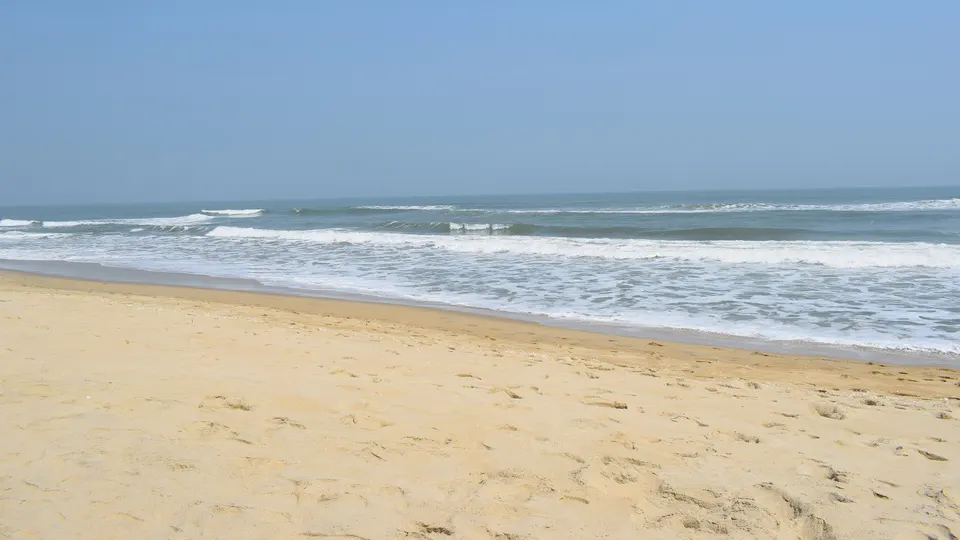
The 2026 emergency works target exactly this stretch: one of the three zones on the Hoi An coast runs about 700 m from Tan Thanh to An Bang in Hoi An Tay ward, with construction set to finish before 15 September 2026, ahead of the storm season (Nhan Dan). Our sources do not yet say how the new embankment has changed the beach, so check the sand before you settle on a cafe here.
Ha My lies further up the coast towards Da Nang, in Dien Ban Dong (Điện Bàn Đông) ward. Vietnam Airlines’ guide calls it relatively untouched and less crowded than its neighbours, with seafood restaurants close by; in October 2026 Bao Phap Luat reported that Da Nang plans to tidy up the Ha My and Thong Nhat beaches, a 5.68 km stretch, in 2027. It suits a quiet half day if you have a car or scooter, not a bicycle hop from the old town.
When to swim: the season and the rough-sea months
Swim between about March and August, and treat September to January as a season for looking at the sea rather than going into it. Vietnam’s national tourism authority describes Hoi An as warm to hot, sunny and clear from February to August, recommends heading to the beach from May to August, and warns that from September tropical storms hit Central Vietnam hard, with heavy rain and some floods from September to November (VNAT).
| Months | What the sources say | For a beach day |
|---|---|---|
| February – April | Warm and sunny from February (VNAT); Da Nang’s portal calls March to August the ideal time for An Bang, dry with a calm sea | Good from March; water still cool early on |
| May – August | VNAT’s beach months; Vietnam Airlines names June to August for beach holidays | Best; hot, so go early or late |
| September – November | Storms from September; heavy rain and floods to November (VNAT); rainy season September to November (Vietnam Airlines) | Often rough; expect swimming bans |
| December – January | Rainy, cool and cloudy into January (VNAT); currents can be strong from October to March (Vietnam Airlines) | Walks, not swims |
The flood-season effect. Storms do more than make waves. In mid-November 2023 more than 2 km of An Bang was covered with water hyacinth, branches and plastic washed down the Thu Bon river after two days of heavy rain; lifeguards and cleaners spent days clearing it, and swimming was banned because of high waves, VnExpress reported. Hoi An’s then chairman said the clean-up is repeated whenever floods come.
For the whole year across Vietnam, see our best time to visit Vietnam.
Is it safe to swim? Lifeguards, warnings and past accidents
Swimming at Hoi An’s beaches is normal in the calm months, but this is open sea, and people have died here. In October 2023 a 24-year-old South Korean tourist drowned at An Bang after going into the water in the evening on the day he arrived; VnExpress International reported that the waves were “rough and dangerous” at the time, and border guards found his body the next afternoon (VnExpress International). In February 2020, outside the storm season, a 59-year-old Canadian was swept away while swimming at An Bang at about 9 am.
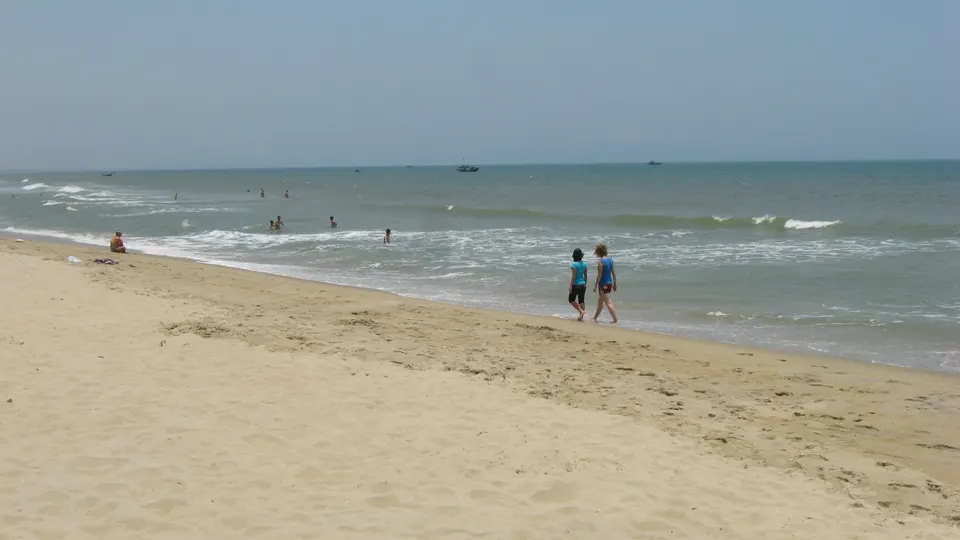
Lifeguards. Vietnam Airlines’ guide says a rescue team is on duty at An Bang; VnExpress mentioned beach lifeguards there in 2023, and VietNamNet quoted a member of the rescue team at Cua Dai in 2026. None of our sources gives their hours or how much of the beach they cover, so swim in front of them and in the designated area, as the Vietnam Airlines guide advises, and follow their instructions.
Warnings. Authorities ban swimming when waves are high, as at An Bang in November 2023, and in late 2025 they posted warning signs and banned swimming in erosion zones. We found no official description of a flag code for these beaches, so treat any sign, rope, whistle or instruction from a lifeguard as final, whatever its colour.
Simple rules that follow from the record:
- Don’t swim alone, after dark or straight after arriving tired; in both drownings above, the swimmer was only missed after he had disappeared.
- Check the sea before you go in: Vietnam Airlines notes calmer water in the early morning and late afternoon and stronger currents from October to March.
- Keep children within reach and stay near the rescue team.
- Keep away from sand cliffs and undercut banks at eroded spots, even on dry land.
Getting there: bicycle, taxi or Grab, and the Cham Islands
Both beaches are an easy ride from the old town. Vietnam Airlines’ guide gives 15 to 20 minutes by bicycle to An Bang, and lists motorbike, taxi and hotel shuttles; Da Nang’s portal describes riding a bicycle, motorbike or e-bike to Cua Dai through rice fields. Cycling is the classic way. In the midday heat or after dark, a taxi or a ride-hailing car is simpler; our guide to Grab in Vietnam explains how the apps work.
- From Da Nang airport: the beaches lie on the coast road south from Da Nang; Da Nang’s portal puts An Bang about 30 km from the city centre (Da Nang Fantasticity). Our Da Nang airport to Hoi An guide compares taxis, shuttles and buses.
- Staying in Da Nang instead? Its own city beach, My Khe (Mỹ Khê), is covered in our Da Nang guide.
- Combining with the old town: a morning on the beach and an evening in town works well; the Hoi An old town ticket covers up to three days, so you lose nothing by splitting your time.
- Basket boats on the river: the Bay Mau coconut forest at Cam Thanh lies between the old town and Cua Dai; our guide to the Hoi An basket boat ride explains prices, timing and how to avoid the crowds.
The Cham Islands. Boats for the Cham Islands, Cu Lao Cham (Cù Lao Chàm), about 15 km offshore, leave from Cua Dai pier, and Vietnam Airlines’ guide gives 20 to 30 minutes by speedboat or long-tail boat. VnExpress’s Hoi An guide, updated in April 2026, puts the speedboat at about 150,000 to 200,000 VND per person. A trip there is a full day of its own; if you plan one, base your beach time at Cua Dai and go when the sea is calm, since the same rough-sea months apply.
Common mistakes, and what to do
Most disappointing Hoi An beach days come from old information or the wrong month.

Common mistakes
- Writing off Cua Dai from old photos. The sandbag pictures date from 2014–2025; in November 2026 the beach was wide again.
- Assuming An Bang never changes. The late-2025 storms opened new erosion spots there and at Tan Thanh, and 2026 works were still under way.
- Booking a beach holiday for October or November. It is the storm and flood season; beaches can be closed to swimmers and covered in debris.
- Swimming on arrival, at dusk or alone. That is how the 2023 drowning at An Bang happened.
- Ignoring signs and ropes. Swimming bans go up in high waves and at eroded spots for a reason.
- Looking for “Cam An” on a new map. An Bang’s old ward name was replaced in 2025: look for Hoi An Tay.
What to do
- Choose: An Bang for food, cafes and an easy bike ride; Cua Dai for space, resorts and the rebuilt beach; Tan Thanh or Ha My for quiet.
- Go between March and August, and in the early morning or late afternoon.
- Swim near the rescue team, in the designated area, with someone watching.
- Check the forecast and local notices from September to January.
- Pair the beach with the old town: our Hue, Hoi An and Da Nang in five days plan shows where a beach afternoon fits, and our where to eat in Hoi An guide covers dinner back in town.
More places along this coast are in our Central Vietnam hub.
Frequently asked questions
How much is the boat from Cua Dai to the Cham Islands?
VnExpress's Hoi An travel guide, updated in April 2026, gives about 150,000 to 200,000 VND per person for a speedboat from Cua Dai to the Cham Islands, a trip of about 20 minutes. Vietnam Airlines' guide gives 20 to 30 minutes by speedboat or long-tail boat from Cua Dai pier.
Is Cua Dai beach still eroded in 2026?
Much less. After late-2025 storms cut the beach back again, new breakwaters, groynes and sand were added, and on 2 November 2026 Tuoi Tre reported that the projects were basically complete, with a dry beach about 40 m and a swimming beach about 60 m wide. On 9 November 2026 Bao Da Nang reported that contractors were finishing the remaining items, with handover due by 31 December 2026.
Can you swim at Hoi An beaches in November?
Often not comfortably or safely. November falls in the central coast's storm and flood season; in November 2023 swimming at An Bang was banned because of high waves and the beach was covered with flood debris. Plan beach days for March to August.
Are there lifeguards at An Bang and Cua Dai?
Both beaches have rescue teams, according to Vietnam Airlines' guide and Vietnamese press reports. Swim in front of them, in the designated area, and follow their instructions; do not assume every stretch of sand is watched.
How do you get from Hoi An to An Bang beach?
By bicycle in about 15 to 20 minutes, or by motorbike, taxi, ride-hailing car or hotel shuttle. Cua Dai is a similar short ride east along the road to the river mouth.
Key sources
- Diện mạo bờ biển Cửa Đại sau khắc phục xói lở · Báo Đà Nẵng, 9 November 2026
- Bãi biển Cửa Đại lột xác ngoạn mục sau khi được đầu tư gần 1.200 tỉ đồng · Tuổi Trẻ, 2 November 2026
- Once-eroded Cua Dai beach makes a comeback after $46 million restoration · VietNamNet, 11 November 2026
- Đà Nẵng đầu tư gần 500 tỷ đồng khắc phục sạt lở sông Thu Bồn và bờ biển Hội An · Nhân Dân, 16 June 2026
- Weather and climate in Vietnam · Vietnam National Authority of Tourism (vietnam.travel)
- Biển An Bàng · Da Nang Fantasticity (Da Nang Department of Culture, Sports and Tourism), 9 April 2026
- South Korean tourist drowns at Hoi An beach · VnExpress International, 23 October 2023
- Names and administrative centers of 34 provinces and centrally-run cities specified · Vietnam Government News (baochinhphu.vn), 15 April 2025
All 22 sources and further reading
- Kinh nghiệm du lịch Hội An 2026 từ A-Z · VnExpress, updated 16 April 2026
- Biển Cửa Đại · Da Nang Fantasticity (Da Nang Department of Culture, Sports and Tourism)
- Storms and rising seas topple bars, sweep away 8-km beach in Hoi An · VnExpress International, 15 November 2025
- Đà Nẵng hồi sinh bãi biển Cửa Đại từng được TripAdvisor vinh danh đẹp nhất châu Á · VietnamPlus (Vietnam News Agency), 6 November 2026
- Da Nang orders $18.9mn emergency embankment project to curb erosion · Tuoi Tre News, 25 April 2026
- Erosion persists along Hoi An coast · Dtinews (Dân Trí), 31 December 2025
- Bờ biển Hội An tan hoang do sạt lở · Sài Gòn Giải Phóng, 15 October 2025
- Hoi An's revived beachfront · Báo Đà Nẵng (from VnExpress), 15 April 2025
- Bãi biển An Bàng ngập rác · VnExpress, 15 November 2023
- Canadian tourist drowns in Hoi An beach · VnExpress International, 13 February 2020
- Discover the 8 most beautiful beaches in Hoi An · Vietnam Airlines travel guide
- Seasons in Vietnam · Vietnam Airlines travel guide
- Bãi biển Hà My · Vietnam Airlines travel guide (Vietnamese)
- Đà Nẵng dự kiến chi hơn 12,56 tỷ đồng chỉnh trang các bãi biển du lịch · Báo Pháp Luật Việt Nam, 22 October 2026
Keep exploring
 Central Vietnam · Travel Hoi An (Hội An): How Many Days, What to See, When to Go How many days Hoi An needs, what the 80,000 or 120,000 dong ticket covers, lantern nights, where to eat, beaches, flood months and getting there from Da Nang.
 Central Vietnam · Travel Da Nang (Đà Nẵng): What to Do, Where to Stay, How Long Da Nang travel guide: the best things to do, whether to stay in Da Nang or Hoi An, a 2–4 day plan with Hue, what to eat and when the rains usually come.
 Central Vietnam · Food Where to Eat in Hoi An (Hội An): Dishes and Local Picks Where to eat in Hoi An as of November 2026: cao lau, white rose dumplings and banh mi shops, the market food hall, breakfast prices and the best times to eat.