All three regions · Food
Banh Chung vs Banh Tet: The Difference and Which to Buy
Banh chung vs banh tet: the difference in shape, leaf, filling and region, how to cut and keep them, and when to buy one before Tet on 6 February 2027.
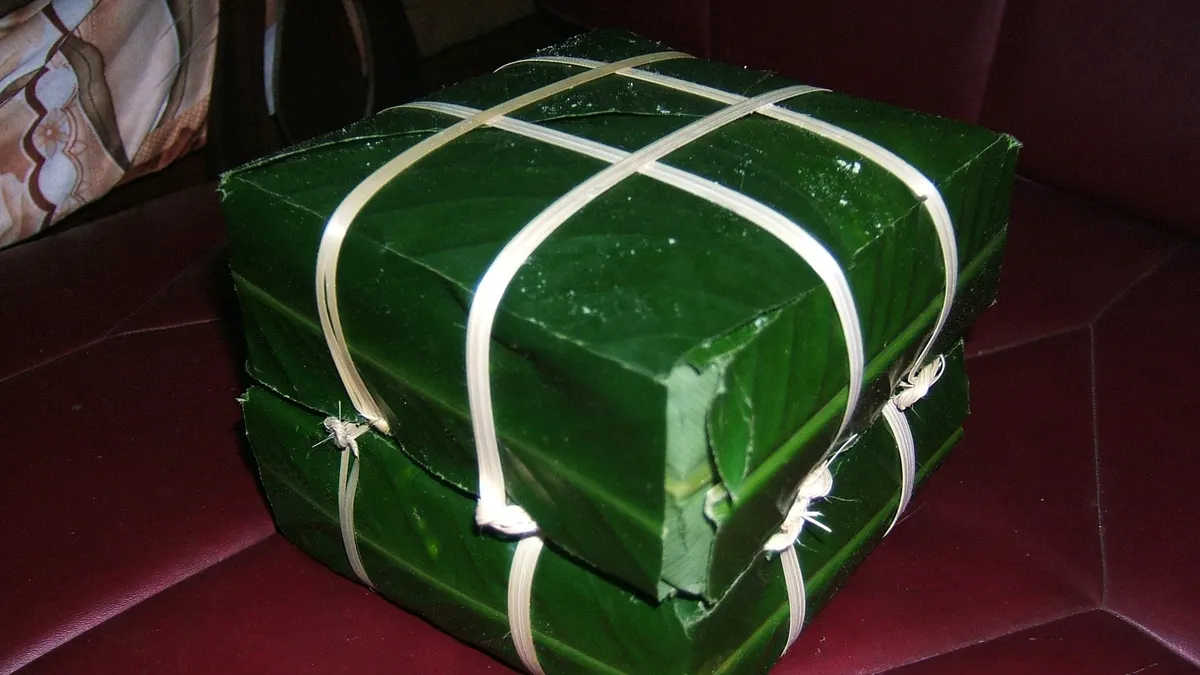
If you are in the North, try banh chung, the green square cake cut into wedges and eaten with pickled shallots; in the South, try banh tet, the banana-leaf log sliced into rounds, savoury or sweet. Both are made for Tet, which in 2027 falls on Saturday 6 February, and at Tet 2026 a village-made banh chung sold wholesale for 40,000 to 50,000 dong (Tien Phong).
Banh chung (bánh chưng) and banh tet (bánh tét) are Vietnam’s Tet rice cakes: sticky rice, mung beans and pork wrapped in leaves and boiled for hours. The North makes a green square, the South rolls a long cylinder, and the Centre makes both. This guide sets the two side by side, explains why they differ, and shows how to cut, eat, store and buy them, including when to see them made before Tet 2027 and the regional and ethnic versions you can find outside the holiday. For the wider festival (flowers, fruit trays, holiday dates), see our guide to Tet across North, Central and South Vietnam.
Banh chung vs banh tet at a glance
| Banh chung (North) | Banh tet (South; also Central) | |
|---|---|---|
| Shape | Square, flat-sided; cut into wedges | Long cylinder (“log”); cut into round slices |
| Leaves | Dong leaves (la dong), which turn the outer rice green | Banana leaves, 2–4 laid lengthwise; some makers add pandan or colour the rice with leaves |
| Classic filling | Glutinous rice, mung bean, pork belly, pepper and shallot | Same base; pork optional, so savoury (with pork) and sweet or vegetarian cakes both exist |
| Filling and colour variants | Red with gac fruit, purple sticky rice, black (Bac Ha), small “hunchback” banh chung gu (Ha Giang) | Banana or plain mung bean (sweet); salted egg yolk (Tra Cuon, Can Tho); purple from la cam leaves, green from pandan; coconut milk and black beans in the South |
| How it is tied and cut | Bamboo strings tied in a cross; the string is pulled through the cake to cut eight wedges | Tied with string; a strip of string slices it into rounds |
| Cooking time (sources) | About 8–9 hours in steam boilers to about 12 hours over wood; one maker boils 12–14 hours | About 4–5 hours (Can Tho purple cakes) to 9–10 hours (Tra Cuon) |
| Keeping (sources) | About 4–5 days at room temperature in dry weather, 15–20 days chilled (it hardens) | About 5–7 days for a well-made Tra Cuon cake; vacuum-packed Can Tho cakes about 5 days |
| Region | North (Red River Delta and uplands); a smaller version in Central Vietnam | South and Mekong Delta; Central Vietnam, where it is often called banh don |
| How it is eaten | Wedges with dua hanh (pickled shallots); pan-fried once a few days old | Rounds: savoury at meals, sweet on the altar or as a snack; with dua mon pickles in Hue; also fried |
| Story attached | Legend of Prince Lang Lieu: square cake for the earth | Debated: tales link it to Emperor Quang Trung’s army |
What is the difference between banh chung and banh tet?
Same ingredients, different shape, leaf and region. Five things set the two cakes apart, roughly in the order you notice them:
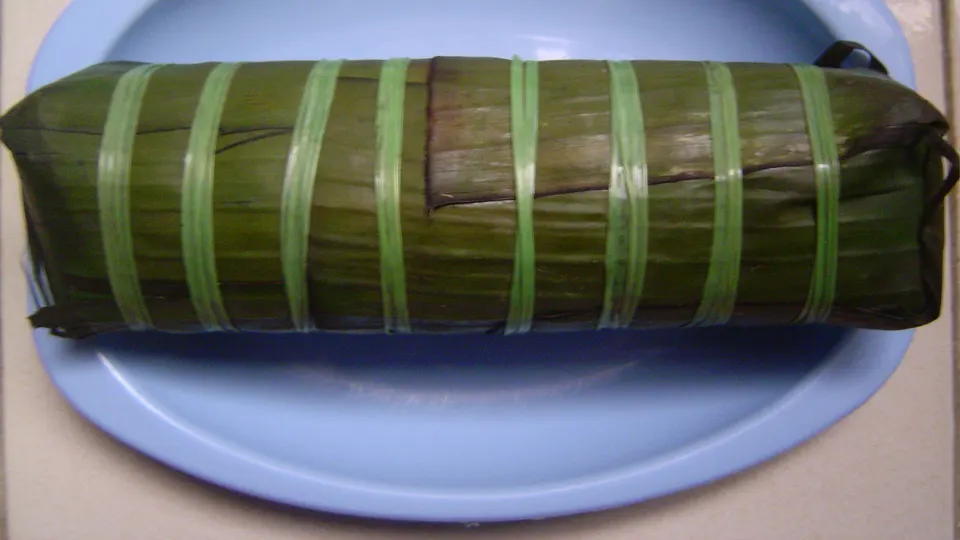
- Shape. Banh chung is a flat square, cut into eight triangular wedges; banh tet is a log, sliced into rounds with a loop of string.
- Leaf and colour. Banh chung is wrapped in dong leaves, which dye the outer rice green during the long boil. Banh tet is rolled in banana leaves, and its rice stays pale unless the maker adds pandan for green or la cam leaves for purple.
- Savoury or sweet. Banh chung is savoury, with pork belly at its centre. Banh tet is made both ways: a savoury cake with pork for meals and a sweet, meatless one with banana or mung bean for the ancestral altar.
- Region and name. Banh chung belongs to the North and banh tet to the South and the Mekong Delta. Central Vietnam makes both, and from Quang Tri to Hue the log is often called banh don.
- The story behind it. The square is tied to the legend of Prince Lang Lieu, while the origin of the log is debated; one practical explanation is that a long, tightly wrapped cake keeps well in a hot climate (see the two sections below).
How to tell them apart in a shop: a square parcel tied in a cross of bamboo strings is banh chung; a long roll tied at intervals along its length is banh tet. A log labelled “chay” is the sweet, meatless kind, and a fist-sized cake with a humped back, from the northern mountains, is banh chung gu.
What is banh chung, and why is it square?
Banh chung is the Northern Tet cake: glutinous rice around a core of mung bean and pork belly seasoned with pepper and shallots, wrapped into a square in dong leaves (la dong (lá dong), the broad leaves of Stachyphrynium placentarium) and tied with split bamboo string (lat (lạt)). After the long boil the leaves dye the outer rice green, and a cut cake shows three coloured layers of rice, bean and pork. It is an offering as much as a food: cakes are placed on altars for ancestors and deities before they are eaten.
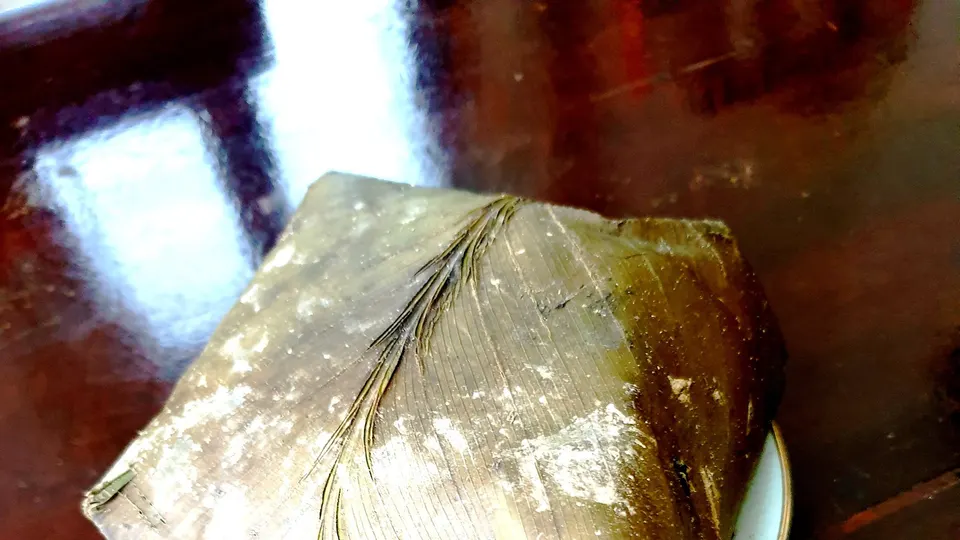
The square comes from a legend. The earliest written version, in the 14th-century collection Linh Nam chich quai (Lĩnh Nam chích quái), tells how the sixth Hung (Hùng) king asked his sons to bring the finest offering, and how the poor, motherless Prince Lang Lieu (Lang Liêu), guided by a dream, made a square cake for the earth and a round banh giay (bánh giầy) for the sky, and was chosen as heir. Saigoneer, retelling the story, calls it “obviously not a factual account” and notes that the historian Tran Quoc Vuong (Trần Quốc Vượng) saw it as “fakelore” whose square-earth, round-heaven idea was borrowed from Chinese cosmology (Saigoneer). Legend or not, the symbolism is still how Vietnamese sources explain the shape: Tuoi Tre describes the square banh chung as the earth and the round banh giay as heaven.
The practice itself has official standing. In 2023 the Ministry of Culture, Sports and Tourism added the making of banh chung and banh giay in Phu Tho, the province of the Hung Kings’ temple, to the national list of intangible cultural heritage, including the cooking contests held at the Hung Temple festival (Nhan Dan).
What is banh tet, and why is it a cylinder?
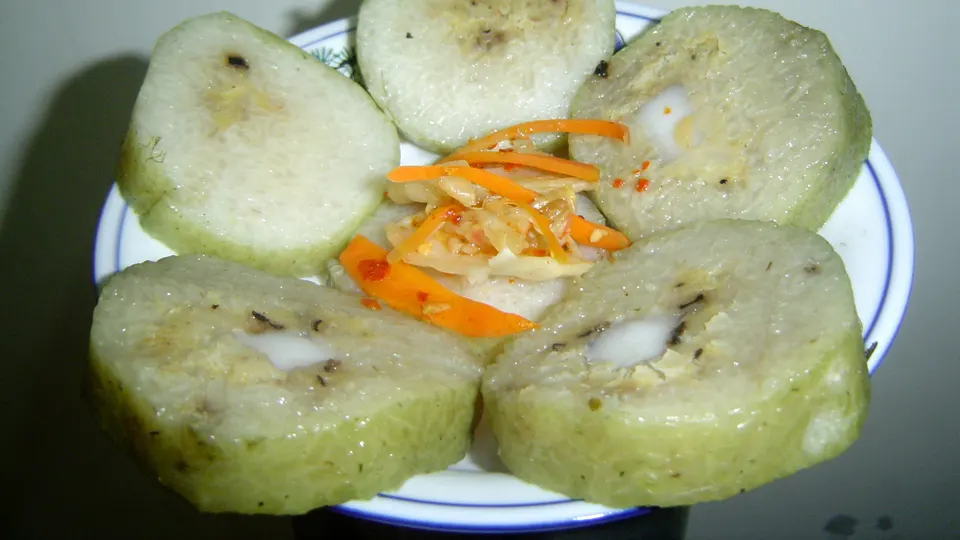
Banh tet is the Southern answer: the same rice, bean and pork, but rolled into a long cylinder in banana leaves instead of dong leaves, with two to four leaves laid lengthwise, then tied with string. Pork is optional. Southern families make both a savoury (man) cake for meals and a sweet, meatless (chay) one, often with banana or plain mung bean, which is placed on the ancestral altar (Tuoi Tre).
Why the change of shape is not settled. One popular story credits Emperor Quang Trung, who is said to have turned the square cake into a portable roll for his soldiers during his campaign against the Qing army in the late 18th century; another says one of his soldiers simply brought the cake from home. Saigoneer reports “many versions” of the tale and stresses that banh tet’s origins “remain a debate”. A more practical explanation offered in the same piece is that a long, tightly wrapped cake keeps well in a hot climate. Treat all of these as stories rather than history.
What happens in Central Vietnam, where both cakes meet?
Central Vietnam has no single rule. Tuoi Tre says Central families use both banh chung and banh tet “depending on the area”, and VTC News adds that the Central banh chung is usually smaller and holds less filling than the Northern one, while the Central banh tet resembles the Southern cake but is mostly eaten at home rather than given as a present.
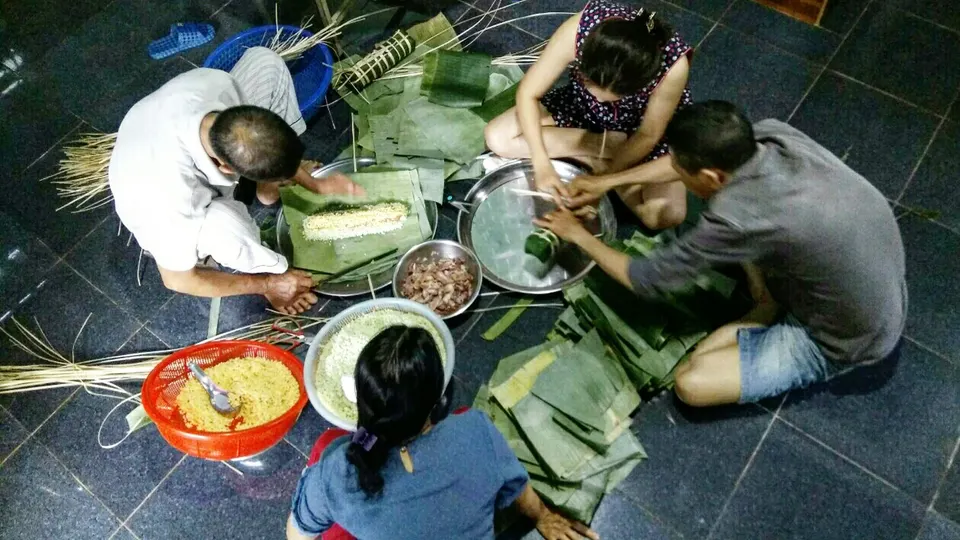
The cylinder also changes its name. From the Quang Tri area down to Hue, VOV notes, people call it banh don (bánh đòn), a “log” cake, and slice it with a fine strip of bamboo string. In Hue, almost every family keeps a few logs of banh tet and a pair of banh chung for Tet, according to Bao Van hoa. The best-known local source is Chuon (Chuồn) village, now called An Truyen, on the Tam Giang lagoon just outside the city, where residents say the craft is more than 400 years old; makers there add pandan leaves for colour and scent, and serve the cake with Hue’s mixed pickles, dua mon (Bao Van hoa). About 15 larger households in the village produce all year.
Which regional and ethnic versions are worth knowing?
The two basic shapes have many local relatives. These are the ones documented in Vietnamese press and official sources:
- Banh tet la cam, Can Tho (purple banh tet). The rice is soaked in water boiled with la cam (lá cẩm), a magenta-leaved plant, so it cooks purple. The Can Tho city portal credits Huynh Thi Trong of Binh Thuy with creating it, lists fillings of salted egg, banana, sweet or plain mung bean and pork fat, and gives about 4–5 hours over a wood fire. Her granddaughter’s Ut Be bakery also uses pandan for green and gac fruit for orange (Tuoi Tre News, 2025).
- Banh tet Tra Cuon (Trà Cuôn), Tra Vinh. A dark-green log with pork, salted egg yolk and sometimes dried shrimp, from a craft village in former Tra Vinh province (since July 2025 part of Vinh Long province). The village was recognised in 2011, the “Tra Cuon” certification mark has been registered, and it has 11 products rated under OCOP, Vietnam’s One Commune One Product scheme; makers boil the cakes for 9–10 hours (Viet Nam News). Tap chi Cong Thuong links the name to the Khmer language, as Tra Vinh has a large Khmer community.
- Banh chung gu (bánh chưng gù), Ha Giang (“hunchback” banh chung). A small, fist-sized cake with a rounded back, wrapped in a single dong leaf rather than the four or five of a lowland cake, made in Ban Tuy village near Ha Giang (since July 2025 part of Tuyen Quang province). The rice is coloured green with water from pounded galangal leaves and filled with mung bean and black-pig pork. Sources disagree on who makes it: Tap chi Cong Thuong (2025) says the Tay of Ban Tuy, Viet Nam News (2020) the Red Dao. More than 90% of the village’s households now make it all year. If you are heading north, see our Ha Giang guide.
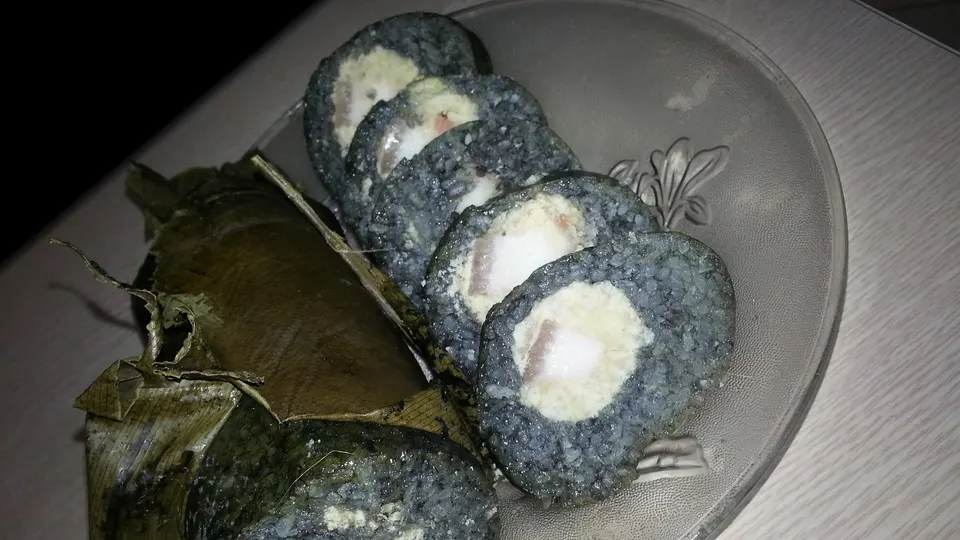
- Black banh chung (banh chung den). The Tay of Bac Ha in Lao Cai mix the rice with charcoal ground from the burnt stems of the nuc nac tree, which turns it black, and now make it daily for visitors (Bao Lao Cai).
- Red and purple banh chung. Some makers colour banh chung with gac fruit (red) or use purple sticky rice; VnExpress profiled a Saigon producer making both in the Northern style.
The pattern is the same everywhere: the base (sticky rice, bean, fat) stays, and the leaf, colour and size follow what grows locally.
How are they made, and do families still boil them overnight?
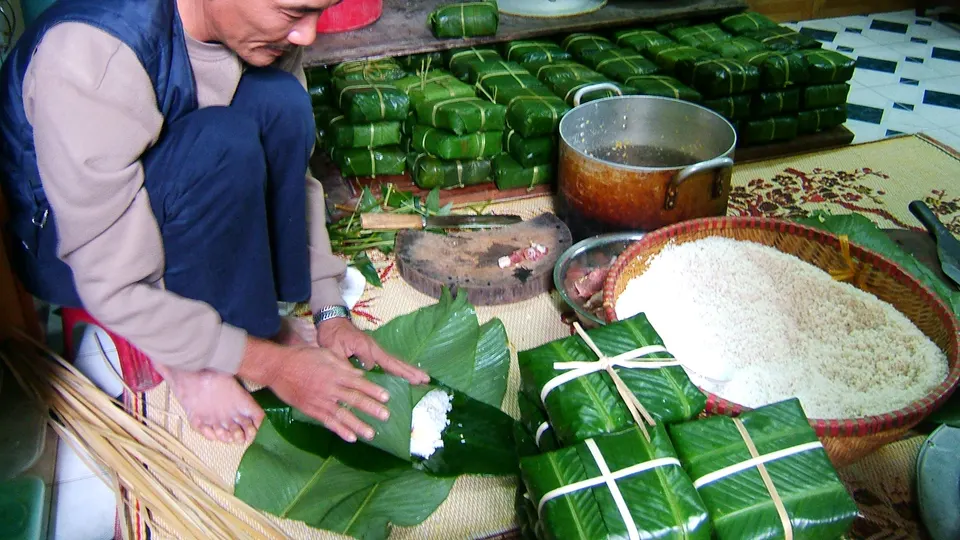
The method is shared, and it is slow. A Bao Dau tu guide gives the classic Northern steps: soak the rice in cold water for 10 to 12 hours, then drain and salt it; use hulled mung beans; cut pork belly with fat into large pieces and season with salt and pepper (the guide warns against fish sauce, which shortens keeping time, although other cooks add it); wash and air-dry the dong leaves; split and soak bamboo strings. Each cake takes five or six leaves, a layer of rice, half the beans, two pieces of pork, the rest of the beans and more rice, folded square by hand or in a wooden mould and tied in a cross.
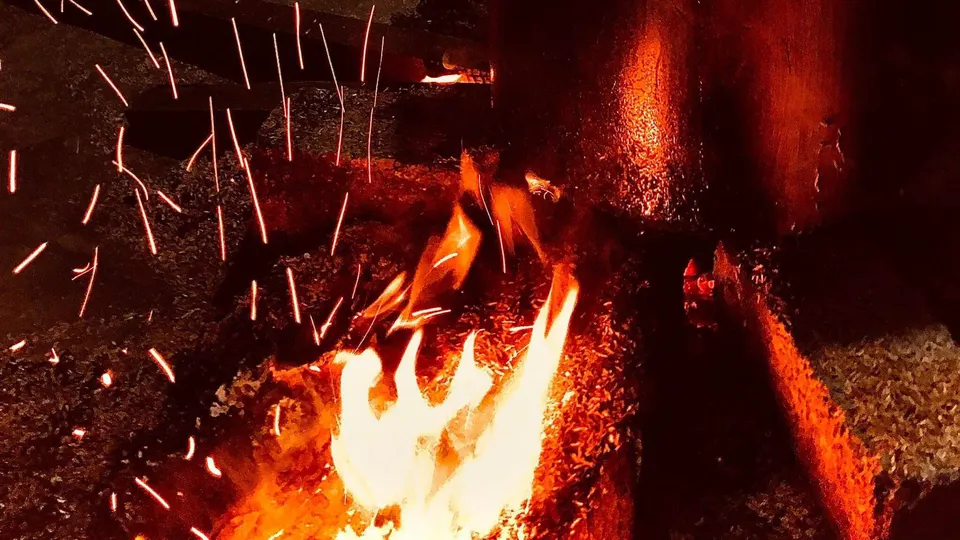
Then comes the boil. The cakes are packed tightly in a big pot so they do not burst, the water is topped up only with boiling water, and they cook for many hours: about 12 according to VOV’s report on Tranh Khuc village, 8 to 9 hours in that village’s steam boilers according to The Saigon Times, and 10 to 12 hours according to the Hanoi city portal. Afterwards the cakes are rinsed and pressed under a weight to squeeze out water. Banh tet is wrapped the same way but rolled lengthwise, and its boiling time ranges from about 4 to 10 hours depending on size and maker.
Tradition vs today. The overnight vigil around the pot, with stories and children waiting for the first cake, is still how many Vietnamese remember Tet. But VietnamPlus notes that “many families choose to buy ready-made cakes rather than prepare them at home”, especially in cities with small kitchens (VietnamPlus). Much of Hanoi’s supply comes from Tranh Khuc (Tranh Khúc), where about 140 of the village’s 150 households make banh chung (Tien Phong, 2026); Viet Nam News put it at about 300 families, some 70% of households, in January 2026, so figures vary with how the village is defined. Some workshops there boil nearly 1,000 cakes in one batch.
How do you cut and eat them?
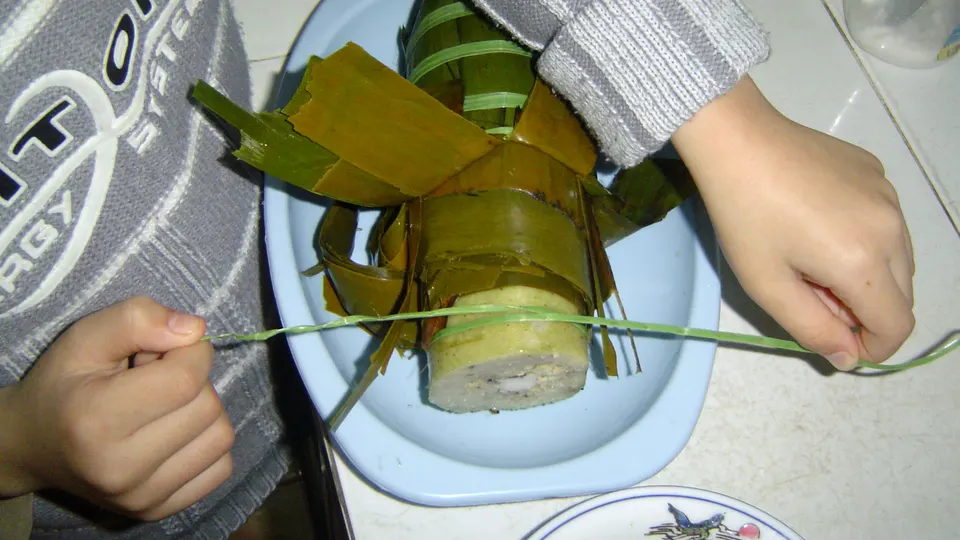
Cut with string, not a knife. Banh chung is so sticky that the bamboo tying string is used instead: it is split into thin threads and pulled through the cake to make eight equal triangles, each showing the three coloured layers (Hanoi city portal). Banh tet is unwrapped and a strip of string is looped round the log to slice it into rounds, neither too thick nor too thin (VOV).
What goes alongside follows the region. In the North, banh chung comes with dua hanh (dưa hành), pickled shallots; VietNamNet describes their sour crunch as the partner to fatty jellied meat and sticky rice cake, and the plate shares the table with boiled chicken and fried spring rolls. In Hue, banh tet is served with dua mon (dưa món) pickles; the rest of each region’s holiday table is in our guide to Tet food by region. In the South, Tuoi Tre notes, the savoury cake is eaten at meals and the sweet one goes on the altar; sliced sweet banana banh tet also makes a snack, a cousin of the sweet soups in our che guide.
Leftovers have their own life once the cake is a few days old: see fried banh chung below.
How long do they keep, and when is leftover cake unsafe?
Less long than many people think. Dr Nguyen Van Tien of the National Institute of Nutrition told Znews in February 2026 that banh chung keeps about 4 to 5 days at room temperature in dry weather; in humid weather it should go in the fridge, where it lasts about 15 to 20 days but turns hard. A well-made Tra Cuon banh tet keeps about 5 to 7 days in normal conditions (Tap chi Cong Thuong), and Can Tho’s Ut Be bakery says its vacuum-packed cakes last up to five days at room temperature and are still edible after a month frozen.
Mould is the real risk. Spores settle on the leaves and grow inward, and mould can produce aflatoxin, which spreads into the cake where you cannot see it; the expert’s advice is to discard the whole cake, not just cut off the mouldy part (Znews). He also advises reheating thoroughly by steaming or boiling, and not soaking cooked cakes in water to keep them green, which makes them spoil faster. Ha Giang’s small banh chung gu keeps worst of all: Viet Nam News says it should be eaten within a day of cooking.
Fried banh chung (banh chung ran) and other ways to use leftovers
After a few days the cakes firm up, and that is when many families turn them into banh chung ran (bánh chưng rán), fried banh chung: slices or small pieces fried on both sides until golden and crisp outside and soft inside, then eaten with pickled vegetables or pickled shallots (dua hanh). Znews calls it the basic leftover dish “for those who are not handy in the kitchen”, and suggests braising the fried pieces with fish sauce or dipping them in tamarind sauce for more flavour.
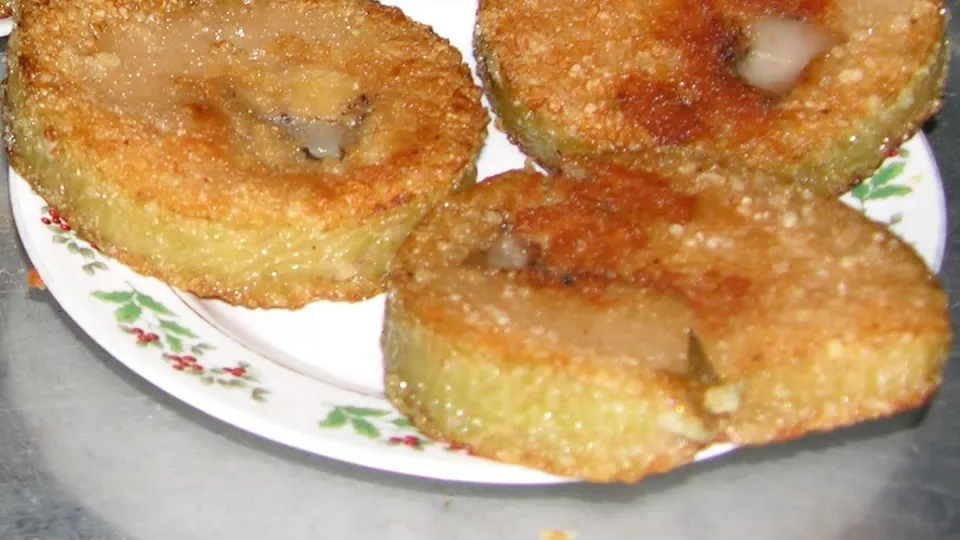
There are three common ways to fry it:
| Method | How (sources) | Result |
|---|---|---|
| In oil | Cut into small pieces or slices; fry both sides in oil until golden (Znews, 2024) | The classic crisp crust |
| “Water-fried” (ran nuoc) | Simmer slices in a non-stick pan with water just to cover; when it has nearly evaporated, break the cake up, press it into a thin layer, flip once it binds and fry both sides golden (VietNamNet, 2026) | Crisp outside, soft inside, with little or no oil; eaten with chilli sauce or ketchup |
| Air fryer | Slices 1.5–2 cm thick on baking paper, brushed with about 2 tablespoons of oil; 180°C for 8 minutes, flip, then 200°C for about 7 minutes (Bao Lam Dong, December 2025) | A puffed, crisp crust without drying the filling |
Other leftover ideas from Vietnamese food pages include banh chung porridge, the cake simmered and mashed into chicken broth and topped with shredded chicken and herbs (Znews); a crisp “pizza” of mashed cake and egg; and a roll of steamed cake wrapped round mashed sweet potato, deep-fried and served with coconut milk sauce and peanuts (VietNamNet, 2026). Banh tet slices can be fried the same way.
One caution: fry only cake that is still sound. If any part shows mould, the nutrition doctor quoted in the section above advises throwing away the whole cake, because the toxin spreads where you cannot see it.
Banh chung or banh tet: which will you like?
Both taste of the same things, so choose by texture and mood:
- For a rich, savoury bite: Northern banh chung, with its thick bean layer and fatty pork, eaten with pickled shallots.
- For something lighter or sweet: banh tet with banana or plain mung bean, often vegetarian.
- For colour and a salty surprise: Can Tho’s purple banh tet or Tra Cuon’s cake with salted egg yolk.
- For crunch: fried slices of either, best from a cake a few days old.
- For a small portion: a fist-sized banh chung gu, eaten the day it is made.
There is no “more authentic” one. Each is the Tet cake of its own region, and many families now buy both. These leaf-wrapped cakes, rather than dumplings, are also one of the clearest food differences between Tet and Chinese New Year.
When can you see them made before Tet 2027?
Tet 2027 falls on Saturday 6 February, and the cakes are made in the last weeks of the old lunar year, so late January and the first days of February are the time to watch. In Tranh Khuc, about 300 families, roughly 70% of households, take part weeks before Tet, and output per household climbs from 300–500 cakes a day to 1,000–3,000 as the holiday nears (Viet Nam News). For trains, flights and what closes over the holiday, see our Tet 2027 travel guide.
| When (2027) | Lunar date | What you can see | Source |
|---|---|---|---|
| From about Friday 22 January | 15th day of the last month | Tranh Khuc enters its peak season, which runs to the 15th day of the first month (about 20 February) | The Saigon Times, 2025 |
| Weeks before Tet | Last month | Hanoi’s Old Quarter Tet-traditions programme; in 2026 it opened on 17 January at the arts centre at 22 Hang Buom, with hands-on banh chung wrapping | Dai bieu Nhan dan, 2026 |
| About a week before Tet | Around the 22nd | Ho Chi Minh City’s annual banh tet wrapping and cooking contest at the Hung Kings memorial temple; in 2026 it was held on 9 February | Tuoi Tre, 2026 |
| Wednesday 3 – Friday 5 February | 27th to 29th | Families boil their own cakes, often overnight; queues at Old Quarter shops such as Quoc Huong | VietNamNet, 2026; SGGP, 2023 |
| Saturday 6 – Monday 8 February | 1st to 3rd of the new year | Cakes on family altars; many family-run shops and markets close, so buy before | Our Tet 2027 travel guide |
Hanoi. Tranh Khuc boils its cakes in big pots over wood fires through the night, for about 10 to 12 hours, with neighbours taking turns to tend the fires, according to a VNA report from February 2026; some workshops now also use steam boilers (The Saigon Times). It is a working village of family workshops rather than a show, so ask before you photograph or step inside. In the city itself, the Old Quarter’s Tet programme offered visitors banh chung wrapping in 2026, run by the Hoan Kiem Lake and Old Quarter management board (Dai bieu Nhan dan); check the 2027 dates nearer the time.
Saigon. On the 27th day of the last month of 2026 (14 February), VietNamNet found families in Tan Son Nhat, Tan Binh and Gia Dinh wards boiling banh tet and banh chung over wood fires, some on the pavement, lifting the first cakes around 1 or 2 am; one family kept its pot going for 30 to 40 hours. For Tet 2027 that day is Wednesday 3 February. A week earlier, the city’s Historical-Cultural Park held its annual banh tet contest at the Hung Kings memorial temple: 102 teams each wrapped and boiled ten pairs of cakes, and the best were offered at the temple on the 26th day of the month (Tuoi Tre). Tuoi Tre’s report does not say whether the public may watch, so check the park’s 2027 announcement first.
Mekong Delta. Tra Cuon’s makers in former Tra Vinh (now Vinh Long province) and Can Tho’s purple-cake bakeries produce all year and step up output for Tet; see the next section for what to buy.
How to buy or order one in the city before Tet 2027
Most city families now buy their cakes rather than boil them, so the practical questions are when to buy and from whom. Tet 2027 falls on Saturday 6 February. As of November 2026, the public-sector holiday is set for Thursday 4 to Wednesday 10 February, from the 28th day of the last lunar month to the 5th of the first, under a Ministry of Home Affairs notice of 9 October 2026; private employers choose their own schedule, according to the Ha Tinh provincial portal. The last lunar month of this year has no 30th day, so New Year’s Eve is Friday 5 February, the 29th. Many family-run shops and markets close for the first days of the new year, so plan to have your cake before then. As a price guide from Tet 2026: Tranh Khuc sold most cakes wholesale at 40,000 to 50,000 dong each (Tien Phong, 2 February 2026), Hanoi apartment blocks ordering together paid 60,000 to 70,000 dong (Dan Tri, 15 February 2026), and in Ho Chi Minh City a 900 g Givral banh chung cost 195,000 dong (Nguoi Lao Dong, January 2026). For Tet 2027, VnBusiness reported on 19 November 2026 that a Hanoi producer of gio cha and banh chung expected Tet orders four to five times the usual level and was trying to keep its everyday prices, while rises of 5 to 15% were forecast mainly for imported goods; check the price when you order.
- Time it to the keeping time. Banh chung keeps about 4 to 5 days at room temperature in dry weather (longer in the fridge, though it hardens), so a cake bought on 3 to 5 February 2027, the 27th to 29th of the last lunar month, covers the first days of Tet. Buy earlier only if you can refrigerate it, and keep the fried-leftover ideas above for the days after.
- Hanoi: follow the cakes from Tranh Khuc. Most of the village’s banh chung is eaten in Hanoi: households sell wholesale to shops, supermarkets and hotels and take orders from dealers in the city and nearby provinces (Tien Phong, 2026), so neighbourhood shops and supermarkets across Hanoi are the easy option. Tranh Khuc itself, now in Nam Phu commune on the city’s southern edge (formerly Duyen Ha commune), was recognised as a traditional craft village in 2011 and makes banh chung all year (The Saigon Times); see the card below. In the Old Quarter, Quoc Huong at 9 Hang Bong, a gio cha (pork roll) shop that Nhan Dan and Ngoi Sao describe as trusted by generations of Hanoians, sells banh chung, and before Tet the queue often reaches the pavement, so go early.
- Banh tet from the Mekong Delta: in Can Tho, Binh Thuy is the home of purple banh tet, and Tra Cuon cakes are sold almost all year, according to Tap chi Cong Thuong; Can Tho’s Ut Be bakery vacuum-packs its cakes. Combine them with a Mekong Delta trip, which usually starts from Ho Chi Minh City.
- Hue: Chuon village’s larger households produce banh tet year-round to order.
- Check what you buy. In the 2026 Tet season, shoppers put a product’s origin, expiry date, storage conditions and safety certification ahead of attractive packaging, and more producers printed QR codes with product details (Tap chi Doanh nghiep va Hoi nhap, 2026). For a cake from a shop or stall, ask whether it was cooked that day or the day before, look for tight wrapping and clean leaves with no mould, eat it within a few days or refrigerate it, and reheat it well.
- Order the right word: “banh chung” gets you the square cake, “banh tet” the log; in Central Vietnam “banh don” also means the log.
- Outside the Tet rush, neither cake is hard to find: Tranh Khuc, Tra Cuon and Chuon all produce through the year, and choice and freshness simply peak in the weeks before Tet.
Which cake to buy, and when, depends on what you need it for:
| What you want | What to buy | When (Tet 2027) | Keeping (sources) | Who it suits |
|---|---|---|---|---|
| A cake for a Tet table in the North | Square banh chung from a neighbourhood shop or supermarket supplied by Tranh Khuc, or from Quoc Huong in the Old Quarter | Wed 3 – Fri 5 February | About 4–5 days at room temperature in dry weather; 15–20 days chilled | Hosts and families in Hanoi |
| A cake for a Tet table in the South | A savoury banh tet with pork, plus a sweet meatless one if the household keeps an altar | Wed 3 – Fri 5 February | About 5–7 days for a well-made Tra Cuon cake | Families in Saigon and the Mekong Delta |
| A gift or a cake to carry between cities | A vacuum-packed banh tet, such as those of Can Tho’s Ut Be bakery | Any time; order well before the Tet rush | Up to about 5 days at room temperature, the bakery says | Travellers moving on after Tet |
| A first taste outside Tet | Either, from a market stall or shop | Any time of year | Refrigerate leftovers and reheat well | Visitors who are not in Vietnam for Tet |
| To watch them being made | A visit to Tranh Khuc village (ask before entering) | From about Fri 22 January | – | Photographers and the curious |
For more regional dishes, browse our Vietnamese food guides.
Where to buy banh chung in Hanoi
Local favourite
Quốc Hương · Giò chả Quốc Hương
Hanoi · Old Quarter (former Hoàn Kiếm district)
9 Hàng Bông Street
A decades-old Old Quarter shop for giò chả (Vietnamese pork roll) and Tet food that also sells banh chung; Nhân Dân and SGGP (2023) describe Hanoians queueing outside it before Tet, and Ngôi Sao (VnExpress group, 2024) says generations of Old Quarter customers trust it.
Order: A banh chung, ideally with a piece of the shop's giò lụa (pork roll) to eat alongside it.
Expect long queues in the last days before Tet. The cakes are not made on the premises: Đại Biểu Nhân Dân reports that Tranh Khúc village families supply them.
Recommended by: Ngôi Sao (VnExpress) (2024), Nhân Dân (2023), Sài Gòn Giải Phóng (2023) · checked November 2026
Local favourite
Tranh Khúc banh chung village · Làng bánh chưng Tranh Khúc
Hanoi · Nam Phù commune, on Hanoi's southern edge
Tranh Khúc village, Nam Phù commune, Hanoi
Hanoi's best-known banh chung village: about 140 of its 150 households make the cakes, all year round, and most of them are eaten in Hanoi, sold wholesale to shops, supermarkets and hotels (Tiền Phong, 2026). In the last weeks before Tet the cakes boil over wood fires through the night (VNA, 2026).
Order: A classic square banh chung; ask whether it was boiled that day.
A working village of family workshops, not a market or a show: there is no single shop, sources do not describe walk-in retail, and the days just before Tet are the busiest. Ask before you photograph or step inside.
Recommended by: Tiền Phong (2026), Vietnam News Agency (VNA) (2026), The Saigon Times (Tuổi Trẻ group) (2025) · checked November 2026
Addresses and details can change; check before you go. We do not accept payment for listings.
Frequently asked questions
Is banh tet the same as banh chung?
They share ingredients and method, but not shape or wrapping. Banh chung is square and wrapped in dong leaves, the Northern Tet cake; banh tet is a long cylinder rolled in banana leaves, the Southern and Central one, and it comes in sweet as well as savoury versions.
How long does banh chung keep?
A doctor at Vietnam's National Institute of Nutrition gives about 4 to 5 days at room temperature in dry weather and about 15 to 20 days in the fridge, although chilled cakes harden. Reheat before eating, and throw away the whole cake if you see mould.
How much does banh chung cost for Tet 2027?
As a guide from Tet 2026, Tranh Khuc village near Hanoi sold most banh chung wholesale at 40,000 to 50,000 dong a cake (Tien Phong), and a 900 g Givral banh chung cost 195,000 dong in Ho Chi Minh City (Nguoi Lao Dong). On 19 November 2026 VnBusiness reported Hanoi producers expecting Tet orders four to five times the usual level while trying to hold their prices.
Can you buy banh chung and banh tet outside Tet?
Yes. Tranh Khuc village near Hanoi makes banh chung all year, Tra Cuon banh tet from the Mekong Delta is sold almost year-round, and many markets and shops keep both in stock, but choice and freshness peak in the weeks before Tet.
When should I buy banh chung or banh tet for Tet 2027?
Buy on Wednesday 3 to Friday 5 February 2027, the last days of the old lunar year, so the cake keeps through Tet on Saturday 6 February: banh chung lasts about 4 to 5 days at room temperature in dry weather. The official holiday runs from 4 to 10 February, and many family-run shops close from New Year's Day.
Key sources
- Hà Nội craft villages bustle as Lunar New Year approaches · Việt Nam News, 23 January 2026
- Bánh chưng, bánh giầy, bánh tét: linh hồn Tết Việt · Tuổi Trẻ (Tiến Vũ), 5 January 2020
- Dishes on Tết (Lunar New Year Celebration) in Hà Nội · Hanoi Capital portal (hanoicapital.chinhphu.vn), 24 May 2010
- Green banh chung – Embracing the soul of Vietnamese Tet · VietnamPlus (Vietnam News Agency), 16 February 2026
- Tết Tales: The Many Folk Stories Behind Vietnam's Sticky Rice Cakes · Saigoneer, 26 January 2025 (first published 2018)
- Bánh tét làng Chuồn mang 'vị Tết' đến người dân xứ Huế · Báo Văn hóa, 24 January 2025
- Trà Cuôn Sticky Rice Cake: a village delicacy making its way beyond provincial borders · Việt Nam News, 15 August 2025
- Lý do bánh chưng dễ bị thiu, mốc · Znews, 21 February 2026 (advice from Dr Nguyễn Văn Tiến, National Institute of Nutrition)
All 41 sources and further reading
- Chốt lịch nghỉ Tết Nguyên đán Đinh Mùi 7 ngày · Báo Quốc tế (Ministry of Foreign Affairs), 3 October 2026
- Hàng Tết 2027 chịu sức ép tăng giá · VnBusiness, 19 November 2026
- Dân chung cư ở Hà Nội bắc bếp đun bánh chưng, quây lợn, mở tiệc đón Tết · Dân Trí, 15 February 2026
- Diễn biến lạ của thị trường bánh chưng, bánh tét Tết năm nay · Người Lao Động (via Tuổi Trẻ), 24 January 2026
- Taste of Tet fills the air in Tranh Khuc chung cake village · Vietnam News Agency (VNA), 12 February 2026
- Through the night for Tet: the warmth of banh chung and banh tet · VietNamNet, 15 February 2026
- Hơn 100 đội tham gia Hội thi gói, nấu bánh tét, lan tỏa hồn Tết phương Nam · Tuổi Trẻ, 9 February 2026
- Trải nghiệm không gian Tết cổ truyền tại phố cổ Hà Nội · Đại biểu Nhân dân, 17 January 2026
- Flavours of three regional Tết feasts in contemporary life · Việt Nam News, 18 February 2026
- Bánh chưng miền Nam, miền Trung khác bánh chưng miền Bắc thế nào? · VTC News (Hạ Vy), 10 February 2021
- Nghề làm bánh chưng, bánh dày ở Phú Thọ là Di sản văn hóa phi vật thể quốc gia · Nhân Dân, 11 May 2023
- Làng bánh chưng Tranh Khúc tất bật vụ Tết · Tiền Phong (Lâm Thuỳ Dương), 2 February 2026
- Ghé thăm làng Tranh Khúc, 'thủ phủ' bánh chưng Hà Nội ngày giáp Tết · The Saigon Times (Tuổi Trẻ group), 27 January 2025
- Chung cake making village in Hanoi hustles ahead of Tet · VOV (Voice of Vietnam), 22 January 2024
- Bí quyết làm bánh chưng ngon và xanh tự nhiên · Báo Đầu tư (Chí Cường), 4 January 2020
- Bánh tét – bánh đòn ngày Tết · VOV, 16 January 2009
- Bánh tét Trà Cuôn nồng đượm khó quên · Tạp chí Công Thương, 24 November 2022
- Bánh tét lá cẩm (sticky rice cake coloured by magenta leaf) · Can Tho City portal (cantho.gov.vn), 12 March 2022
- 4-generation southern Vietnam-based banh tet shop works day and night to meet Tet demand · Tuổi Trẻ News, 22 January 2025
- Bản Tùy: Quanh năm thơm nức bánh chưng gù · Tạp chí Công Thương, 24 June 2025
- Dao Đỏ ethnic group's bánh chưng gù become popular in Hà Nội · Việt Nam News, 16 November 2020
- Lưu luyến hương vị đặc sản bánh chưng đen Bắc Hà · Báo Lào Cai, 26 August 2020
- Bánh chưng nếp cẩm, gấc · VnExpress (Lê Nguyễn), 1 February 2021
- Pickled onions add flavour to Tet feast · VietNamNet, 23 January 2020
- Gợi ý các món ăn từ bánh chưng thừa sau Tết để giải ngấy · VietNamNet (Hà Nguyễn), 20 February 2026
- Làm gì với bánh chưng thừa sau Tết · Znews (Trúc Hồ), 13 February 2024
- Mẹo làm bánh chưng rán bằng nồi chiên không dầu giòn rụm · Báo Lâm Đồng (Tuệ Nhân), 19 December 2025
- Tết gọn nhẹ, chọn lọc kỹ: Người Việt thay đổi cách mua thực phẩm dịp Tết 2026 · Tạp chí Doanh nghiệp và Hội nhập (Hà Hương), 28 January 2026
- Tết Nguyên đán 2027, công chức, viên chức được nghỉ 7 ngày liên tục · Cổng thông tin điện tử tỉnh Hà Tĩnh, 9 October 2026 (Ministry of Home Affairs notice 11483/TB-BNV)
- Cả nước chính thức còn 34 tỉnh, thành phố · Báo Pháp Luật Việt Nam, 12 June 2025
- Những địa chỉ mua giò chả nổi tiếng ở Hà Nội · Ngôi Sao (VnExpress), 8 February 2024
- Bánh chưng Tết phố xưa · Nhân Dân, 15 January 2023
- Người dân Hà Nội kiên nhẫn xếp hàng để mua bánh chưng, giò chả tết · Sài Gòn Giải Phóng, 21 January 2023
Keep exploring
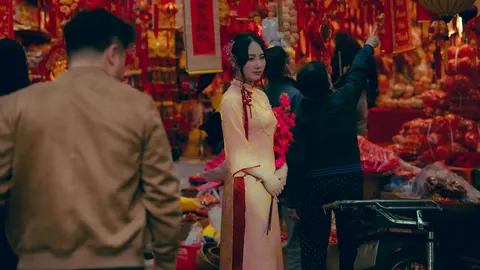 North · Central · South · Culture Tet (Tết) 2027 by Region: North, Central, South Compared How Tet differs in North, Central and South Vietnam: peach vs mai, banh chung vs banh tet, fruit trays, pickles, first visitors, plus the Tet 2027 dates.
 North · Central · South · Travel Tet 2027 in Vietnam: When to Travel and What's Open Travelling at Tet 2027 (4–10 Feb): when to book trains and flights, fares as of November 2026, Long Thanh airport, and what stays open in Hanoi, Hue and Saigon.
 North · Central · South · Food Che (Chè) by Region: Which to Try in Hanoi, Hue and Saigon Vietnamese che compared: Hanoi's gentle bean and lotus che, Hue's trays of 20 small bowls, Saigon's coconut milk and ice, why they differ and how to order.
 North Vietnam · Travel Hanoi: How Many Days, What to See and When to Go Hanoi travel guide for 2026: how many days and where to stay, Noi Bai airport, walking-street hours, the new low-emission zone, Train Street and where to eat.