North Vietnam · Culture
Hanoi's 36 Streets: What the Names Mean and How to Walk Them
What Hanoi's 36 streets really were, which Hang streets still sell what their names say, where the guild temples stand, and a self-guided Old Quarter walk.
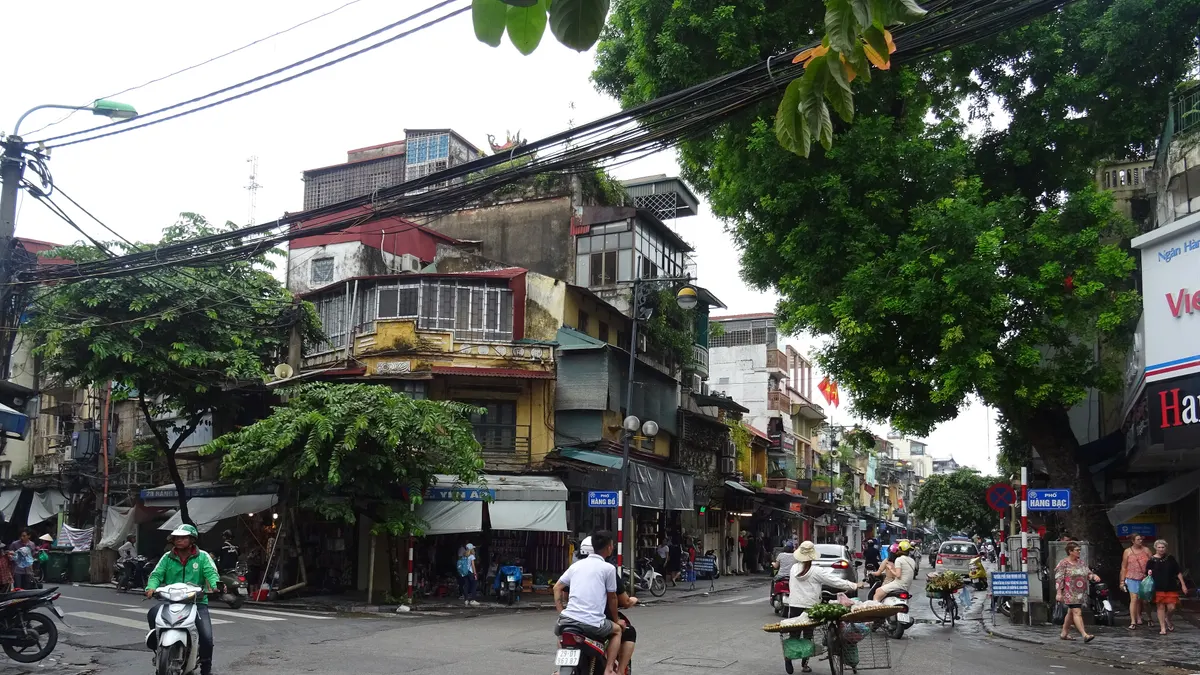
Hanoi’s Old Quarter has far more than 36 streets: the “36” counted phuong, guild wards of the Le-era capital, and about 80 Hanoi street names still begin with Hang (“wares”). A few streets, such as Hang Bac (Hàng Bạc) for silver and Hang Ma (Hàng Mã) for votive paper, still sell what their names say. As of November 2026 most of the quarter lies in Hoan Kiem (Hoàn Kiếm) ward, formed on 1 July 2025 when Hanoi abolished its districts.
The Old Quarter (Pho co (Phố cổ)), the grid of narrow streets just north of Hoan Kiem Lake, is widely known as “Hà Nội 36 phố phường”, “Hanoi of the 36 streets and guilds”. The phrase is a little misleading. It describes a merchant and craft town that grew beside the royal citadel of Thang Long (Thăng Long), where people practising the same trade lived together, worshipped together and gave their street its name: silver on Hang Bac, votive paper on Hang Ma, tin on Hang Thiec (Hàng Thiếc). The number 36 has never matched the map exactly, because the guilds and streets changed from one period to the next (Hanoi capital portal). This guide goes street by street through what the names mean, where the craftspeople came from, which shrines they left behind, and how to walk the quarter so you can read it for yourself. For the rest of the city, start with our Hanoi travel guide.
What does “36 pho phuong” actually mean?
The key word is phuong (phường), not pho (phố) (street). Under the Le (Lê) dynasty (15th–18th centuries) a phuong was two things at once: an association of people in the same trade and the smallest administrative unit of the capital. Records suggest the capital had 61 phuong under the Tran (Trần) dynasty (1225–1400), reduced to 36 under the Le. Nguyen Trai’s geography Du dia chi (Dư địa chí) (1438) says each of the city’s two districts, Tho Xuong (Thọ Xương) and Quang Duc (Quảng Đức), had 18, and the 18th-century writer Pham Dinh Ho (Phạm Đình Hổ) also describes Thang Long as “composed of 36 guilds”.
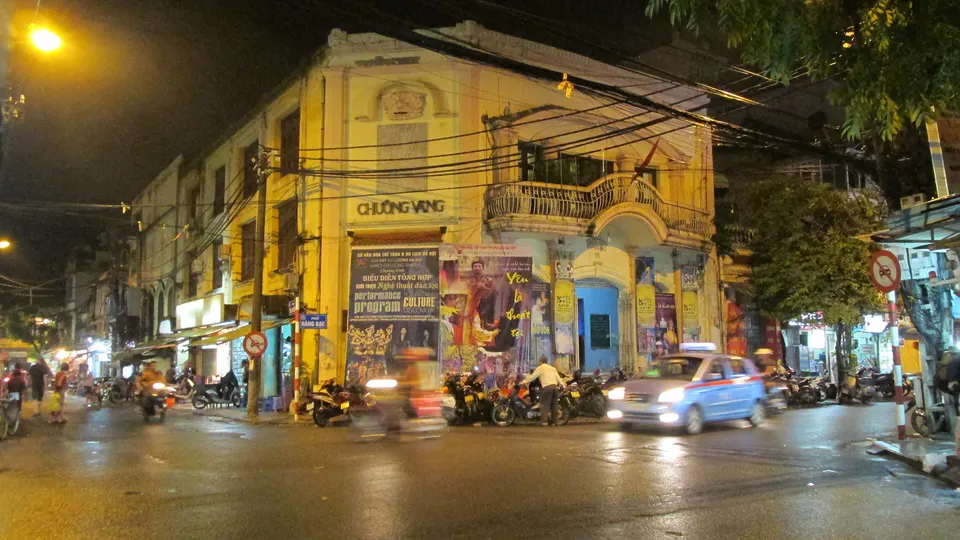
Which 36 they were is another matter. Not all of them appear in Nguyen Trai’s text, researchers have compiled lists of up to 49 ward names, and the Thang Long heritage centre says scholars “still can not agree” on the exact list (Thang Long heritage centre). Some ward names survive as street names, such as Hang Dao (Hàng Đào), while others vanished. Meanwhile the streets multiplied. A 2009 Nhan Dan (Nhân Dân) count put the number of Hanoi streets beginning with Hang (Hàng) (“wares”) at about 80.
So read “36” as a traditional name for a historic district, kept alive by folk songs and poems, not a count you can check on a map. The idea is still celebrated: in September 2026 the Temple of Literature staged Net Kinh Ky, an exhibition on the history, name origins and crafts of the 36 streets, as part of the second Thang Long–Hanoi Festival, VietNamNet reported on 13 September 2026.
How did craft villages turn into trade streets?
The Old Quarter began to form after King Ly Thai To (King Lý Thái Tổ) made Thang Long his capital in 1010, and it filled up after the 15th century. The court and the city needed goods, and skilled people from villages in the Red River Delta moved in to make and sell them. Reporting on a 2020 exhibition at Kim Ngan (Kim Ngân) communal house, Dai bieu Nhan dan (Đại biểu Nhân dân) dated this trend to the 17th–18th centuries and named source villages such as Dan Loan (dyeing), Quat Dong (embroidery), Nhi Khe (wood turning), Da Hoi (blacksmithing) and Dinh Cong (goldsmithing). Each craft clustered in one place, and the cluster became a guild street.
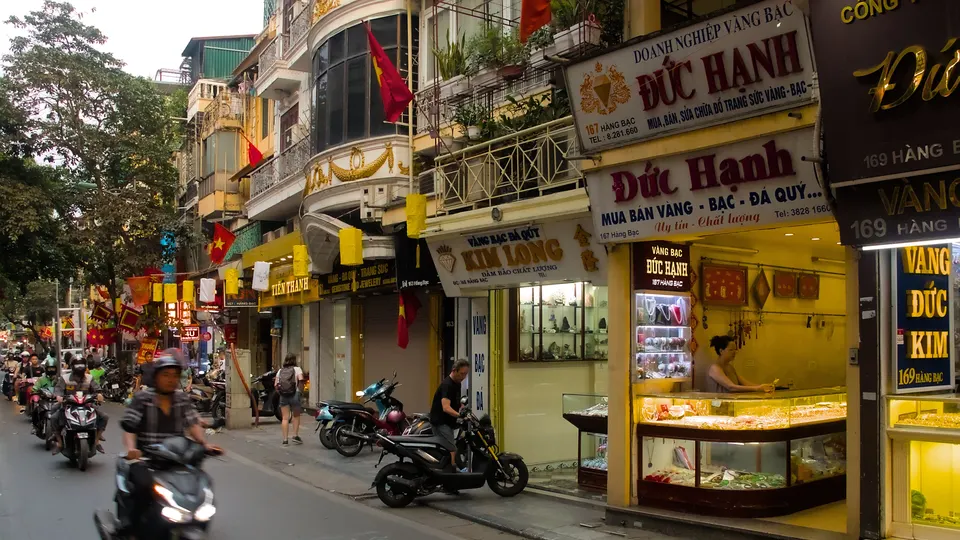
Hang Bac, Silver Street, shows how this worked. Tradition credits Luu Xuan Tin (Lưu Xuân Tín), a minister under King Le Thanh Tong (King Lê Thánh Tông), with setting up a silver-ingot workshop in the citadel and bringing in craftsmen from his home village. Silver casters from Chau Khe (Châu Khê) (also written Trau Khe (Trâu Khê), in the former Hai Duong (Hải Dương) province, since July 2025 part of Hai Phong (Hải Phòng) city) worked here alongside jewellers from Dong Xam (Đồng Xâm) in the former Thai Binh (Thái Bình) province (since July 2025 part of Hung Yen (Hưng Yên) province), who made large silver urns, betel boxes and trays. Jewellers from Dinh Cong, a village on the city’s southern edge, settled next door on today’s Hang Bo (Hàng Bồ) and made earrings, bracelets and rings. Money-changers worked on Hang Bac too, which is why the French called it the street of exchangers (Hanoi Times). When the Nguyen (Nguyễn) dynasty moved the mint to Hue (Huế) in the early 19th century, many Chau Khe families stayed and turned to jewellery.
The same pattern repeats elsewhere. Dyers mostly from Dan Loan settled Hang Dao and formed the guild of Dai Loi (Đại Lợi) by the 14th–15th centuries. Tinsmiths from Yen Noi (Yên Nội) village made oil lamps, incense burners and tea trays on Hang Thiec. Lacquer-box makers from Ha Vi (Hà Vĩ) village settled Hang Hom (Hàng Hòm) in the mid-19th century. The guild street was an urban outpost of a village: people kept their home village’s patron god and passed the trade down the family.
Which streets still sell what their names say?
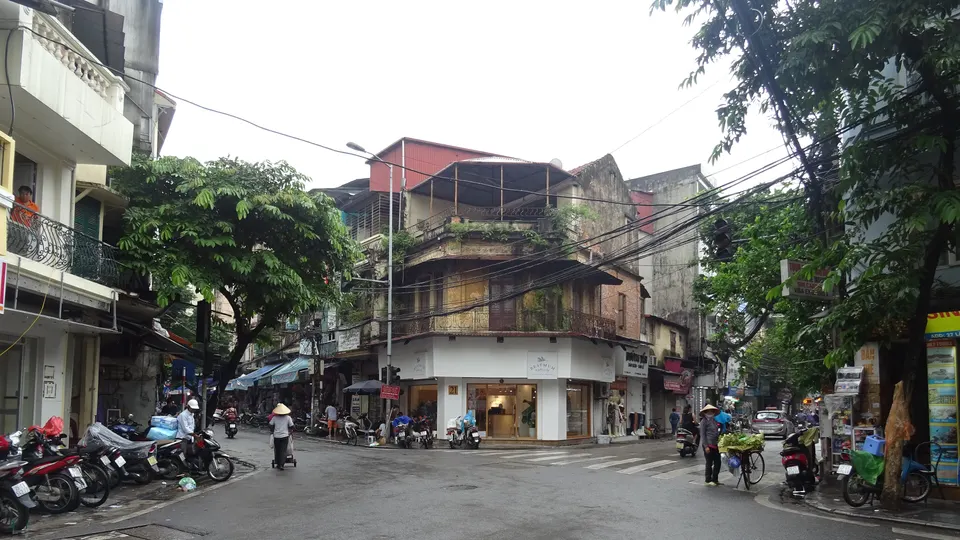
Some do, many do not. The table pairs each name with the trade recorded for it and what the street is known for in the most recent source we found. Dates matter here: several “today” entries come from reports written between 2009 and 2024.
| Street | Name means | Historic trade (and settlers where recorded) | What you find today |
|---|---|---|---|
| Hang Bac | Silver | Silver casting, jewellery, money-changing; Chau Khe and Dong Xam craftspeople | Still lined with jewellery shops (2022) |
| Hang Dao | Red-dyed cloth | Dyeing by settlers from Dan Loan, then silk and brocade | Clothes, watches and haberdashery; start of the weekend night market |
| Hang Gai (Hàng Gai) | Hemp (ramie) | Rope, hammocks and fishing line; later woodblock printing | Silk shops aimed at visitors |
| Hang Thiec | Tin | Tinsmiths from Yen Noi village: lamps, incense burners, trays | Tin and sheet-metal goods; most shops now trade items made in rural workshops (2009) |
| Hang Ma | Votive paper | Joss paper and paper ornaments; families from Tan Khai (Tân Khải) village | Votive paper, lanterns and Mid-Autumn toys |
| Hang Chieu (Hàng Chiếu) | Sleeping mats | Sedge mats | Still sells mats (2009) |
| Hang Duong (Hàng Đường) | Sugar | Sugar and sweets | Sweets and o mai (ô mai), spiced dried fruit (2009) |
| Hang Buom (Hàng Buồm) | Sails | Bags, sails and mats woven from rattan and sedge; Chinese merchant quarter | Shops, food and a former Cantonese guild hall |
| Lan Ong (Lãn Ông) | Named after a physician | Formerly Phuc Kien (Phúc Kiến) street; metals, then herbal medicine from the early 20th century | Traditional medicine shops (2024) |
| Cha Ca (Chả Cá) | Grilled fish | Formerly Hang Son (lacquer and paint) | Named after the dish that made it famous |
Nhan Dan’s 2009 survey gives the clearest picture of the drift. Hang Be (Hàng Bè) no longer sells bamboo rafts because the river has moved away; nobody sells woven cot (cót) on Hang Cot (Hàng Cót); Hang Thung (Hàng Thùng) sells hot pork offal rather than barrels; Hang Gai sells silk rather than fishing line. Some streets were renamed outright: Hang Son became Cha Ca street after cha ca La Vong, the turmeric fish first sold there, and Hang Bua (Hàng Bừa) became Lo Ren (Nhan Dan). Other streets moved into new trades: Hang Bat Dan (Hàng Bát Đàn) is now known for its pho shops.
Lan Ong is a special case. It is named after Hai Thuong Lan Ong (Hải Thượng Lãn Ông), the pen name of the physician Le Huu Trac (1720–1791), and before the 20th century was called Phuc Kien, after the Fujian community that lived there. Vietnam (Việt Nam) News traces its herbal shops to Vietnamese families who opened them in the early 20th century, many with practitioners from Da Nguu (Đa Ngưu) and Nghia Trai (Nghĩa Trai) villages in Hung Yen. It is one of the few streets that has kept its trade for more than a century, and the smell of dried herbs is the first thing many visitors notice.
Where are the guild temples and village shrines?
A guild was also a congregation. Craftspeople built communal houses (dinh (đình)) and temples to honour the founder of their craft (to nghe (tổ nghề)) or their home village’s tutelary god, and many still stand behind ordinary shopfronts. The Old Quarter still has 14 communal houses dedicated to craft founders, though others have been lost (Dai bieu Nhan dan), among more than 60 communal houses in the quarter.
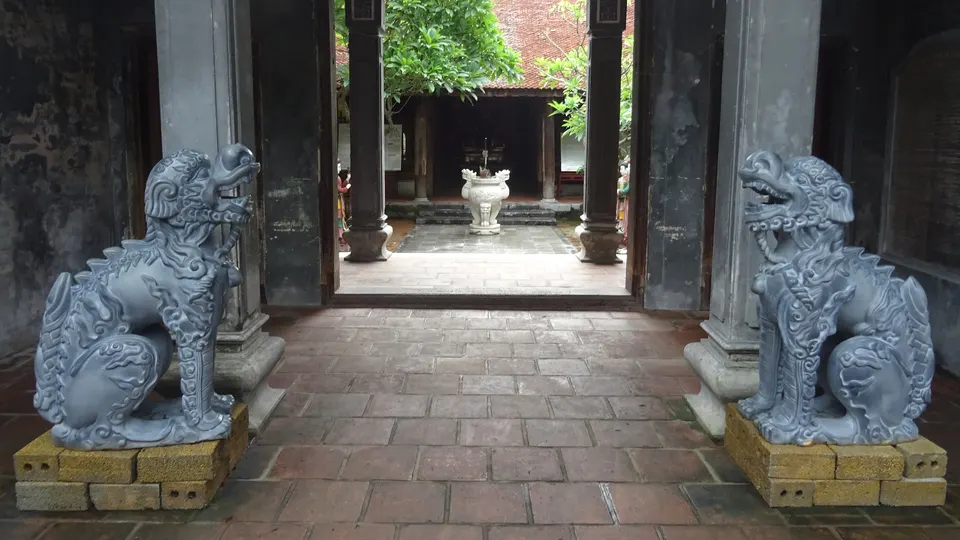
- Kim Ngan communal house, 42 Hang Bac. Built by the Chau Khe silversmiths for the founders of their craft; Heritage magazine says it is dedicated to Hien Vien (Hiên Viên), honoured as the founder of all trades. Today it hosts exhibitions and performances about the Old Quarter. The Chau Khe villagers built two communal houses in the city.
- Bach Ma (Bạch Mã) temple, 76 Hang Buom. One of the oldest shrines in the quarter, documented back to the Ly (Lý) and Tran dynasties; some writers date its origins to the 9th century, before the guilds. Legend says that when Ly Thai To’s builders kept failing to raise the citadel walls, a white horse (bach ma) appeared and showed where to build. It is one of the four temples said to guard Thang Long, the one for the east.
- The dyers’ communal house on Hang Dao. According to the Hanoi (Hà Nội) government portal, a stele at No. 90A records that a communal house for the village’s tutelary god was put up there in 1706.
- The Cantonese assembly hall, 22 Hang Buom. Not a Vietnamese guild house but the meeting hall of a Chinese merchant community, built in 1803 according to Saigoneer. Cantonese traders had settled the Ha Khau (Hà Khẩu) area (today’s Hang Buom) from the 17th century. The hall reopened at the end of 2021 as an arts and culture centre.
These buildings explain something you can feel in the streets. A street was not only a shopping strip. It was a community with a shrine, a patron, a festival day and a home village somewhere in the delta.
Why are Old Quarter houses so narrow?
The typical Old Quarter building is a tube house (nha ong (nhà ống)): a narrow shopfront that runs a long way back from the street. Two reasons are usually given. Space along a busy trade street was limited, and shops were taxed according to the width of their frontage, so families built narrow and deep. The Hanoi capital portal describes houses 2–3 m wide and 50–100 m long, some reaching through to a parallel street, and suggests they evolved from early market stalls. A 2021 AFP report gives a more typical modern figure of barely 4 m wide and about three times as deep, published by Tuoi Tre (Tuổi Trẻ) News.
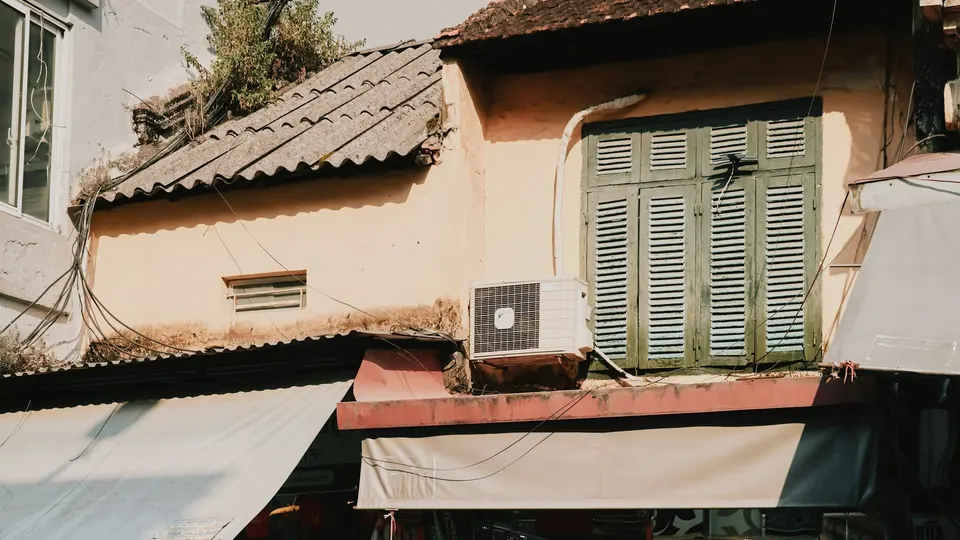
Inside, a traditional tube house alternates rooms with open-air light wells (gieng troi (giếng trời)), which bring in light and air. The shop is at the front and the family lives behind and above it. Few buildings from the Le period survive; most houses were built around the end of the 19th century, often on older foundations. That is why the quarter looks less ancient than its history.
The easiest place to see the layout is the heritage house at 87 Ma May (Mã Mây), an early 19th-century house restored in 1999 as a pilot of the Old Quarter conservation project. Nhan Dan describes a narrow front opening onto a deep plan of two zones separated by a light well with a water basin and rockery, an ancestral altar in the most formal upstairs room at the front, and a kitchen at the back. It is now run as a model of a traditional Old Quarter home. Since 2 January 2025 it has charged a small entry fee, as has the Cantonese assembly hall at 22 Hang Buom, according to the Hoan Kiem Lake and Old Quarter Management Board as reported by Bao Lao Cai.
What has changed: tradition versus today
The biggest change is that the link between street, trade and home village has loosened. Many workshops have moved out of the quarter (Hang Thiec’s shops now mostly sell items made in rural workshops), and on most streets the ground floor sells whatever pays. Hang Dao revived after the mid-1980s reforms with watches and ready-to-wear clothes; Hang Gai and Hang Bac lean towards visitors; Ta Hien (Tạ Hiện) is known as a beer street (see where to eat in the Old Quarter, street by street). Inside many tube houses, families now live in a fraction of the space their grandparents had, and courtyards have been roofed over.
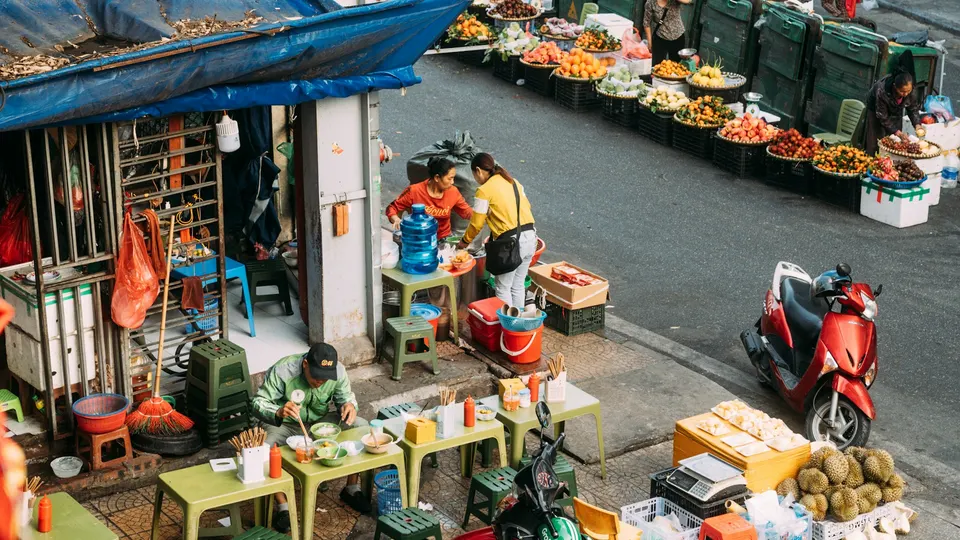
Tourism has also turned some streets into evening venues. The Hang Dao–Dong Xuan (Đồng Xuân) night market began in 2004 on Hang Ngang (Hàng Ngang), Hang Dao, Hang Duong and Dong Xuan, and runs on weekend evenings. Six more Old Quarter streets, including Hang Buom, Ma May and Ta Hien, were later opened to pedestrians on Friday, Saturday and Sunday nights, with traditional music such as ca tru, Hanoi’s sung poetry, and chau van (chầu văn). If you want to see the streets as working trade streets, come on a weekday morning. If you want the festival atmosphere, come on a weekend night. For an evening indoors, the Thang Long Water Puppet Theatre sits next to the quarter, opposite Hoan Kiem Lake; our Hanoi water puppet guide compares it with the city’s other shows.
Some trades still follow the calendar. Hang Ma fills up before the Mid-Autumn Festival with lanterns and paper toys, and again from the 24th day of the last lunar month until the eve of Tet, when families buy votive paper for the ancestral altar.
Which time to go depends on what you want to see:
| When | What you see | Who it suits |
|---|---|---|
| Weekday morning | Working trade streets: jewellers on Hang Bac, tinware on Hang Thiec, herbal shops on Lan Ong | Readers who want to see the guild streets at work |
| Friday, Saturday and Sunday nights | Hang Dao–Dong Xuan night market; Hang Buom, Ma May, Ta Hien and other streets closed to traffic, with ca tru and chau van performances | Visitors after street food and festival atmosphere |
| Weeks before Mid-Autumn | Hang Ma full of lanterns and paper toys | Families and photographers |
| 24th day of the last lunar month to Tet eve | Hang Ma selling votive paper for ancestral altars | Readers curious about living Tet customs |
The addresses have changed too. Since 1 July 2025 Hanoi has had no districts: the city is governed directly through 126 wards and communes, cut from 526 (Hanoi People’s Committee). The former Hang Bac, Hang Bo, Hang Buom, Hang Dao, Hang Gai, Hang Ma and Ly Thai To wards, together with parts of neighbouring wards, now form Hoan Kiem ward. The rest of the old Dong Xuan ward went to Ba Dinh (Ba Đình) ward. Older guidebooks and many hotel addresses still say “Hoan Kiem district”.
A self-guided walk through the guild streets
This loop links the streets and shrines above in a logical order. It is a few kilometres on foot; allow a morning, and take a map, because the street grid bends and street names change at nearly every junction. For the same area as a timed plan with the 2026 entry fees and opening hours, use our 3-hour Old Quarter walk.
- Hoan Kiem Lake, north shore. Start where the quarter meets the lake and walk north up Hang Dao. Look for old upper floors and shutters above the modern shop signs.
- Hang Bac. Turn east onto Silver Street. Stop at Kim Ngan communal house (No. 42) and notice how many jewellers still trade here.
- Ma May. Turn north and visit the heritage house at No. 87 to see a tube house from the inside: the light well, the altar room, the kitchen at the back.
- Hang Buom. At the top of Ma May, find Bach Ma temple (No. 76) and the Cantonese assembly hall (No. 22). This was the old Ha Khau ward, a trading hub near the Red River and To Lich (Tô Lịch) River where Chinese merchants settled.
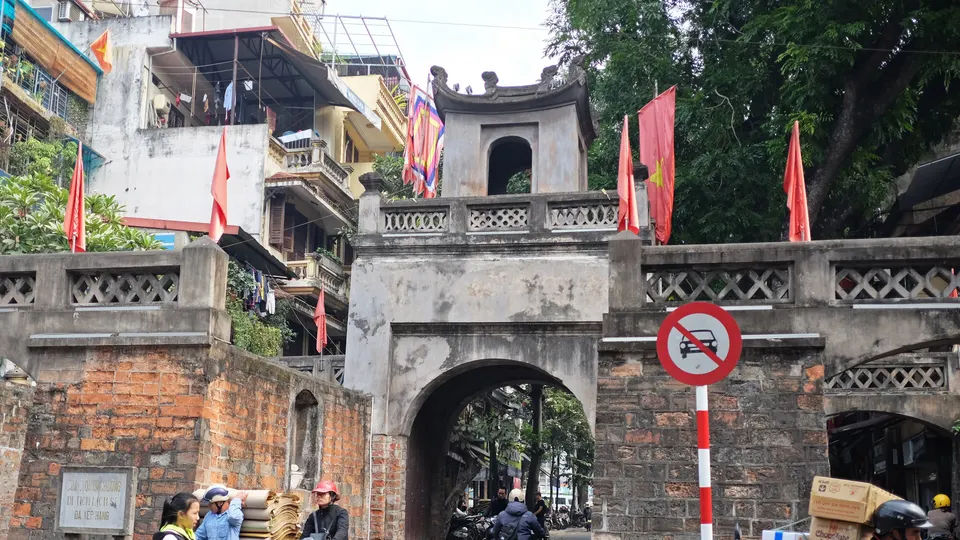
- O Quan Chuong (Ô Quan Chưởng). Head north-east along Dao Duy Tu (Đào Duy Từ) to the last surviving gate of the old city, first built in 1749 under King Le Hien Tong (Vietnam News). Hanoi once had 21 such gates. The name is usually explained as honouring a guard commander who died defending it against the French in 1873.
- Hang Chieu. Walk west from the gate; VnExpress (September 2026) describes the street as running from O Quan Chuong to the crossing of Hang Duong and Hang Ma. After a fire in 1888 it was rebuilt by the French as the first street in Hanoi laid out on a Western plan, with pavements, trees and drains.
- Dong Xuan market. Near the western end, the quarter’s big covered market dates from 1889, when two older riverside markets were combined. It was badly damaged by fire in 1994.
- Hang Ma, Lan Ong and Hang Thiec. Head west into Hang Ma for votive paper and lanterns, then work your way south to Lan Ong for the herbal shops and on to Hang Thiec for tinware.
- Back via Hang Gai. Return towards the lake through Hang Gai’s silk shops. If you need a break, try a cup of Hanoi’s egg coffee.
The walk works in any season, but Hang Ma in the weeks before Mid-Autumn or Tet (Tết) shows a trade street doing what it was built for. It makes a natural first morning in our 3-day Hanoi itinerary.
How to visit respectfully
The Old Quarter is a living neighbourhood, not an open-air museum. Most tube houses are homes above and behind the shop, and the communal houses are places of worship with their own caretakers and festival days.
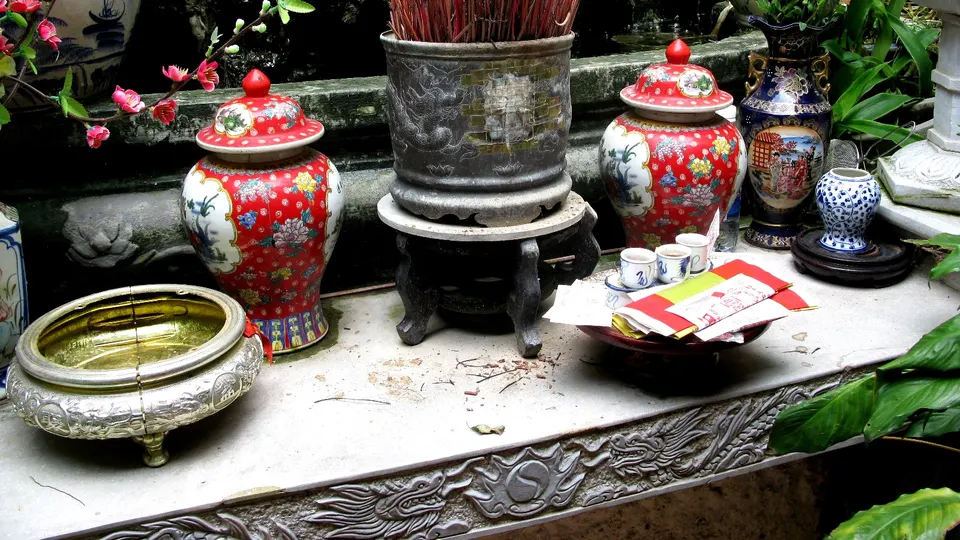
- Dress for the shrines. Cover shoulders and knees when you enter a temple or communal house. Hanoi temples take this seriously: Ngoc Son (Ngọc Sơn) Temple on Hoan Kiem Lake even lends coats to visitors who arrive underdressed (DTiNews).
- Treat altars as altars. Do not touch offerings or sit on altar steps, speak quietly, and ask before photographing people who are praying.
- Remember that shops are workplaces. Ask before photographing artisans or the inside of a shop, and do not block narrow doorways or pavements, which are often the family’s workspace and parking.
- Buy, rather than only look. A paper lantern from Hang Ma, a tin tray from Hang Thiec or a bag of herbs from Lan Ong supports the trades that give these streets their names.
- Mind the time. Residents rise early and the quarter has homes on every upper floor. Keep evenings outside the weekend walking streets reasonably quiet.
For the wider region, see our North Vietnam hub, and for more on festivals and customs, browse our culture guides.
Frequently asked questions
Do I need a ticket to visit the Hanoi Old Quarter's heritage houses?
Walking the streets is free, but since 2 January 2025 the heritage house at 87 Ma May and the old Cantonese assembly hall at 22 Hang Buom have charged a small entry fee, with free entry for children under 16 and half price for seniors and students, according to the Hoan Kiem Lake and Old Quarter Management Board. Bach Ma temple and the guild communal houses are working places of worship, so cover shoulders and knees.
When is the Old Quarter night market on?
The Hang Dao–Dong Xuan night market, running since 2004, opens on weekend evenings, and six nearby streets including Hang Buom, Ma May and Ta Hien become pedestrian streets on Friday, Saturday and Sunday nights. To see the Hang streets as working trade streets, go on a weekday morning instead.
Is the Old Quarter still in Hoan Kiem district?
There are no districts any more. Since 1 July 2025 Hanoi has been divided directly into 126 wards and communes, and most of the Old Quarter forms Hoan Kiem ward. Older maps and hotel addresses still say "Hoan Kiem district".
Which Old Quarter street should I visit for Mid-Autumn lanterns or Tet votive paper?
Go to Hang Ma, the votive-paper street. It fills with lanterns and paper toys in the weeks before the Mid-Autumn Festival, and with votive paper for ancestral altars from the 24th day of the last lunar month until the eve of Tet.
Is there an exhibition about Hanoi's 36 streets in 2026?
In September 2026 the Temple of Literature in Hanoi showed Net Kinh Ky, an exhibition on the history, name origins and crafts of the 36 streets, as part of the second Thang Long–Hanoi Festival, VietNamNet reported. The report gave no closing date, so check before you go.
Key sources
- Layers of meaning · Government of Viet Nam (Hà Nội capital portal), Hàm Châu and Nguyễn Vinh Phúc, 12 Apr 2010
- 36 old wards were planned from Early Le Dynasty · Thăng Long - Hà Nội Heritage Conservation Centre, 15 Jan 2010
- Hà Nội còn bao nhiêu phố mang chữ Hàng? · Nhân Dân (Băng Sơn), 10 Dec 2009
- Hang Bac: the core street of the Old Quarter · Hanoi Times
- "Phố cổ Hà Nội - Dấu tích làng nghề xưa" · Đại biểu Nhân dân (Thái Minh), 18 Dec 2020
- A gate to the past · Việt Nam News, 20 Oct 2024
- State President Luong Cuong attends launch of Hanoi two-tiered administrative system · Hanoi People's Committee portal, 30 Jun 2025
- Free proper attire for visitors in Ngoc Son temple · DTiNews (Dân Trí), 21 Apr 2017
All 32 sources and further reading
- Old streets, old crafts · Heritage (Vietnam Airlines magazine), 8 Aug 2022
- Silk street · Government of Viet Nam (Thăng Long - Hà Nội portal), 1 Feb 2010
- Hang Thiec Street · Vietnam News Agency, 27 Nov 2009
- Hang Duong Street · Vietnam News Agency, 30 Sep 2009
- Hang Ma street: a glittering space of buoyant businesses · Hanoi Times
- Traditional medicine in Hà Nội: a timeless remedy · Việt Nam News, 8 Dec 2024
- Lan Ong street (VNA report) · DTiNews (Dân Trí), 10 Jun 2014
- Chuyện phố cổ Hà Nội · VnExpress (Phương Linh), 22 Sep 2026
- Hanoi exhibition brings the capital's historic 36 streets to life · VietNamNet, 13 Sep 2026
- Fourteen communal houses worshipping guild founders in the Old Quarter · Hanoi Times
- Bạch Mã – The temple associated with famous ancient legends · Government of Viet Nam (Thăng Long - Hà Nội portal), 26 Jun 2010
- The rich history behind one of Hanoi's 2 remaining Chinese guild halls · Saigoneer (Uyên Đỗ), 5 Apr 2023
- Unique Cantonese assembly hall in the heart of Hanoi's Old Quarter · Hanoi Times, 26 Jul 2023
- Hai điểm di tích trên phố cổ Hà Nội thu phí tham quan từ ngày 2/1/2025 · Báo Lào Cai (from the Hoàn Kiếm Lake and Old Quarter Management Board), 1 Jan 2025
- Nếp xưa nhà cổ ở Mã Mây · Nhân Dân, 6 Aug 2018
- The tube houses that dominate Hanoi's streets · Tuổi Trẻ News (AFP), 10 Jun 2021
- Hanoi's legendary gates · Vietnam National Authority of Tourism (from Hanoi Times), Jul 2022
- Dong Xuan Market, a busy trade center in Hanoi · Hanoi Times
- Pedestrian streets, night market in Hanoi · VOV5 (Voice of Vietnam)
- Six pedestrian streets open in Hanoi's Old Quarter · Hanoi Times
- Old Quarter in Hanoi (travel guide) · Vietnam Airlines
- Resolution 1656/NQ-UBTVQH15 on the reorganization of commune-level administrative divisions of Hanoi · LuatVietnam (text of the National Assembly Standing Committee resolution), 2025
- Resolution 202/2025/QH15 on the reorganization of provincial-level administrative divisions · LuatVietnam (text of the National Assembly resolution), 2025
- Old Quarter, Hanoi · Wikipedia (background only)
Keep exploring
 North Vietnam · Travel Hanoi: How Many Days, What to See and When to Go Hanoi travel guide for 2026: how many days and where to stay, Noi Bai airport, walking-street hours, the new low-emission zone, Train Street and where to eat.
 North Vietnam · Food Cha Ca La Vong (Chả Cá Lã Vọng): Where and How to Eat It Where to eat cha ca La Vong in Hanoi, including the 2026 MICHELIN picks, how to eat the turmeric fish with dill at the table, and how it differs from fish cake.
 North · Central · South · Culture Tet (Tết) 2027 by Region: North, Central, South Compared How Tet differs in North, Central and South Vietnam: peach vs mai, banh chung vs banh tet, fruit trays, pickles, first visitors, plus the Tet 2027 dates.